Introduction
Customer Experience (CX) Platforms are software systems that help businesses manage, analyze, and improve how customers interact with their brand across multiple touchpoints—web, mobile, email, support, and in-store. These platforms unify customer data, automate engagement, and provide insights to deliver personalized and consistent experiences.
In the current landscape, CX has become a primary competitive differentiator. With AI-driven personalization, omnichannel engagement, and real-time analytics becoming standard expectations, organizations must invest in CX platforms to remain relevant. Customers expect seamless, proactive, and personalized interactions—and CX platforms enable that at scale.
Common use cases include:
- Omnichannel customer engagement (email, chat, social, voice)
- Customer journey mapping and optimization
- Personalization and targeted marketing campaigns
- Customer feedback and sentiment analysis
- Support automation and ticket management
What buyers should evaluate:
- Data unification and customer 360 capabilities
- AI/automation features
- Omnichannel support
- Integration ecosystem
- Scalability and performance
- Security and compliance
- Ease of use and onboarding
- Pricing model and ROI
- Reporting and analytics depth
Best for: Marketing teams, customer success leaders, product managers, IT teams, and enterprises aiming to improve retention and engagement across industries like e-commerce, SaaS, banking, and telecom.
Not ideal for: Very small businesses with limited customer interaction complexity or those needing only basic CRM functionality; simpler tools may suffice.
Key Trends in Customer Experience (CX) Platforms
- AI-powered personalization is becoming the default, enabling real-time recommendations and predictive engagement.
- Conversational AI and chatbots are replacing traditional support workflows.
- Unified customer data platforms (CDPs) are merging with CX tools to create a single source of truth.
- Omnichannel orchestration is now essential, not optional.
- Privacy-first design driven by global compliance requirements (GDPR, regional data laws).
- Low-code/no-code automation is enabling non-technical users to design journeys.
- Real-time analytics and insights are becoming critical for decision-making.
- Composable CX architectures allow modular tool integration instead of monolithic systems.
- Cloud-native deployment dominates, with hybrid models emerging for regulated industries.
How We Selected These Tools (Methodology)
- Evaluated market adoption and brand presence across industries
- Assessed feature completeness, especially AI and omnichannel capabilities
- Reviewed performance and reliability signals from enterprise use cases
- Considered security and compliance readiness for global deployment
- Analyzed integration ecosystem and API flexibility
- Checked fit across SMB, mid-market, and enterprise segments
- Prioritized tools with active product innovation
- Included a mix of enterprise-grade and scalable SMB solutions
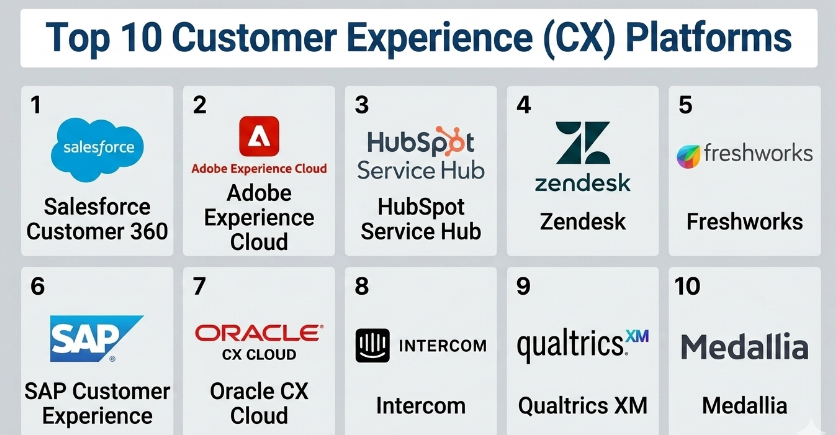
Top 10 Customer Experience (CX) Platforms
#1 — Salesforce Customer 360
Short description: A comprehensive CX platform that integrates CRM, marketing, service, and analytics into a unified ecosystem. Designed for enterprises needing full customer lifecycle management with deep customization and scalability.
Key Features
- Unified customer data platform
- AI-driven insights (Einstein AI)
- Omnichannel engagement
- Advanced workflow automation
- Real-time analytics dashboards
- Customizable CRM modules
Pros
- Highly scalable and customizable
- Strong ecosystem and integrations
Cons
- Complex implementation
- High cost for smaller businesses
Platforms / Deployment
Cloud
Security & Compliance
SSO, MFA, encryption, audit logs; SOC 2, GDPR (as applicable)
Integrations & Ecosystem
Extensive ecosystem with APIs and marketplace.
- Marketing tools
- ERP systems
- Data platforms
- Third-party apps
Support & Community
Strong enterprise support, extensive documentation, and large global community.
#2 — Adobe Experience Cloud
Short description: A powerful CX platform focused on content, analytics, and personalization. Ideal for enterprises managing digital experiences at scale across channels.
Key Features
- Real-time customer data platform
- Advanced analytics and segmentation
- Personalization engine
- Content management integration
- AI-powered recommendations
Pros
- Strong analytics capabilities
- Excellent for content-driven CX
Cons
- Complex setup
- Expensive for SMBs
Platforms / Deployment
Cloud
Security & Compliance
Not publicly stated
Integrations & Ecosystem
Strong integration with Adobe products and APIs.
- CMS systems
- Marketing tools
- Analytics platforms
Support & Community
Enterprise-grade support; documentation is detailed but technical.
#3 — HubSpot Service Hub
Short description: A user-friendly CX platform focusing on customer support and engagement, particularly suited for SMBs and growing businesses.
Key Features
- Ticketing system
- Customer feedback tools
- Live chat and bots
- Knowledge base
- CRM integration
Pros
- Easy to use
- Quick onboarding
Cons
- Limited advanced customization
- Scaling limitations
Platforms / Deployment
Web / Cloud
Security & Compliance
SSO, encryption; GDPR support
Integrations & Ecosystem
Wide integrations with marketing and CRM tools.
- Email platforms
- CRM systems
- Automation tools
Support & Community
Strong support and onboarding resources.
#4 — Zendesk
Short description: A widely used CX and customer support platform offering omnichannel ticketing and automation.
Key Features
- Omnichannel ticketing
- AI chatbots
- Knowledge base
- Customer analytics
- Workflow automation
Pros
- Scalable support system
- Strong automation
Cons
- Pricing complexity
- Limited customization in lower tiers
Platforms / Deployment
Web / Cloud
Security & Compliance
SSO, encryption; SOC 2
Integrations & Ecosystem
Large integration ecosystem.
- CRM tools
- Messaging apps
- Analytics tools
Support & Community
Strong support ecosystem and active community.
#5 — Freshworks (Freshdesk CX Suite)
Short description: An integrated CX suite combining support, engagement, and CRM features for SMBs and mid-market businesses.
Key Features
- Omnichannel support
- AI-powered bots
- Ticket automation
- Customer analytics
- Self-service portals
Pros
- Affordable pricing
- Easy to deploy
Cons
- Limited enterprise features
- Customization constraints
Platforms / Deployment
Cloud
Security & Compliance
Not publicly stated
Integrations & Ecosystem
Supports common integrations.
- CRM
- Messaging apps
- Helpdesk tools
Support & Community
Good documentation and support for SMBs.
#6 — SAP Customer Experience
Short description: Enterprise-grade CX platform focused on commerce, marketing, and customer data management.
Key Features
- Customer data platform
- Commerce integration
- Personalization tools
- Marketing automation
- Analytics
Pros
- Strong enterprise capabilities
- Deep integration with SAP ecosystem
Cons
- Complex deployment
- High cost
Platforms / Deployment
Cloud / Hybrid
Security & Compliance
Not publicly stated
Integrations & Ecosystem
Deep SAP ecosystem integration.
- ERP systems
- Commerce tools
- Analytics platforms
Support & Community
Enterprise-level support; requires skilled teams.
#7 — Oracle CX Cloud
Short description: A robust CX platform offering marketing, sales, and service capabilities with AI-driven automation.
Key Features
- AI-driven engagement
- Customer journey orchestration
- Data analytics
- Campaign management
- CRM integration
Pros
- Comprehensive features
- Enterprise scalability
Cons
- Complex UI
- High learning curve
Platforms / Deployment
Cloud
Security & Compliance
Not publicly stated
Integrations & Ecosystem
Broad enterprise integrations.
- ERP
- CRM
- Data systems
Support & Community
Enterprise support; documentation varies.
#8 — Intercom
Short description: A conversational CX platform focusing on messaging, support automation, and customer engagement.
Key Features
- Live chat
- AI chatbots
- Customer messaging
- Automation workflows
- Product tours
Pros
- Strong conversational UX
- Easy to implement
Cons
- Limited enterprise analytics
- Pricing can scale quickly
Platforms / Deployment
Web / Cloud
Security & Compliance
Not publicly stated
Integrations & Ecosystem
Integrates with SaaS tools.
- CRM
- Analytics
- Messaging apps
Support & Community
Good onboarding and documentation.
#9 — Qualtrics XM
Short description: Experience management platform focused on capturing and analyzing customer feedback.
Key Features
- Survey and feedback tools
- Sentiment analysis
- Experience analytics
- Reporting dashboards
- AI insights
Pros
- Strong analytics
- Deep customer insights
Cons
- Complex setup
- High pricing
Platforms / Deployment
Cloud
Security & Compliance
Not publicly stated
Integrations & Ecosystem
Integrates with enterprise tools.
- CRM
- Analytics
- Data platforms
Support & Community
Enterprise support with structured onboarding.
#10 — Medallia
Short description: CX platform focused on real-time feedback, analytics, and experience improvement.
Key Features
- Real-time feedback collection
- Experience analytics
- AI insights
- Customer journey mapping
- Reporting tools
Pros
- Strong analytics
- Enterprise-ready
Cons
- Expensive
- Requires training
Platforms / Deployment
Cloud
Security & Compliance
Not publicly stated
Integrations & Ecosystem
Enterprise integrations.
- CRM
- Analytics tools
- Data platforms
Support & Community
Enterprise-level support; onboarding required.
Comparison Table (Top 10)
| Tool Name | Best For | Platform(s) Supported | Deployment | Standout Feature | Public Rating |
|---|---|---|---|---|---|
| Salesforce Customer 360 | Enterprises | Web | Cloud | Unified customer data | N/A |
| Adobe Experience Cloud | Content-driven CX | Web | Cloud | Advanced analytics | N/A |
| HubSpot Service Hub | SMBs | Web | Cloud | Ease of use | N/A |
| Zendesk | Support teams | Web | Cloud | Omnichannel ticketing | N/A |
| Freshworks CX Suite | SMB/Mid-market | Web | Cloud | Affordable CX suite | N/A |
| SAP Customer Experience | Enterprises | Web | Cloud/Hybrid | SAP ecosystem | N/A |
| Oracle CX Cloud | Enterprises | Web | Cloud | AI-driven CX | N/A |
| Intercom | SaaS companies | Web | Cloud | Conversational UX | N/A |
| Qualtrics XM | Feedback analytics | Web | Cloud | Sentiment analysis | N/A |
| Medallia | Enterprise CX | Web | Cloud | Real-time feedback | N/A |
Evaluation & Scoring of Customer Experience (CX) Platforms
| Tool Name | Core (25%) | Ease (15%) | Integrations (15%) | Security (10%) | Performance (10%) | Support (10%) | Value (15%) | Weighted Total |
|---|---|---|---|---|---|---|---|---|
| Salesforce Customer 360 | 9 | 6 | 9 | 8 | 9 | 9 | 6 | 8.2 |
| Adobe Experience Cloud | 9 | 5 | 8 | 7 | 9 | 8 | 6 | 7.9 |
| HubSpot Service Hub | 7 | 9 | 7 | 7 | 7 | 8 | 8 | 7.7 |
| Zendesk | 8 | 8 | 8 | 7 | 8 | 8 | 7 | 7.9 |
| Freshworks CX Suite | 7 | 8 | 7 | 6 | 7 | 7 | 8 | 7.3 |
| SAP Customer Experience | 9 | 5 | 9 | 7 | 9 | 8 | 6 | 8.0 |
| Oracle CX Cloud | 9 | 5 | 8 | 7 | 9 | 8 | 6 | 7.9 |
| Intercom | 7 | 9 | 7 | 6 | 7 | 7 | 7 | 7.3 |
| Qualtrics XM | 8 | 6 | 7 | 7 | 8 | 8 | 6 | 7.5 |
| Medallia | 8 | 6 | 7 | 7 | 8 | 8 | 6 | 7.5 |
How to interpret scores:
- Scores are comparative within this category, not absolute benchmarks.
- Higher scores indicate stronger overall balance across features, usability, and value.
- Enterprise tools score high in core features but lower in ease/value.
- SMB-focused tools score higher in ease and value.
Which Customer Experience (CX) Platforms
Solo / Freelancer
Choose tools like HubSpot or Intercom for simplicity and affordability.
SMB
Freshworks and HubSpot offer balanced features with ease of use.
Mid-Market
Zendesk and Intercom provide scalability and automation.
Enterprise
Salesforce, SAP, Adobe, and Oracle dominate due to depth and integrations.
Budget vs Premium
- Budget: Freshworks, HubSpot
- Premium: Salesforce, Adobe, SAP
Feature Depth vs Ease of Use
- Deep features: Salesforce, Oracle
- Ease of use: HubSpot, Intercom
Integrations & Scalability
- Strong integrations: Salesforce, SAP
- Moderate: HubSpot, Zendesk
Security & Compliance Needs
- Enterprise compliance: Salesforce, SAP
- Basic needs: HubSpot, Freshworks
Frequently Asked Questions (FAQs)
1. What is a CX platform?
A CX platform helps businesses manage and improve customer interactions across channels. It combines data, analytics, and engagement tools.
2. How much do CX platforms cost?
Pricing varies widely, from affordable SMB plans to enterprise-level subscriptions. Costs depend on features and scale.
3. How long does implementation take?
Implementation can range from a few days (SMB tools) to several months (enterprise platforms).
4. Are CX platforms secure?
Most platforms offer standard security features, but compliance levels vary by provider.
5. Can CX platforms integrate with existing tools?
Yes, most platforms support integrations with CRM, marketing, and analytics tools.
6. What are common mistakes when choosing a CX platform?
Ignoring scalability, overpaying for unused features, and not validating integrations.
7. Do CX platforms support AI?
Yes, modern platforms include AI for personalization, automation, and analytics.
8. Can small businesses benefit from CX platforms?
Yes, especially with user-friendly tools like HubSpot and Freshworks.
9. Is switching CX platforms difficult?
It can be complex due to data migration and workflow changes.
10. What alternatives exist?
Basic CRM or helpdesk tools can be alternatives for simpler needs.
Conclusion
Customer Experience (CX) platforms have evolved from simple support tools into comprehensive ecosystems that drive business growth, customer loyalty, and operational efficiency. The “best” platform depends heavily on your organization’s size, complexity, and goals. Enterprise solutions like Salesforce and SAP offer unmatched depth, while tools like HubSpot and Freshworks prioritize usability and cost efficiency. The key is to align your choice with your business needs—whether it’s scalability, automation, or simplicity. As a next step, shortlist two or three platforms, test them with real workflows, and validate integration, security, and ROI before making a final decision.
