Introduction
Manufacturing Resource Planning (MRP) tools are systems that help manufacturers plan, schedule, and manage production, inventory, materials, and supply chains. In simple terms, they ensure that the right materials are available at the right time to meet production goals without overstocking or delays.
Today, manufacturing is becoming more complex due to global supply chains, fluctuating demand, and rising costs. Modern MRP tools are evolving with AI-driven forecasting, automation, and real-time analytics to help businesses stay competitive and efficient.
Real-world use cases:
- Managing raw materials and inventory across multiple warehouses
- Planning production schedules based on demand forecasts
- Reducing stockouts and excess inventory
- Coordinating suppliers and procurement workflows
- Improving manufacturing efficiency and cost control
What buyers should evaluate:
- Inventory and demand planning capabilities
- Production scheduling and automation
- Integration with ERP, CRM, and finance tools
- Scalability across multiple plants or regions
- Reporting and analytics features
- Ease of use and training requirements
- Deployment flexibility (cloud vs on-premise)
- Security and compliance features
- Vendor support and ecosystem
Best for: Manufacturing companies, supply chain managers, operations teams, production planners, and finance leaders in SMBs to large enterprises.
Not ideal for: Freelancers, service-based businesses, or companies without physical inventory—simpler inventory tools may be more suitable in those cases.
Key Trends in Manufacturing Resource Planning (MRP) Tools
- AI-powered demand forecasting and predictive analytics
- Real-time inventory tracking using IoT and sensors
- Cloud-first and SaaS-based deployment models
- Integration with MES, ERP, and supply chain platforms
- Low-code and customizable workflows
- Advanced reporting dashboards with data visualization
- Focus on compliance, traceability, and audit readiness
- Mobile-first interfaces for shop floor operations
- Subscription-based pricing replacing traditional licensing
- Automation of procurement and supplier collaboration
How We Selected These Tools (Methodology)
- Evaluated tools with strong market adoption and industry recognition
- Assessed feature completeness across inventory, planning, and production
- Considered reliability and performance in real-world manufacturing scenarios
- Reviewed security capabilities and compliance signals where available
- Analyzed integration capabilities with ERP, CRM, and supply chain tools
- Included solutions suitable for SMBs, mid-market, and enterprises
- Considered usability, onboarding, and training requirements
- Looked at vendor ecosystem, partner support, and community strength
- Balanced between cloud-native and traditional systems
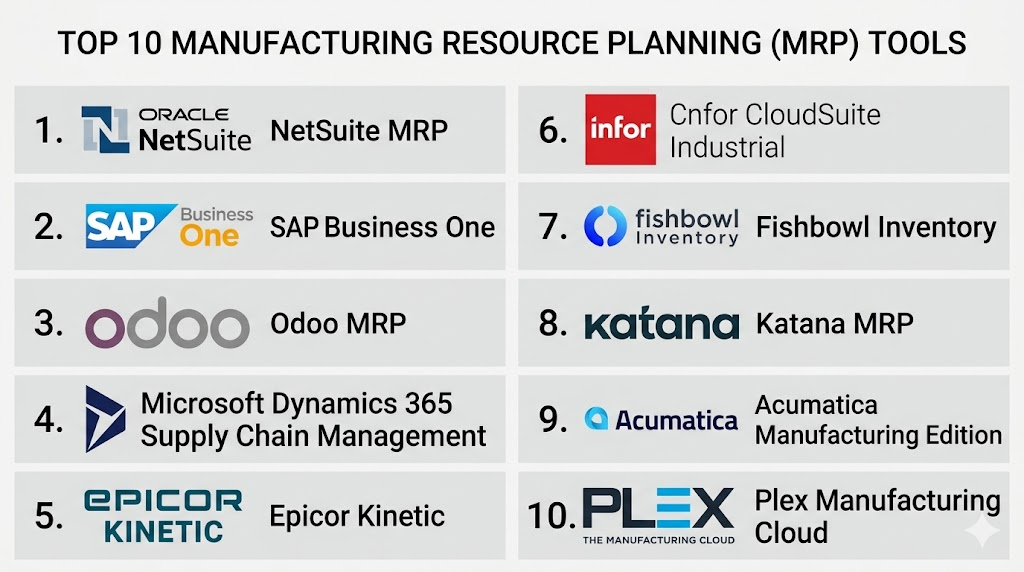
Top 10 Manufacturing Resource Planning (MRP) Tools
#1 — NetSuite MRP
Short description: A cloud-based ERP with strong MRP capabilities, designed for mid-sized to large enterprises needing end-to-end business management.
Key Features
- Demand planning and forecasting
- Inventory and warehouse management
- Production scheduling
- Financial and ERP integration
- Multi-location support
- Real-time dashboards
Pros
- Strong ERP integration
- Scalable for growing businesses
Cons
- Complex setup
- Higher cost for small businesses
Platforms / Deployment
Web / Cloud
Security & Compliance
RBAC, encryption, audit logs (others not publicly stated)
Integrations & Ecosystem
Strong ERP ecosystem with integrations across finance, CRM, and eCommerce.
- CRM systems
- Financial tools
- Supply chain platforms
Support & Community
Enterprise-level support with extensive documentation; partner ecosystem available.
#2 — SAP Business One
Short description: A comprehensive ERP solution with MRP functionality for small to mid-sized enterprises.
Key Features
- Material requirements planning
- Inventory and procurement management
- Production planning
- Financial integration
- Reporting and analytics
Pros
- Strong enterprise features
- Reliable performance
Cons
- Requires skilled implementation
- Limited flexibility without customization
Platforms / Deployment
Windows / Cloud / On-premise
Security & Compliance
Not publicly stated
Integrations & Ecosystem
Integrates with SAP ecosystem and third-party tools.
- ERP modules
- Analytics tools
- CRM platforms
Support & Community
Strong enterprise support and global partner network.
#3 — Odoo MRP
Short description: A modular, open-source ERP platform with flexible MRP capabilities for SMBs.
Key Features
- Bill of materials management
- Production planning
- Inventory tracking
- Work center management
- Quality control modules
Pros
- Highly customizable
- Cost-effective
Cons
- Requires technical expertise
- Support depends on deployment
Platforms / Deployment
Web / Cloud / Self-hosted
Security & Compliance
Varies / Not publicly stated
Integrations & Ecosystem
Large ecosystem with modules for CRM, accounting, and inventory.
- Odoo apps
- Third-party plugins
- APIs
Support & Community
Strong open-source community; commercial support available.
#4 — Microsoft Dynamics 365 Supply Chain Management
Short description: Enterprise-grade MRP and supply chain solution integrated with the Microsoft ecosystem.
Key Features
- AI-driven demand forecasting
- Production scheduling
- Inventory optimization
- IoT integration
- Advanced analytics
Pros
- Strong integration with Microsoft tools
- Advanced analytics
Cons
- High implementation cost
- Requires training
Platforms / Deployment
Web / Cloud
Security & Compliance
SSO, MFA, encryption (others not publicly stated)
Integrations & Ecosystem
Deep integration with Microsoft ecosystem.
- Azure services
- Power BI
- Office tools
Support & Community
Enterprise-level support with strong documentation.
#5 — Epicor Kinetic
Short description: A manufacturing-focused ERP with advanced MRP features for mid-sized and enterprise manufacturers.
Key Features
- Production planning
- Supply chain management
- Inventory control
- Scheduling optimization
- Industry-specific modules
Pros
- Tailored for manufacturing
- Strong industry features
Cons
- Complex interface
- Customization can be costly
Platforms / Deployment
Cloud / On-premise
Security & Compliance
Not publicly stated
Integrations & Ecosystem
Supports integration with ERP and third-party systems.
- CRM tools
- Supply chain platforms
Support & Community
Strong vendor support; smaller community than SAP.
#6 — Infor CloudSuite Industrial
Short description: A cloud-based manufacturing ERP with built-in MRP for discrete and process industries.
Key Features
- Demand planning
- Production scheduling
- Inventory tracking
- Analytics dashboards
- Industry-specific workflows
Pros
- Industry-focused features
- Cloud-native architecture
Cons
- Limited customization flexibility
- Learning curve
Platforms / Deployment
Cloud
Security & Compliance
Not publicly stated
Integrations & Ecosystem
Integrates with Infor ecosystem and external tools.
- ERP modules
- Analytics platforms
Support & Community
Enterprise support with moderate community presence.
#7 — Fishbowl Inventory
Short description: Inventory and MRP solution designed for small to mid-sized manufacturers.
Key Features
- Inventory tracking
- Manufacturing workflows
- Order management
- Reporting tools
- Barcode integration
Pros
- Easy to use
- Affordable for SMBs
Cons
- Limited advanced features
- Not ideal for large enterprises
Platforms / Deployment
Windows / Cloud
Security & Compliance
Not publicly stated
Integrations & Ecosystem
Integrates with accounting and inventory systems.
- QuickBooks
- eCommerce platforms
Support & Community
Good support for SMBs; smaller community.
#8 — Katana MRP
Short description: Cloud-based MRP tool focused on small manufacturers and eCommerce businesses.
Key Features
- Real-time inventory tracking
- Production scheduling
- Order management
- Visual dashboards
- Automation tools
Pros
- Simple and intuitive
- Fast implementation
Cons
- Limited enterprise features
- Scaling limitations
Platforms / Deployment
Web / Cloud
Security & Compliance
Not publicly stated
Integrations & Ecosystem
Strong integrations with eCommerce tools.
- Shopify
- Accounting tools
Support & Community
Good onboarding and support for SMBs.
#9 — Acumatica Manufacturing Edition
Short description: Cloud ERP with flexible MRP capabilities for mid-sized manufacturers.
Key Features
- Inventory management
- Production planning
- Financial integration
- Reporting tools
- Cloud scalability
Pros
- Flexible deployment
- Strong reporting
Cons
- Requires customization
- Learning curve
Platforms / Deployment
Cloud / Hybrid
Security & Compliance
Not publicly stated
Integrations & Ecosystem
Integrates with ERP and third-party systems.
- CRM tools
- Finance systems
Support & Community
Growing ecosystem with good vendor support.
#10 — Plex Manufacturing Cloud
Short description: A cloud-native manufacturing platform with built-in MRP and MES capabilities.
Key Features
- Production and inventory management
- Quality management
- Real-time analytics
- Compliance tracking
- Shop floor integration
Pros
- Strong real-time capabilities
- Integrated MES features
Cons
- Complex implementation
- Higher cost
Platforms / Deployment
Cloud
Security & Compliance
Not publicly stated
Integrations & Ecosystem
Supports integration with manufacturing systems.
- ERP tools
- IoT platforms
Support & Community
Enterprise-level support; niche community.
Comparison Table (Top 10)
| Tool Name | Best For | Platform(s) Supported | Deployment | Standout Feature | Public Rating |
|---|---|---|---|---|---|
| NetSuite MRP | Enterprises | Web | Cloud | ERP integration | N/A |
| SAP Business One | SMBs | Windows | Cloud/On-premise | Enterprise features | N/A |
| Odoo MRP | SMBs | Web | Cloud/Self-hosted | Customization | N/A |
| Microsoft Dynamics 365 SCM | Enterprises | Web | Cloud | AI forecasting | N/A |
| Epicor Kinetic | Mid-market | Web | Cloud/On-premise | Industry focus | N/A |
| Infor CloudSuite | Enterprises | Web | Cloud | Industry workflows | N/A |
| Fishbowl Inventory | SMBs | Windows | Cloud | Ease of use | N/A |
| Katana MRP | Small businesses | Web | Cloud | Real-time tracking | N/A |
| Acumatica | Mid-market | Web | Cloud/Hybrid | Flexibility | N/A |
| Plex Manufacturing Cloud | Enterprises | Web | Cloud | MES integration | N/A |
Evaluation & Scoring of Manufacturing Resource Planning (MRP) Tools
| Tool Name | Core (25%) | Ease (15%) | Integrations (15%) | Security (10%) | Performance (10%) | Support (10%) | Value (15%) | Weighted Total |
|---|---|---|---|---|---|---|---|---|
| NetSuite MRP | 9 | 7 | 9 | 8 | 9 | 8 | 7 | 8.3 |
| SAP Business One | 8 | 6 | 8 | 7 | 8 | 8 | 7 | 7.6 |
| Odoo MRP | 7 | 7 | 8 | 6 | 7 | 7 | 9 | 7.4 |
| Microsoft Dynamics 365 SCM | 9 | 7 | 9 | 9 | 9 | 8 | 6 | 8.5 |
| Epicor Kinetic | 8 | 6 | 7 | 7 | 8 | 7 | 7 | 7.4 |
| Infor CloudSuite | 8 | 6 | 8 | 7 | 8 | 7 | 6 | 7.3 |
| Fishbowl Inventory | 6 | 8 | 6 | 6 | 7 | 7 | 8 | 6.9 |
| Katana MRP | 6 | 9 | 6 | 6 | 7 | 7 | 8 | 7.0 |
| Acumatica | 8 | 7 | 8 | 7 | 8 | 7 | 7 | 7.6 |
| Plex Manufacturing Cloud | 9 | 6 | 7 | 7 | 9 | 8 | 6 | 7.8 |
How to interpret scores:
- Scores are comparative, not absolute
- Higher scores indicate better overall fit across criteria
- Enterprise tools score higher in features but lower in ease
- SMB tools score higher in usability and value
- Choose based on your specific business needs, not just total score
Which Manufacturing Resource Planning (MRP) Tools
Solo / Freelancer
Not typically needed. Consider simple inventory tools instead.
SMB
- Best choices: Katana MRP, Fishbowl, Odoo
- Focus on ease of use and affordability
Mid-Market
- Best choices: Acumatica, Epicor
- Balance between features and scalability
Enterprise
- Best choices: NetSuite, SAP, Microsoft Dynamics
- Focus on integration, scalability, and compliance
Budget vs Premium
- Budget: Odoo, Katana
- Premium: SAP, Microsoft Dynamics
Feature Depth vs Ease of Use
- Deep features: SAP, NetSuite
- Easy to use: Katana, Fishbowl
Integrations & Scalability
- Strong integrations: Microsoft Dynamics, NetSuite
- Moderate: Odoo, Acumatica
Security & Compliance Needs
- Enterprise-grade: Microsoft Dynamics, NetSuite
- Basic: SMB tools
Frequently Asked Questions (FAQs)
What is an MRP tool?
An MRP tool helps manage materials, inventory, and production planning in manufacturing environments.
How much do MRP tools cost?
Pricing varies widely based on features and scale; typically subscription-based or license-based.
Are MRP tools only for large companies?
No, many tools are designed for SMBs and startups.
How long does implementation take?
It can range from weeks (for SMB tools) to several months (for enterprise systems).
Do MRP tools integrate with ERP systems?
Yes, most modern MRP tools integrate with ERP, CRM, and accounting systems.
What are common mistakes when choosing an MRP tool?
Ignoring scalability, underestimating training needs, and poor integration planning.
Are cloud-based MRP tools better?
Cloud tools offer flexibility and lower upfront costs, but on-premise may suit compliance needs.
Can MRP tools handle multi-location inventory?
Yes, most mid-market and enterprise tools support this.
How secure are MRP systems?
Security varies; enterprise tools offer stronger compliance and controls.
Can I switch MRP tools later?
Yes, but migration can be complex and requires planning.
Conclusion
Manufacturing Resource Planning (MRP) tools are essential for modern manufacturing operations, helping businesses optimize inventory, production, and supply chains. The right tool can significantly improve efficiency, reduce costs, and enhance decision-making through real-time data and automation. However, there is no one-size-fits-all solution. Small businesses may prioritize simplicity and cost, while enterprises require deep integrations, scalability, and compliance features. Tools like Katana and Fishbowl are ideal for smaller teams, while NetSuite, SAP, and Microsoft Dynamics cater to complex enterprise environments.
