Introduction
Manufacturing Execution Systems (MES) are software platforms that manage, monitor, and optimize production operations on the shop floor in real time. In simple terms, MES acts as a bridge between enterprise systems (like ERP) and physical production processes, ensuring that manufacturing activities are efficient, traceable, and controlled.
Today, MES is no longer just about tracking production—it plays a central role in digital manufacturing, quality control, compliance, and operational intelligence. With increasing pressure to improve productivity, reduce downtime, and maintain strict quality standards, MES platforms have become essential for modern manufacturing environments.
Real-world use cases include:
- Production tracking and scheduling
- Quality management and compliance
- Traceability and genealogy tracking
- Downtime and performance monitoring
- Inventory and material flow control
What buyers should evaluate:
- Real-time visibility and data capture
- Integration with ERP, SCADA, and PLC systems
- Quality and compliance features
- Scalability across plants and lines
- Ease of customization and deployment
- Reporting and analytics capabilities
- Workflow and process automation
- User interface and usability
- Industry-specific features
- Total cost of ownership
Best for: Manufacturing companies, automotive, pharmaceuticals, food & beverage, electronics, and any industry requiring real-time production control and traceability.
Not ideal for: Small workshops with simple processes, businesses without automation systems, or companies that only need basic reporting instead of full production control.
Key Trends in Manufacturing Execution Systems (MES)
- Integration with Industry 4.0: MES platforms are becoming central hubs for smart manufacturing
- Cloud and hybrid MES: More vendors offering flexible deployment models
- AI-driven insights: Predictive maintenance and process optimization
- Real-time analytics: Faster decision-making on the shop floor
- Low-code MES platforms: Easier customization without heavy coding
- Digital twins: Simulation and real-time system modeling
- IoT connectivity: Seamless integration with sensors and machines
- Mobile MES access: Monitoring and control from mobile devices
- Compliance automation: Stronger regulatory support for industries like pharma
- Data standardization: Improved interoperability across systems
How We Selected These Tools (Methodology)
- Evaluated market leadership and adoption in manufacturing industries
- Assessed core MES functionality and completeness
- Reviewed integration with ERP, SCADA, and industrial systems
- Considered scalability and performance in real environments
- Analyzed ease of use and deployment flexibility
- Checked vendor ecosystem and partner support
- Balanced enterprise and mid-market MES solutions
- Focused on industry-specific capabilities
- Considered long-term value and cost efficiency
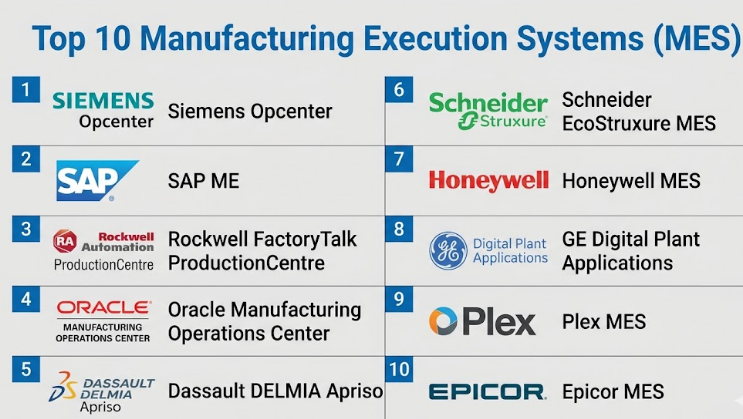
Top 10 Manufacturing Execution Systems (MES)
#1 — Siemens Opcenter
Short description: Enterprise MES platform designed for complex manufacturing operations with strong integration across Siemens ecosystem.
Key Features
- Production planning and execution
- Quality management
- Traceability and genealogy
- Advanced analytics
- Integration with Siemens automation systems
- Scalable architecture
Pros
- Strong enterprise capabilities
- High scalability
Cons
- Expensive
- Complex implementation
Platforms / Deployment
Windows / Cloud / Hybrid
Security & Compliance
Not publicly stated
Integrations & Ecosystem
Strong integration with industrial automation and enterprise systems.
- ERP systems
- PLCs and SCADA
- Data analytics tools
Support & Community
Enterprise-level support and documentation.
#2 — SAP ME (Manufacturing Execution)
Short description: MES solution integrated with SAP ERP, ideal for enterprises already using SAP ecosystem.
Key Features
- Real-time production control
- Integration with SAP ERP
- Quality management
- Shop floor execution
- Compliance support
- Reporting tools
Pros
- Seamless ERP integration
- Strong compliance features
Cons
- High cost
- Requires SAP expertise
Platforms / Deployment
Cloud / Hybrid
Security & Compliance
Not publicly stated
Integrations & Ecosystem
- SAP ERP
- Supply chain systems
- Analytics tools
Support & Community
Strong enterprise support.
#3 — Rockwell FactoryTalk ProductionCentre
Short description: MES platform tailored for manufacturing industries with strong integration with Rockwell automation systems.
Key Features
- Production management
- Quality control
- Performance tracking
- Integration with Rockwell PLCs
- Reporting and analytics
- Scalable design
Pros
- Strong automation integration
- Reliable performance
Cons
- Vendor lock-in
- Licensing complexity
Platforms / Deployment
Windows / Hybrid
Security & Compliance
Not publicly stated
Integrations & Ecosystem
- Rockwell systems
- Industrial devices
- ERP integration
Support & Community
Strong vendor support.
#4 — Oracle Manufacturing Operations Center
Short description: MES solution focused on data-driven manufacturing and integration with Oracle systems.
Key Features
- Real-time production monitoring
- Data analytics
- Integration with Oracle ERP
- Workflow automation
- Quality tracking
- Scalable platform
Pros
- Strong analytics capabilities
- Enterprise integration
Cons
- Complex setup
- Costly
Platforms / Deployment
Cloud / Hybrid
Security & Compliance
Not publicly stated
Integrations & Ecosystem
- Oracle ecosystem
- Data tools
- ERP systems
Support & Community
Enterprise-level support.
#5 — Dassault DELMIA Apriso
Short description: MES platform for global manufacturing operations with strong process control and visibility.
Key Features
- Production execution
- Global operations management
- Traceability
- Quality control
- Workflow automation
- Real-time analytics
Pros
- Global scalability
- Strong process control
Cons
- Complex implementation
- High cost
Platforms / Deployment
Cloud / Hybrid
Security & Compliance
Not publicly stated
Integrations & Ecosystem
- PLM systems
- ERP integration
- Industrial tools
Support & Community
Enterprise support available.
#6 — Schneider EcoStruxure MES
Short description: MES solution focused on energy management and industrial automation integration.
Key Features
- Production monitoring
- Energy management
- IoT integration
- Quality control
- Real-time analytics
- Scalable design
Pros
- Strong IoT features
- Energy optimization
Cons
- Vendor ecosystem dependency
- Setup complexity
Platforms / Deployment
Cloud / Hybrid
Security & Compliance
Not publicly stated
Integrations & Ecosystem
- IoT devices
- Automation systems
- APIs
Support & Community
Enterprise-level support.
#7 — Honeywell MES
Short description: MES platform designed for process industries like oil, gas, and chemicals.
Key Features
- Production execution
- Process optimization
- Quality tracking
- Real-time monitoring
- Integration with control systems
- Analytics tools
Pros
- Industry-specific features
- Reliable performance
Cons
- Expensive
- Complex setup
Platforms / Deployment
Hybrid
Security & Compliance
Not publicly stated
Integrations & Ecosystem
- Industrial control systems
- Data platforms
Support & Community
Strong enterprise support.
#8 — GE Digital Plant Applications
Short description: MES platform for production management and performance optimization.
Key Features
- Production tracking
- Performance monitoring
- Quality management
- Analytics tools
- Integration with GE systems
- Scalable architecture
Pros
- Strong analytics
- Flexible deployment
Cons
- Learning curve
- Limited UI flexibility
Platforms / Deployment
Cloud / Hybrid
Security & Compliance
Not publicly stated
Integrations & Ecosystem
- Industrial systems
- ERP integration
Support & Community
Enterprise support available.
#9 — Plex MES
Short description: Cloud-based MES platform designed for manufacturing operations.
Key Features
- Cloud-native architecture
- Production tracking
- Quality management
- Inventory control
- Analytics tools
- Real-time monitoring
Pros
- Easy deployment
- Cloud-based flexibility
Cons
- Subscription cost
- Limited customization
Platforms / Deployment
Cloud
Security & Compliance
Not publicly stated
Integrations & Ecosystem
- ERP systems
- APIs
- Data tools
Support & Community
Commercial support available.
#10 — Epicor MES
Short description: MES solution focused on mid-market manufacturing companies.
Key Features
- Production tracking
- Quality control
- Shop floor visibility
- Integration with Epicor ERP
- Reporting tools
- Scalable design
Pros
- Good for mid-market
- Easy integration with ERP
Cons
- Limited advanced features
- Dependency on Epicor ecosystem
Platforms / Deployment
Cloud / Hybrid
Security & Compliance
Not publicly stated
Integrations & Ecosystem
- ERP systems
- Manufacturing tools
Support & Community
Vendor support available.
Comparison Table (Top 10)
| Tool Name | Best For | Platform(s) Supported | Deployment | Standout Feature | Public Rating |
|---|---|---|---|---|---|
| Siemens Opcenter | Enterprise | Windows | Hybrid | Advanced MES features | N/A |
| SAP ME | SAP users | Cloud | Hybrid | ERP integration | N/A |
| FactoryTalk ProductionCentre | Manufacturing | Windows | Hybrid | Automation integration | N/A |
| Oracle MOC | Data-driven ops | Cloud | Hybrid | Analytics | N/A |
| DELMIA Apriso | Global ops | Cloud | Hybrid | Process control | N/A |
| EcoStruxure MES | Energy focus | Cloud | Hybrid | IoT integration | N/A |
| Honeywell MES | Process industry | Hybrid | Hybrid | Industry-specific | N/A |
| GE Plant Applications | Performance | Cloud | Hybrid | Analytics | N/A |
| Plex MES | Cloud manufacturing | Cloud | Cloud | SaaS model | N/A |
| Epicor MES | Mid-market | Cloud | Hybrid | ERP integration | N/A |
Evaluation & Scoring of Manufacturing Execution Systems (MES)
| Tool Name | Core | Ease | Integrations | Security | Performance | Support | Value | Weighted Total |
|---|---|---|---|---|---|---|---|---|
| Siemens Opcenter | 9 | 6 | 9 | 7 | 9 | 9 | 7 | 8.3 |
| SAP ME | 9 | 6 | 9 | 7 | 9 | 9 | 6 | 8.1 |
| FactoryTalk ProductionCentre | 8 | 7 | 8 | 6 | 8 | 8 | 7 | 7.6 |
| Oracle MOC | 8 | 6 | 8 | 7 | 8 | 8 | 6 | 7.5 |
| DELMIA Apriso | 9 | 6 | 8 | 7 | 9 | 9 | 6 | 8.0 |
| EcoStruxure MES | 8 | 7 | 8 | 7 | 8 | 8 | 7 | 7.7 |
| Honeywell MES | 9 | 6 | 8 | 7 | 9 | 9 | 6 | 8.0 |
| GE Plant Applications | 8 | 7 | 8 | 6 | 8 | 8 | 7 | 7.6 |
| Plex MES | 7 | 9 | 7 | 6 | 7 | 7 | 8 | 7.5 |
| Epicor MES | 7 | 8 | 7 | 6 | 7 | 7 | 8 | 7.4 |
How to interpret scores:
- Scores are relative comparisons across tools
- Enterprise tools score higher in performance and scalability
- Cloud tools score higher in ease of use
- Integration-heavy tools perform well in ecosystem category
- Choose based on your manufacturing complexity
Which Manufacturing Execution Systems (MES)
Solo / Freelancer
- Not typically applicable for MES
SMB
- Best: Plex MES, Epicor MES
- Reason: Simpler deployment and lower complexity
Mid-Market
- Best: EcoStruxure MES, GE Plant Applications
- Reason: Balanced features and scalability
Enterprise
- Best: Siemens Opcenter, SAP ME, DELMIA Apriso
- Reason: Advanced capabilities and global scalability
Budget vs Premium
- Budget: Plex, Epicor
- Premium: Siemens, SAP, Dassault
Feature Depth vs Ease of Use
- Depth: Siemens, SAP
- Ease: Plex
Integrations & Scalability
- Strongest: SAP, Siemens
Security & Compliance Needs
- Enterprise platforms provide stronger controls
Frequently Asked Questions (FAQs)
What is an MES system?
MES is software that manages and monitors manufacturing operations in real time.
Is MES different from ERP?
Yes, MES focuses on shop floor operations, while ERP manages business processes.
Do I need MES for small manufacturing?
Not always; simpler systems may be sufficient.
Can MES integrate with SCADA?
Yes, most MES platforms integrate with SCADA systems.
Is MES cloud-based?
Many modern MES solutions offer cloud or hybrid deployment.
What industries use MES?
Automotive, pharma, food, electronics, and more.
Is MES expensive?
Costs vary depending on scale and features.
How long does MES implementation take?
It depends on complexity; typically months for large systems.
Can MES improve productivity?
Yes, by optimizing workflows and reducing downtime.
Can I switch MES systems?
Yes, but migration requires careful planning.
Conclusion
Manufacturing Execution Systems are essential for modern manufacturing environments that require real-time visibility, control, and optimization. They help bridge the gap between business systems and production processes, ensuring efficiency, quality, and compliance. There is no single best MES platform for every organization. Enterprise solutions offer deep functionality and scalability, while cloud-based options provide flexibility and faster deployment. The right choice depends on your production complexity, integration needs, and long-term goals.
