Introduction
Industrial Automation SCADA Systems (Supervisory Control and Data Acquisition) are software platforms used to monitor, control, and manage industrial processes in real time. In simple terms, SCADA systems collect data from machines, sensors, and equipment, and allow operators to visualize and control operations from a central interface.
In modern industries, SCADA systems are no longer just monitoring tools—they are critical for automation, predictive maintenance, and operational efficiency. With the rise of Industry 4.0, IoT, and smart manufacturing, SCADA platforms now integrate with AI, cloud computing, and advanced analytics to drive intelligent decision-making.
Real-world use cases include:
- Monitoring manufacturing production lines
- Managing power grids and utilities
- Controlling water treatment plants
- Oil and gas pipeline monitoring
- Smart building and infrastructure management
What buyers should evaluate:
- Real-time data processing capability
- Scalability across multiple sites
- Integration with PLCs and industrial devices
- Visualization and dashboard capabilities
- Alarm management and event handling
- Security features and access control
- Support for IoT and cloud integration
- Reliability and uptime performance
- Licensing and cost model
- Ease of deployment and maintenance
Best for: Manufacturing companies, energy and utilities, oil and gas industries, infrastructure projects, and enterprises managing large-scale industrial operations.
Not ideal for: Small businesses without automation needs, simple monitoring setups, or environments where manual control is sufficient.
Key Trends in Industrial Automation SCADA Systems
- Cloud-enabled SCADA: Increasing adoption of hybrid and cloud-based monitoring systems
- IoT integration: Seamless connection with smart sensors and devices
- AI-driven analytics: Predictive maintenance and anomaly detection
- Cybersecurity focus: Stronger protection against industrial cyber threats
- Mobile access: Remote monitoring via mobile apps and web dashboards
- Edge computing: Faster decision-making closer to data sources
- Interoperability: Support for multiple industrial protocols (Modbus, OPC UA)
- Low-code interfaces: Easier configuration and deployment
- Digital twin integration: Simulation and real-time system mirroring
- Subscription pricing models: Shift from perpetual licenses to SaaS
How We Selected These Tools (Methodology)
- Evaluated market adoption and industry usage
- Assessed feature completeness and reliability
- Reviewed integration capabilities with industrial hardware
- Considered security and compliance readiness
- Analyzed performance in large-scale deployments
- Checked vendor ecosystem and support services
- Balanced enterprise and mid-market solutions
- Focused on real-world industrial use cases
- Considered ease of use and deployment flexibility
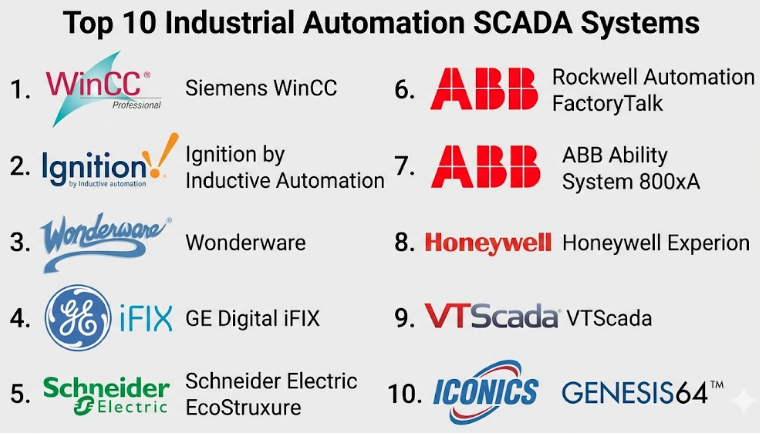
Top 10 Industrial Automation SCADA Systems
#1 — Siemens WinCC
Short description: Enterprise-grade SCADA platform widely used in manufacturing and industrial automation environments.
Key Features
- Real-time monitoring and control
- Advanced visualization dashboards
- Integration with Siemens PLCs
- Scalable architecture
- Alarm and event management
- Data logging and reporting
Pros
- Highly reliable for industrial use
- Strong ecosystem support
Cons
- Expensive licensing
- Complex setup
Platforms / Deployment
Windows / Cloud / Hybrid
Security & Compliance
RBAC, encryption (details vary)
Integrations & Ecosystem
Strong integration within Siemens ecosystem and industrial automation stack.
- PLCs and industrial controllers
- Industrial protocols
- Enterprise systems
Support & Community
Enterprise-level support with extensive documentation.
#2 — Ignition by Inductive Automation
Short description: Modern SCADA platform known for flexibility, scalability, and unlimited licensing model.
Key Features
- Web-based architecture
- Unlimited tags and clients
- Real-time data processing
- Modular design
- Cross-platform support
- MQTT support
Pros
- Flexible licensing
- Easy scalability
Cons
- Requires initial setup effort
- Learning curve for advanced features
Platforms / Deployment
Windows / Linux / macOS / Cloud
Security & Compliance
Role-based access, encryption (Not fully detailed)
Integrations & Ecosystem
Highly extensible with modern industrial and IT systems.
- MQTT
- SQL databases
- APIs
Support & Community
Strong community and vendor support.
#3 — Wonderware (AVEVA System Platform)
Short description: Industry-leading SCADA solution for large-scale industrial operations.
Key Features
- Real-time monitoring
- Advanced analytics
- Visualization tools
- Scalable architecture
- Industrial IoT integration
- Alarm management
Pros
- Proven enterprise solution
- Rich feature set
Cons
- High cost
- Complex deployment
Platforms / Deployment
Windows / Cloud / Hybrid
Security & Compliance
Not publicly stated
Integrations & Ecosystem
- Industrial systems
- Enterprise software
- Data analytics tools
Support & Community
Strong enterprise support.
#4 — GE Digital iFIX
Short description: SCADA platform designed for industrial automation and real-time data visualization.
Key Features
- Real-time control
- Data visualization
- Alarm management
- High reliability
- Integration with GE systems
- Scalable deployment
Pros
- Reliable performance
- Strong industrial focus
Cons
- Legacy UI elements
- Limited flexibility
Platforms / Deployment
Windows
Security & Compliance
Not publicly stated
Integrations & Ecosystem
- Industrial hardware
- Data systems
Support & Community
Enterprise support available.
#5 — Schneider Electric EcoStruxure
Short description: Integrated SCADA platform for energy management and industrial automation.
Key Features
- Energy monitoring
- IoT integration
- Real-time analytics
- Cloud connectivity
- Scalable architecture
- Dashboard visualization
Pros
- Strong IoT capabilities
- Energy-focused features
Cons
- Vendor ecosystem dependency
- Setup complexity
Platforms / Deployment
Cloud / Hybrid
Security & Compliance
Not publicly stated
Integrations & Ecosystem
- IoT devices
- Energy systems
- APIs
Support & Community
Enterprise-level support.
#6 — Rockwell Automation FactoryTalk
Short description: SCADA solution tailored for manufacturing and industrial environments.
Key Features
- Real-time monitoring
- Integration with Rockwell PLCs
- Data analytics
- Alarm management
- Visualization tools
- Scalable design
Pros
- Strong manufacturing integration
- Reliable performance
Cons
- Vendor lock-in
- Licensing cost
Platforms / Deployment
Windows / Hybrid
Security & Compliance
Not publicly stated
Integrations & Ecosystem
- Rockwell ecosystem
- Industrial devices
Support & Community
Strong vendor support.
#7 — ABB Ability System 800xA
Short description: SCADA and distributed control system for large industrial operations.
Key Features
- Process control
- Real-time monitoring
- Advanced analytics
- Integrated control system
- Scalable platform
- Visualization tools
Pros
- Highly scalable
- Strong process control
Cons
- Complex implementation
- High cost
Platforms / Deployment
Windows / Hybrid
Security & Compliance
Not publicly stated
Integrations & Ecosystem
- ABB systems
- Industrial protocols
Support & Community
Enterprise-grade support.
#8 — Honeywell Experion
Short description: SCADA system focused on process industries like oil, gas, and chemicals.
Key Features
- Process control
- Real-time data
- Alarm management
- Advanced visualization
- Integration with control systems
- Data analytics
Pros
- Strong industry focus
- Reliable performance
Cons
- Expensive
- Complex setup
Platforms / Deployment
Windows / Hybrid
Security & Compliance
Not publicly stated
Integrations & Ecosystem
- Industrial systems
- Control devices
Support & Community
Enterprise support available.
#9 — VTScada
Short description: SCADA platform known for reliability and rapid deployment.
Key Features
- Real-time monitoring
- Built-in redundancy
- Alarm management
- Data logging
- Visualization tools
- Scalable architecture
Pros
- Easy deployment
- High reliability
Cons
- Limited advanced analytics
- Smaller ecosystem
Platforms / Deployment
Windows
Security & Compliance
Not publicly stated
Integrations & Ecosystem
- Industrial devices
- SCADA protocols
Support & Community
Good vendor support.
#10 — ICONICS GENESIS64
Short description: SCADA and HMI platform with strong visualization and IoT capabilities.
Key Features
- Advanced visualization
- IoT integration
- Real-time monitoring
- Cloud connectivity
- Data analytics
- Scalable design
Pros
- Strong visualization
- Modern interface
Cons
- Learning curve
- Setup complexity
Platforms / Deployment
Windows / Cloud / Hybrid
Security & Compliance
Not publicly stated
Integrations & Ecosystem
- IoT systems
- APIs
- Industrial protocols
Support & Community
Commercial support with growing ecosystem.
Comparison Table (Top 10)
| Tool Name | Best For | Platform(s) Supported | Deployment | Standout Feature | Public Rating |
|---|---|---|---|---|---|
| Siemens WinCC | Manufacturing | Windows | Hybrid | Industrial integration | N/A |
| Ignition | Flexible SCADA | Cross-platform | Cloud | Unlimited licensing | N/A |
| Wonderware | Enterprise | Windows | Hybrid | Advanced analytics | N/A |
| GE iFIX | Industrial ops | Windows | On-premise | Reliability | N/A |
| EcoStruxure | Energy mgmt | Cloud | Hybrid | IoT focus | N/A |
| FactoryTalk | Manufacturing | Windows | Hybrid | PLC integration | N/A |
| ABB 800xA | Large industry | Windows | Hybrid | Process control | N/A |
| Honeywell Experion | Oil & gas | Windows | Hybrid | Industry-specific | N/A |
| VTScada | Utilities | Windows | On-premise | Reliability | N/A |
| ICONICS GENESIS64 | IoT SCADA | Windows | Hybrid | Visualization | N/A |
Evaluation & Scoring of Industrial Automation SCADA Systems
| Tool Name | Core | Ease | Integrations | Security | Performance | Support | Value | Weighted Total |
|---|---|---|---|---|---|---|---|---|
| Siemens WinCC | 9 | 6 | 9 | 7 | 9 | 9 | 7 | 8.3 |
| Ignition | 8 | 9 | 9 | 7 | 8 | 9 | 9 | 8.7 |
| Wonderware | 9 | 6 | 9 | 7 | 9 | 9 | 6 | 8.1 |
| GE iFIX | 8 | 7 | 7 | 6 | 8 | 8 | 7 | 7.5 |
| EcoStruxure | 8 | 7 | 8 | 7 | 8 | 8 | 7 | 7.7 |
| FactoryTalk | 8 | 7 | 8 | 6 | 8 | 8 | 7 | 7.6 |
| ABB 800xA | 9 | 6 | 8 | 7 | 9 | 9 | 6 | 8.0 |
| Honeywell Experion | 9 | 6 | 8 | 7 | 9 | 9 | 6 | 8.0 |
| VTScada | 7 | 8 | 6 | 6 | 8 | 7 | 8 | 7.4 |
| ICONICS GENESIS64 | 8 | 7 | 8 | 6 | 8 | 7 | 7 | 7.6 |
How to interpret scores:
- Higher scores indicate balanced capabilities across all criteria
- Enterprise tools score higher in performance and reliability
- Flexible platforms score higher in ease and value
- Open vs enterprise differences affect pricing and usability
- Choose based on your operational needs
Which Industrial Automation SCADA Systems
Solo / Freelancer
- Not typically applicable; SCADA is enterprise-focused
SMB
- Best: Ignition, VTScada
- Reason: Lower cost and easier deployment
Mid-Market
- Best: EcoStruxure, FactoryTalk
- Reason: Balanced features and scalability
Enterprise
- Best: Siemens WinCC, Wonderware, ABB 800xA
- Reason: Large-scale reliability and integration
Budget vs Premium
- Budget: Ignition
- Premium: Siemens, ABB, Honeywell
Feature Depth vs Ease of Use
- Depth: Wonderware, ABB
- Ease: Ignition
Integrations & Scalability
- Strongest: Siemens, Rockwell, Schneider
Security & Compliance Needs
- Enterprise-grade systems provide better controls
Frequently Asked Questions (FAQs)
What is a SCADA system?
It is a system used to monitor and control industrial processes remotely.
Is SCADA still relevant today?
Yes, it is essential for modern industrial automation and IoT.
Are SCADA systems expensive?
Costs vary widely depending on scale and vendor.
Can SCADA work with IoT devices?
Yes, modern SCADA platforms support IoT integration.
Do I need specialized skills?
Yes, industrial automation knowledge is required.
Are SCADA systems secure?
Security depends on configuration and vendor capabilities.
Can SCADA systems scale?
Yes, enterprise solutions support large-scale deployments.
What industries use SCADA?
Manufacturing, energy, utilities, oil and gas.
Can I switch SCADA systems?
Yes, but migration can be complex.
What are alternatives?
PLC-based systems or simple monitoring tools.
Conclusion
Industrial Automation SCADA Systems are the backbone of modern industrial operations. They enable real-time monitoring, control, and optimization of complex processes across industries. From manufacturing plants to energy grids, SCADA platforms ensure efficiency, reliability, and safety. Choosing the right SCADA system depends on your operational scale, industry requirements, and integration needs. While enterprise platforms offer deep functionality and scalability, flexible solutions like Ignition provide cost-effective alternatives.
