Introduction
AI Content Generation Tools are software platforms that use artificial intelligence to create written, visual, or multimedia content automatically. These tools can generate blog posts, marketing copy, social media captions, emails, product descriptions, and even scripts—saving time while maintaining consistency and quality.
In today’s fast-paced digital environment, content demand has exploded. Businesses, creators, and teams are expected to produce high-quality content at scale. AI tools help bridge the gap by accelerating production, reducing manual effort, and enabling experimentation across formats and channels.
Real-world use cases:
- Marketing teams generating SEO blogs and ad copy
- SaaS companies creating product documentation
- Agencies scaling client content production
- Startups producing landing pages quickly
- Developers automating documentation and release notes
What buyers should evaluate:
- Content quality and accuracy
- Customization and brand voice control
- Ease of use and onboarding
- Integration with CMS and tools
- Security and compliance capabilities
- Pricing and scalability
- Multilingual support
- Output formats (text, image, code)
- Collaboration features
Best for: marketers, content creators, SaaS teams, startups, agencies, and enterprises looking to scale content production efficiently.
Not ideal for: highly regulated content environments requiring strict human validation, or niche creative writing requiring deep human originality.
Key Trends in AI Content Generation Tools
- Multimodal AI expansion: Tools now support text, images, video, and audio generation in one platform.
- Fine-tuned brand voice models: Companies train AI on their tone, style, and guidelines.
- Workflow automation: Integration with CMS, CRMs, and marketing pipelines is becoming standard.
- AI copilots: Embedded AI assistants inside everyday tools like editors and IDEs.
- Privacy-first deployments: Enterprise-grade security and private model hosting options are increasing.
- Prompt engineering abstraction: Users rely less on prompts and more on structured workflows.
- Real-time collaboration: Teams co-create content using shared AI workspaces.
- AI + SEO integration: Built-in keyword analysis and ranking optimization features.
- API-first ecosystems: Developers integrate content generation into apps and products.
- Usage-based pricing models: Flexible pricing tied to tokens, usage, or output volume.
How We Selected These Tools (Methodology)
- Evaluated market adoption and industry recognition
- Assessed feature depth and innovation
- Reviewed ease of use and onboarding experience
- Considered security and compliance readiness
- Analyzed integration capabilities and API support
- Checked performance reliability and scalability
- Compared support quality and documentation
- Evaluated fit across SMB, mid-market, and enterprise
- Ensured diversity across use cases (marketing, dev, enterprise)
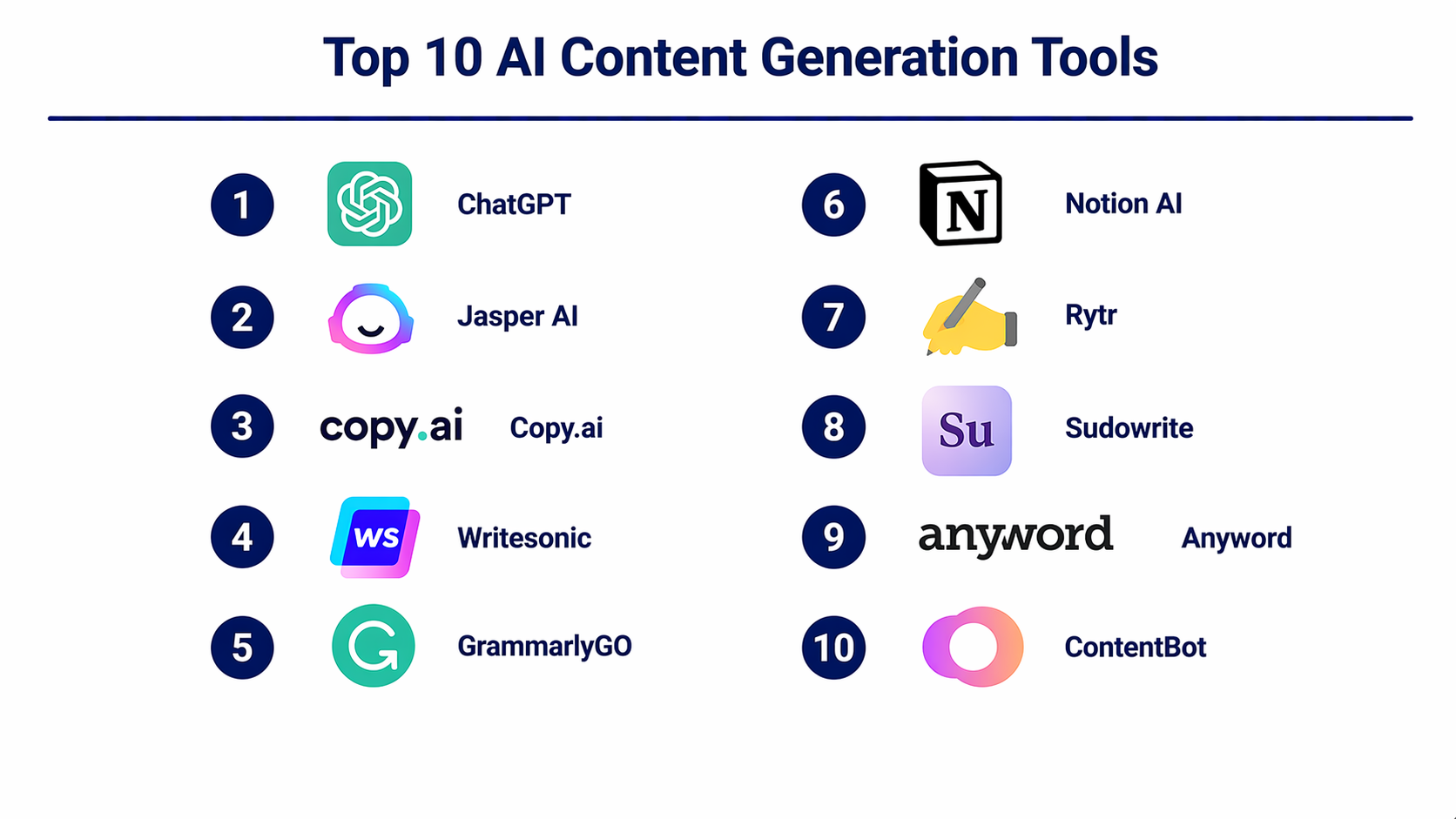
Top 10 AI Content Generation Tools
#1 — ChatGPT
Short description: A versatile AI assistant for generating text, code, and creative content. Suitable for individuals, teams, and enterprises.
Key Features
- Conversational AI interface
- Content creation across formats
- Code generation and debugging
- Custom GPT workflows
- Multilingual support
- Context-aware responses
- Plugin and API support
Pros
- Highly flexible across use cases
- Easy to use with minimal learning curve
Cons
- Requires prompt refinement for best results
- Output consistency can vary
Platforms / Deployment
Web / iOS / Android
Cloud
Security & Compliance
SSO, encryption, enterprise controls (availability varies by plan)
Integrations & Ecosystem
Strong ecosystem with APIs and plugins.
- CMS tools
- Developer APIs
- Automation tools
- Custom integrations
Support & Community
Large global community, extensive documentation, strong enterprise support.
#2 — Jasper AI
Short description: AI writing assistant focused on marketing and brand voice consistency.
Key Features
- Brand voice training
- Marketing templates
- SEO integration
- Campaign workflows
- Collaboration tools
- Long-form content generation
Pros
- Excellent for marketing teams
- Strong brand consistency
Cons
- Higher pricing for advanced features
- Less flexible outside marketing use cases
Platforms / Deployment
Web
Cloud
Security & Compliance
SSO, role-based access (details vary)
Integrations & Ecosystem
- SEO tools
- CMS platforms
- Marketing automation
Support & Community
Strong onboarding and customer success support.
#3 — Copy.ai
Short description: AI-powered content generator focused on automation and workflow creation.
Key Features
- Workflow automation builder
- Marketing content templates
- AI-powered sales copy
- API access
- Bulk content generation
Pros
- Easy automation setup
- Good for scaling content operations
Cons
- Limited deep customization
- Output quality varies by use case
Platforms / Deployment
Web
Cloud
Security & Compliance
Not publicly stated
Integrations & Ecosystem
- CRM tools
- Marketing platforms
- APIs
Support & Community
Good documentation and onboarding resources.
#4 — Writesonic
Short description: AI writing platform for SEO, blogs, and ads with integrated AI chat.
Key Features
- Blog generation tools
- AI chatbot integration
- SEO optimization features
- Landing page generator
- Multi-language support
Pros
- Strong SEO features
- Affordable pricing tiers
Cons
- Interface can feel cluttered
- Output sometimes needs editing
Platforms / Deployment
Web
Cloud
Security & Compliance
Not publicly stated
Integrations & Ecosystem
- CMS tools
- SEO platforms
- APIs
Support & Community
Responsive support with active user base.
#5 — GrammarlyGO
Short description: AI writing assistant integrated into grammar and editing workflows.
Key Features
- Context-aware rewriting
- Tone adjustment
- Grammar and clarity checks
- Email and document generation
- Real-time suggestions
Pros
- Seamless integration into writing workflows
- High accuracy for editing
Cons
- Limited creative generation capabilities
- Not a full content platform
Platforms / Deployment
Web / Desktop extensions
Cloud
Security & Compliance
Encryption, enterprise features (varies)
Integrations & Ecosystem
- Email clients
- Document tools
- Browser extensions
Support & Community
Strong support and enterprise adoption.
#6 — Notion AI
Short description: AI integrated into productivity workspace for content and documentation.
Key Features
- AI writing within documents
- Task automation
- Knowledge base creation
- Summarization tools
- Collaborative editing
Pros
- Excellent for team collaboration
- Integrated workflow environment
Cons
- Limited advanced AI customization
- Not specialized for marketing
Platforms / Deployment
Web / Desktop / Mobile
Cloud
Security & Compliance
Enterprise security features (varies)
Integrations & Ecosystem
- Productivity tools
- APIs
- Workflow automation
Support & Community
Strong community and documentation.
#7 — Rytr
Short description: Budget-friendly AI writing tool for quick content generation.
Key Features
- Content templates
- Multi-language support
- Tone selection
- Short-form content generation
- Plagiarism checker
Pros
- Affordable pricing
- Simple interface
Cons
- Limited advanced features
- Not ideal for enterprise use
Platforms / Deployment
Web
Cloud
Security & Compliance
Not publicly stated
Integrations & Ecosystem
- Basic integrations
- Limited API support
Support & Community
Basic support with growing user base.
#8 — Sudowrite
Short description: AI writing assistant focused on creative storytelling and fiction writing.
Key Features
- Story generation
- Character development tools
- Scene expansion
- Creative prompts
- Style enhancement
Pros
- Excellent for creative writers
- Unique storytelling features
Cons
- Not suited for business content
- Limited enterprise features
Platforms / Deployment
Web
Cloud
Security & Compliance
Not publicly stated
Integrations & Ecosystem
- Writing tools
- Minimal integrations
Support & Community
Niche but active creative community.
#9 — Anyword
Short description: AI content platform focused on performance-driven marketing copy.
Key Features
- Predictive performance scoring
- Ad copy generation
- Audience targeting
- Data-driven optimization
- Campaign analytics
Pros
- Strong analytics capabilities
- Great for ad optimization
Cons
- Limited non-marketing use
- Premium pricing
Platforms / Deployment
Web
Cloud
Security & Compliance
Not publicly stated
Integrations & Ecosystem
- Marketing platforms
- Analytics tools
- APIs
Support & Community
Good enterprise support options.
#10 — ContentBot
Short description: AI tool for automating blog writing and marketing content workflows.
Key Features
- Blog automation tools
- AI writer workflows
- Content templates
- API access
- Bulk generation
Pros
- Good automation capabilities
- Flexible pricing
Cons
- UI can be less intuitive
- Output quality varies
Platforms / Deployment
Web
Cloud
Security & Compliance
Not publicly stated
Integrations & Ecosystem
- APIs
- Marketing tools
- Automation platforms
Support & Community
Moderate support with active updates.
Comparison Table (Top 10)
| Tool Name | Best For | Platform(s) Supported | Deployment | Standout Feature | Public Rating |
|---|---|---|---|---|---|
| ChatGPT | General-purpose AI | Web, Mobile | Cloud | Conversational AI | N/A |
| Jasper AI | Marketing teams | Web | Cloud | Brand voice training | N/A |
| Copy.ai | Workflow automation | Web | Cloud | Workflow builder | N/A |
| Writesonic | SEO content | Web | Cloud | SEO tools | N/A |
| GrammarlyGO | Editing & rewriting | Web, Extensions | Cloud | Context-aware editing | N/A |
| Notion AI | Productivity workflows | Web, Desktop | Cloud | AI inside workspace | N/A |
| Rytr | Budget users | Web | Cloud | Affordable plans | N/A |
| Sudowrite | Creative writing | Web | Cloud | Storytelling tools | N/A |
| Anyword | Performance marketing | Web | Cloud | Predictive scoring | N/A |
| ContentBot | Content automation | Web | Cloud | Blog automation | N/A |
Evaluation & Scoring of AI Content Generation Tools
| Tool Name | Core | Ease | Integrations | Security | Performance | Support | Value | Weighted Total |
|---|---|---|---|---|---|---|---|---|
| ChatGPT | 9 | 9 | 9 | 8 | 9 | 9 | 8 | 8.8 |
| Jasper AI | 8 | 8 | 8 | 7 | 8 | 8 | 7 | 7.8 |
| Copy.ai | 8 | 9 | 7 | 6 | 8 | 7 | 8 | 7.8 |
| Writesonic | 8 | 8 | 7 | 6 | 7 | 7 | 8 | 7.6 |
| GrammarlyGO | 7 | 9 | 8 | 7 | 8 | 8 | 7 | 7.8 |
| Notion AI | 7 | 9 | 8 | 7 | 8 | 8 | 8 | 8.0 |
| Rytr | 6 | 9 | 6 | 5 | 7 | 6 | 9 | 7.2 |
| Sudowrite | 7 | 8 | 5 | 5 | 7 | 6 | 7 | 6.8 |
| Anyword | 8 | 7 | 7 | 6 | 8 | 7 | 7 | 7.5 |
| ContentBot | 7 | 7 | 7 | 6 | 7 | 6 | 8 | 7.2 |
How to interpret scores:
- Scores are comparative within this category
- Weighted totals reflect real-world usability and value
- Higher scores indicate balanced performance across criteria
- Choose based on your specific use case, not just ranking
Which AI Content Generation Tools for You?
Solo / Freelancer
- Best options: Rytr, ChatGPT
- Focus on affordability and ease of use
SMB
- Best options: Writesonic, Copy.ai
- Look for automation and scalability
Mid-Market
- Best options: Jasper AI, Notion AI
- Balance collaboration and advanced features
Enterprise
- Best options: ChatGPT, Jasper AI, Anyword
- Prioritize security, integrations, and customization
Budget vs Premium
- Budget: Rytr, Writesonic
- Premium: Jasper AI, Anyword
Feature Depth vs Ease of Use
- Feature-rich: ChatGPT, Jasper AI
- Simple: Rytr, GrammarlyGO
Integrations & Scalability
- Strong integrations: ChatGPT, Copy.ai
- Limited integrations: Sudowrite
Security & Compliance Needs
- Enterprise-ready: ChatGPT, GrammarlyGO
- Basic: Rytr, ContentBot
Frequently Asked Questions (FAQs)
What are AI content generation tools?
They are software platforms that use AI to create written or multimedia content automatically.
Are these tools suitable for SEO?
Yes, many tools include SEO optimization features, but human review is still important.
How do pricing models work?
Most tools use subscription or usage-based pricing.
Can AI replace human writers?
No, AI complements human creativity but does not fully replace it.
Are these tools secure?
Security varies by vendor; enterprise tools offer better compliance features.
Do they support multiple languages?
Yes, most tools support multiple languages.
How long does onboarding take?
Typically a few hours to a few days depending on complexity.
Can I integrate them with my CMS?
Yes, many tools offer API or direct integrations.
What are common mistakes?
Over-relying on AI without editing and poor prompt usage.
Can I switch tools easily?
Yes, but migrating workflows may require effort.
Conclusion
AI content generation tools have become essential for modern digital workflows. Whether you are a solo creator, a startup, or a large enterprise, these platforms can significantly improve efficiency, consistency, and scalability of content production. However, the “best” tool depends entirely on your use case—whether you prioritize cost, performance, integrations, or creative flexibility. Instead of selecting a single tool blindly, the smarter approach is to shortlist two or three options based on your needs. Run small pilots, test real workflows, and validate output quality. Also evaluate how well each tool integrates with your existing systems and whether it meets your security requirements. This practical evaluation will ensure long-term success rather than short-term convenience.
