Introduction
Business Intelligence (BI) tools are software platforms that help organizations collect, analyze, and visualize data to make better decisions. In simple terms, they turn raw data into dashboards, reports, and insights that business users can actually understand.
In the current data-driven environment, BI tools are no longer optional. With increasing data volume, distributed systems, and AI-driven analytics, companies need fast, reliable, and secure ways to interpret information. Modern BI tools now include AI-assisted insights, real-time analytics, and embedded reporting, making them more powerful than traditional reporting systems.
Common use cases:
- Sales performance dashboards and forecasting
- Marketing analytics and campaign tracking
- Financial reporting and budgeting
- Operational monitoring and KPIs
- Customer behavior analysis
What buyers should evaluate:
- Ease of use and learning curve
- Data integration capabilities
- Visualization flexibility
- Performance with large datasets
- Security and compliance features
- Scalability and deployment options
- Pricing model and total cost
- AI/automation capabilities
Best for: Data analysts, business leaders, IT teams, startups to large enterprises, and industries like finance, healthcare, retail, and SaaS.
Not ideal for: Very small teams with minimal data needs or organizations that only require simple spreadsheets; in such cases, lightweight tools may be sufficient.
Key Trends in Business Intelligence (BI) Tools
- AI-powered insights: Natural language queries and automated recommendations
- Augmented analytics: AI-driven data discovery and anomaly detection
- Self-service BI: Non-technical users creating reports independently
- Real-time analytics: Streaming data dashboards for instant decisions
- Embedded BI: Integrating analytics into apps and workflows
- Cloud-first deployment: Shift toward SaaS and hybrid models
- Data governance focus: Stronger controls for compliance and auditability
- Semantic layers: Standardized business metrics across teams
- Collaboration features: Shared dashboards and in-tool commenting
- Cost optimization models: Usage-based and scalable pricing
How We Selected These Tools (Methodology)
- Evaluated market adoption and brand recognition
- Assessed feature completeness and innovation
- Considered performance and scalability signals
- Reviewed security and compliance capabilities
- Analyzed integration ecosystems and APIs
- Checked fit across SMB, mid-market, and enterprise
- Balanced ease of use vs advanced functionality
- Considered community and vendor support maturity
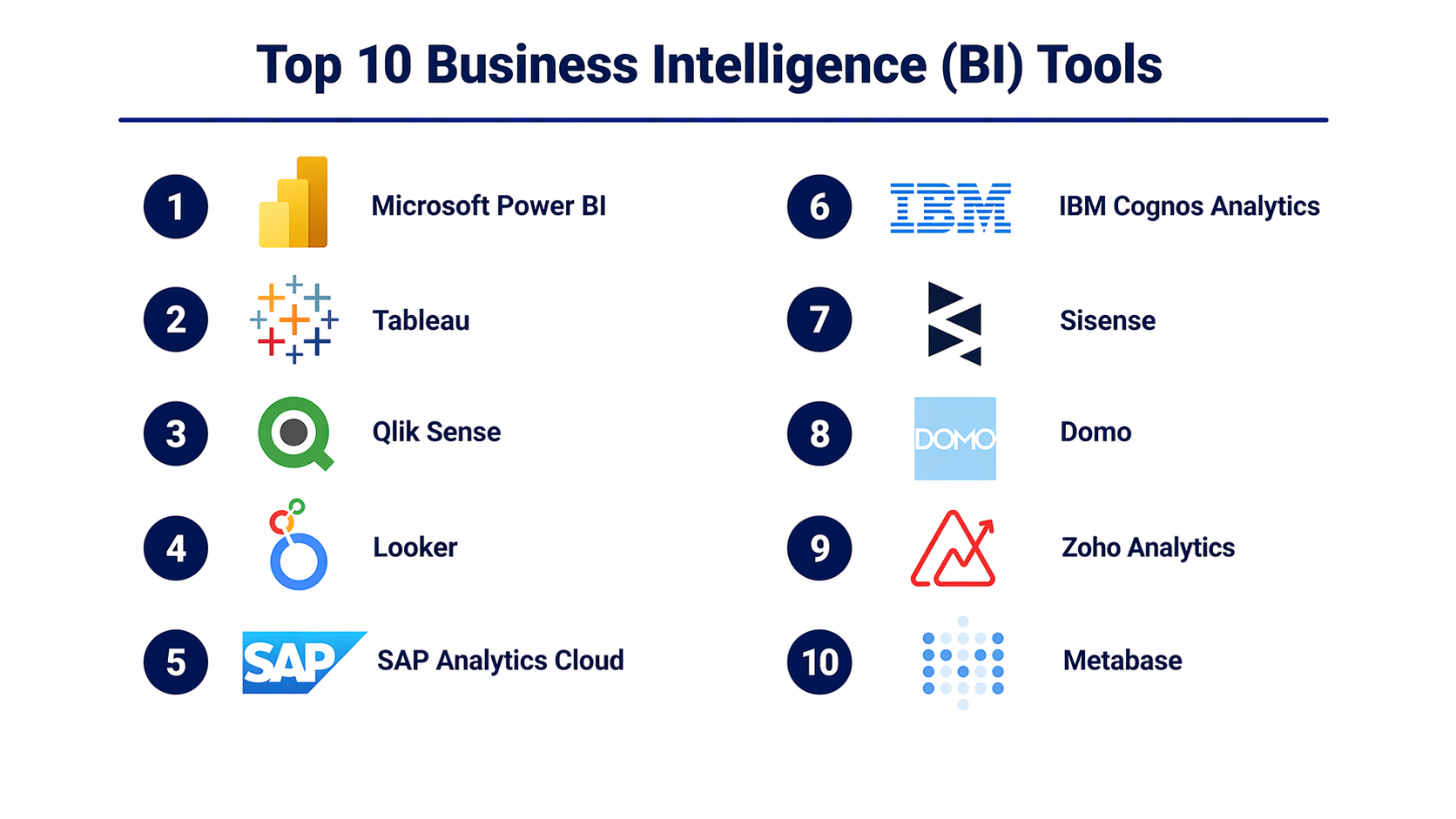
Top 10 Business Intelligence (BI) Tools
#1 — Microsoft Power BI
Short description: A widely used BI platform offering strong visualization, integration with Microsoft ecosystem, and enterprise scalability.
Key Features
- Interactive dashboards and reports
- AI-powered insights and Q&A
- Integration with Excel and Azure
- Data modeling capabilities
- Real-time analytics support
Pros
- Strong ecosystem integration
- Cost-effective for SMBs
Cons
- Learning curve for advanced features
- Performance issues with very large datasets
Platforms / Deployment
Web / Windows / iOS / Android
Cloud / Self-hosted
Security & Compliance
SSO, MFA, RBAC, encryption; SOC 2, ISO 27001 (commonly referenced)
Integrations & Ecosystem
Integrates deeply with Microsoft products and external data sources.
- Azure
- SQL Server
- Excel
- APIs
Support & Community
Strong documentation, large global community, enterprise support available.
#2 — Tableau
Short description: A leading BI tool known for powerful data visualization and analytics capabilities.
Key Features
- Advanced data visualization
- Drag-and-drop interface
- Real-time analytics
- Data blending
- AI-driven insights
Pros
- Best-in-class visualizations
- Strong community
Cons
- Expensive for small teams
- Steeper learning curve
Platforms / Deployment
Web / Windows / macOS
Cloud / Self-hosted
Security & Compliance
SSO, MFA, encryption, RBAC; Not publicly stated for certifications in this context
Integrations & Ecosystem
Supports wide range of data sources and APIs.
- Databases
- Cloud platforms
- APIs
Support & Community
Very strong community, extensive tutorials, enterprise support.
#3 — Qlik Sense
Short description: A self-service BI tool with associative data engine and strong analytics capabilities.
Key Features
- Associative data model
- Self-service dashboards
- AI insights
- Data storytelling
- Embedded analytics
Pros
- Powerful analytics engine
- Flexible data exploration
Cons
- Complex setup
- UI not as intuitive
Platforms / Deployment
Web / Windows
Cloud / Hybrid
Security & Compliance
Not publicly stated
Integrations & Ecosystem
- APIs
- Databases
- Cloud systems
Support & Community
Good documentation and enterprise support.
#4 — Looker (Google Looker)
Short description: A modern BI platform focused on data modeling and embedded analytics.
Key Features
- Semantic modeling layer
- Embedded analytics
- Real-time dashboards
- SQL-based modeling
- API-first approach
Pros
- Strong data governance
- Developer-friendly
Cons
- Requires SQL knowledge
- Higher cost
Platforms / Deployment
Web
Cloud
Security & Compliance
Not publicly stated
Integrations & Ecosystem
- BigQuery
- APIs
- Cloud services
Support & Community
Enterprise-grade support, growing community.
#5 — SAP Analytics Cloud
Short description: Enterprise BI platform combining analytics, planning, and predictive capabilities.
Key Features
- Integrated planning and BI
- Predictive analytics
- Data visualization
- Collaboration tools
- AI features
Pros
- Strong enterprise capabilities
- Integrated planning
Cons
- Expensive
- Complex setup
Platforms / Deployment
Web
Cloud
Security & Compliance
Not publicly stated
Integrations & Ecosystem
- SAP ecosystem
- APIs
Support & Community
Strong enterprise support.
#6 — IBM Cognos Analytics
Short description: A mature BI platform offering reporting, dashboards, and AI insights.
Key Features
- Reporting and dashboards
- AI insights
- Data preparation
- Natural language queries
- Scheduling
Pros
- Strong reporting capabilities
- Enterprise reliability
Cons
- Outdated UI
- Complexity
Platforms / Deployment
Web / Windows
Cloud / On-prem
Security & Compliance
Not publicly stated
Integrations & Ecosystem
- Databases
- APIs
Support & Community
Enterprise-level support.
#7 — Sisense
Short description: A flexible BI platform designed for embedded analytics and scalability.
Key Features
- Embedded BI
- Custom dashboards
- Data integration
- API-first architecture
- AI analytics
Pros
- Highly customizable
- Strong embedding capabilities
Cons
- Requires technical setup
- Pricing varies
Platforms / Deployment
Web
Cloud / Hybrid
Security & Compliance
Not publicly stated
Integrations & Ecosystem
- APIs
- Data warehouses
Support & Community
Good support, smaller community.
#8 — Domo
Short description: A cloud-based BI platform focused on real-time data and business dashboards.
Key Features
- Real-time dashboards
- Data connectors
- Collaboration tools
- Mobile analytics
- Alerts and automation
Pros
- Easy to use
- Strong cloud capabilities
Cons
- Costly
- Limited customization
Platforms / Deployment
Web / iOS / Android
Cloud
Security & Compliance
Not publicly stated
Integrations & Ecosystem
- Cloud apps
- APIs
Support & Community
Good support, moderate community.
#9 — Zoho Analytics
Short description: Affordable BI tool with strong reporting and integration capabilities.
Key Features
- Drag-and-drop reporting
- AI assistant
- Data blending
- Embedded analytics
- Scheduling
Pros
- Cost-effective
- Easy to use
Cons
- Limited scalability
- Fewer advanced features
Platforms / Deployment
Web
Cloud
Security & Compliance
Not publicly stated
Integrations & Ecosystem
- Zoho apps
- APIs
Support & Community
Good documentation, SMB-focused support.
#10 — Metabase
Short description: Open-source BI tool suitable for startups and small teams.
Key Features
- Simple dashboards
- SQL queries
- Data visualization
- Open-source flexibility
- Self-hosted options
Pros
- Free and open-source
- Easy setup
Cons
- Limited advanced features
- Scaling challenges
Platforms / Deployment
Web
Cloud / Self-hosted
Security & Compliance
Not publicly stated
Integrations & Ecosystem
- Databases
- APIs
Support & Community
Active open-source community.
Comparison Table (Top 10)
| Tool Name | Best For | Platform(s) Supported | Deployment | Standout Feature | Public Rating |
|---|---|---|---|---|---|
| Microsoft Power BI | SMB & Enterprise | Web, Windows, Mobile | Cloud/Hybrid | Microsoft integration | N/A |
| Tableau | Data visualization | Web, Desktop | Cloud/On-prem | Visual analytics | N/A |
| Qlik Sense | Advanced analytics | Web | Hybrid | Associative engine | N/A |
| Looker | Data modeling | Web | Cloud | Semantic layer | N/A |
| SAP Analytics Cloud | Enterprise BI | Web | Cloud | Planning + BI | N/A |
| IBM Cognos | Reporting | Web | Hybrid | Reporting engine | N/A |
| Sisense | Embedded BI | Web | Hybrid | Custom dashboards | N/A |
| Domo | Real-time dashboards | Web, Mobile | Cloud | Real-time analytics | N/A |
| Zoho Analytics | SMB reporting | Web | Cloud | Affordable BI | N/A |
| Metabase | Startups | Web | Self-hosted | Open-source | N/A |
Evaluation & Scoring of Business Intelligence (BI) Tools
| Tool Name | Core | Ease | Integrations | Security | Performance | Support | Value | Weighted Total |
|---|---|---|---|---|---|---|---|---|
| Power BI | 9 | 8 | 9 | 8 | 8 | 9 | 9 | 8.6 |
| Tableau | 9 | 7 | 8 | 8 | 9 | 9 | 7 | 8.3 |
| Qlik Sense | 8 | 7 | 8 | 7 | 8 | 8 | 7 | 7.7 |
| Looker | 8 | 6 | 9 | 8 | 8 | 8 | 7 | 7.8 |
| SAP Analytics Cloud | 9 | 6 | 8 | 8 | 9 | 9 | 6 | 8.0 |
| IBM Cognos | 8 | 6 | 7 | 8 | 8 | 8 | 7 | 7.5 |
| Sisense | 8 | 7 | 8 | 7 | 8 | 7 | 7 | 7.6 |
| Domo | 8 | 8 | 7 | 7 | 8 | 7 | 7 | 7.6 |
| Zoho Analytics | 7 | 9 | 7 | 6 | 7 | 7 | 9 | 7.6 |
| Metabase | 6 | 8 | 6 | 6 | 7 | 6 | 9 | 6.9 |
How to interpret scores:
- Scores are relative comparisons, not absolute benchmarks
- Higher scores indicate stronger overall capability
- Weighting emphasizes core features and value
- Choose based on your specific use case, not just total score
Which Business Intelligence (BI) Tools Right for You?
Solo / Freelancer
Choose Zoho Analytics or Metabase for affordability and simplicity.
SMB
Power BI or Zoho Analytics offer strong value and ease of use.
Mid-Market
Tableau or Qlik Sense provide balance between power and scalability.
Enterprise
SAP Analytics Cloud, Looker, or Power BI for governance and scale.
Budget vs Premium
- Budget: Zoho, Metabase
- Premium: Tableau, SAP
Feature Depth vs Ease of Use
- Easy: Domo, Zoho
- Advanced: Tableau, Qlik
Integrations & Scalability
- Strong integrations: Power BI, Looker
- Scalable: SAP, Tableau
Security & Compliance Needs
- Enterprise-grade: Power BI, SAP, Looker
Frequently Asked Questions (FAQs)
What is a BI tool?
A BI tool helps convert raw data into dashboards and reports for decision-making.
Are BI tools expensive?
Pricing varies widely; some tools are affordable while enterprise tools can be costly.
Do BI tools require coding?
Some tools are no-code, while others require SQL for advanced use.
Can BI tools handle real-time data?
Yes, many modern tools support real-time analytics.
Are BI tools secure?
Most offer security features, but compliance varies by vendor.
How long does implementation take?
It depends on complexity; from days to months.
Can I switch BI tools easily?
Migration can be complex depending on data and integrations.
What industries use BI tools?
Almost all industries including finance, healthcare, retail, and tech.
Are open-source BI tools good?
They are good for small teams but may lack enterprise features.
What is embedded BI?
Embedding dashboards directly into applications or workflows.
Conclusion
Business Intelligence tools have evolved from simple reporting systems into powerful decision-making platforms. Today, they combine data integration, visualization, AI insights, and collaboration into a single ecosystem. However, the “best” BI tool depends entirely on your context—team size, technical expertise, budget, and business goals.
