Introduction
Privacy Management Tools help organizations manage, monitor, and enforce data privacy policies across systems, applications, and user data. In simple terms, these tools ensure that personal data is collected, processed, stored, and shared in a compliant and secure way.
With increasing regulations like GDPR, CCPA, and global data protection laws, privacy management is no longer just a legal requirement—it is a business necessity. Organizations must track where data lives, how it is used, and ensure users can exercise their rights (like data access or deletion).
Common use cases:
- Managing user consent and preferences
- Data mapping and classification across systems
- Handling Data Subject Access Requests (DSARs)
- Monitoring compliance with privacy regulations
- Risk assessment and audit readiness
What buyers should evaluate:
- Data discovery and mapping capabilities
- Consent and preference management
- DSAR automation and workflows
- Integration with enterprise systems
- Compliance reporting and audit trails
- Scalability across regions and systems
- Security and encryption capabilities
- Ease of use for legal and compliance teams
- Automation and AI features
- Deployment flexibility
Best for: Compliance teams, legal departments, data protection officers, SaaS companies, enterprises handling customer data, and regulated industries.
Not ideal for: Small teams with minimal personal data exposure or businesses that only need basic policy documentation tools.
Key Trends in Privacy Management Tools
- AI-driven data discovery to identify sensitive data automatically
- Automated DSAR workflows reducing manual compliance effort
- Consent orchestration across channels (web, mobile, apps)
- Integration with DevOps and data pipelines for privacy-by-design
- Global compliance frameworks support across multiple jurisdictions
- Privacy risk scoring and dashboards for real-time monitoring
- Cloud-first platforms replacing manual compliance processes
- Embedded privacy APIs for developers
- Zero-trust data access models integrated into privacy tools
- Vendor risk and third-party privacy tracking
How We Selected These Tools (Methodology)
- Considered market presence and adoption across industries
- Evaluated feature coverage across privacy lifecycle
- Assessed automation and AI capabilities
- Reviewed security and compliance support signals
- Analyzed integration ecosystem and APIs
- Compared tools across enterprise and mid-market needs
- Prioritized ease of use for non-technical stakeholders
- Included tools with global compliance support
- Considered scalability and performance indicators
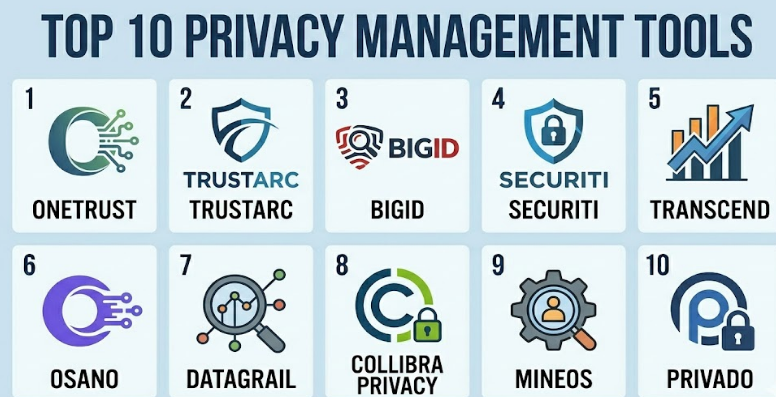
Top 10 Privacy Management Tools
#1 — OneTrust
Short description: A widely adopted enterprise privacy management platform offering comprehensive compliance, consent, and risk management capabilities.
Key Features
- Consent and preference management
- Data mapping and discovery
- DSAR automation
- Vendor risk management
- Compliance reporting dashboards
Pros
- Comprehensive feature set
- Strong enterprise adoption
Cons
- Complex implementation
- Higher cost
Platforms / Deployment
Web
Cloud
Security & Compliance
SSO, RBAC, audit logs
Other certifications: Not publicly stated
Integrations & Ecosystem
- CRM systems
- Cloud platforms
- APIs for integration
Support & Community
Strong enterprise support and global presence.
#2 — TrustArc
Short description: A mature privacy platform focused on risk assessment, compliance automation, and governance.
Key Features
- Privacy risk assessment
- Data inventory and mapping
- DSAR management
- Regulatory compliance tools
- Reporting and analytics
Pros
- Strong compliance capabilities
- Mature governance features
Cons
- UI may feel outdated
- Requires training
Platforms / Deployment
Web
Cloud
Security & Compliance
Encryption, access controls
Other certifications: Not publicly stated
Integrations & Ecosystem
- Enterprise systems
- APIs
Support & Community
Established support ecosystem.
#3 — BigID
Short description: A data intelligence platform focused on discovering and classifying sensitive data across environments.
Key Features
- AI-based data discovery
- Data classification
- Risk insights
- Data governance tools
- Privacy compliance features
Pros
- Strong data discovery
- AI-driven insights
Cons
- Requires setup effort
- Complex configurations
Platforms / Deployment
Web
Cloud / Hybrid
Security & Compliance
Encryption, RBAC
Other certifications: Not publicly stated
Integrations & Ecosystem
- Cloud platforms
- Data systems
- APIs
Support & Community
Enterprise-level support.
#4 — Securiti
Short description: A privacy and data governance platform offering automation and AI-driven compliance.
Key Features
- Data intelligence and mapping
- Privacy automation
- Consent management
- Risk scoring
- Compliance dashboards
Pros
- AI-driven automation
- Unified platform
Cons
- Limited awareness compared to leaders
- Pricing varies
Platforms / Deployment
Web
Cloud
Security & Compliance
Encryption
Other certifications: Not publicly stated
Integrations & Ecosystem
- Cloud apps
- APIs
Support & Community
Growing support ecosystem.
#5 — Transcend
Short description: A developer-focused privacy platform designed for automating user data rights requests.
Key Features
- DSAR automation
- Data deletion workflows
- Privacy APIs
- Consent management
- Data mapping
Pros
- Developer-friendly
- Strong automation
Cons
- Requires technical expertise
- Limited non-technical UI features
Platforms / Deployment
Web
Cloud
Security & Compliance
Encryption, access controls
Other certifications: Not publicly stated
Integrations & Ecosystem
- APIs
- SaaS platforms
Support & Community
Strong developer support.
#6 — Osano
Short description: A privacy platform focused on consent management and compliance monitoring.
Key Features
- Consent management
- Vendor monitoring
- Compliance alerts
- Privacy dashboards
- Risk management
Pros
- Easy to use
- Good for SMBs
Cons
- Limited enterprise features
- Less advanced analytics
Platforms / Deployment
Web
Cloud
Security & Compliance
Encryption
Other certifications: Not publicly stated
Integrations & Ecosystem
- Website integrations
- APIs
Support & Community
Good onboarding and support.
#7 — DataGrail
Short description: A privacy management platform focused on automating data subject requests and compliance workflows.
Key Features
- DSAR automation
- Data mapping
- Workflow automation
- Integration connectors
- Reporting tools
Pros
- Easy implementation
- Strong integrations
Cons
- Limited advanced analytics
- Pricing varies
Platforms / Deployment
Web
Cloud
Security & Compliance
Encryption, access controls
Other certifications: Not publicly stated
Integrations & Ecosystem
- SaaS tools
- APIs
Support & Community
Reliable support for growing companies.
#8 — Collibra Privacy
Short description: A data governance platform with strong privacy and compliance features.
Key Features
- Data governance
- Privacy compliance
- Data catalog
- Risk management
- Workflow automation
Pros
- Strong governance capabilities
- Enterprise-ready
Cons
- Complex setup
- Requires expertise
Platforms / Deployment
Web
Cloud / Hybrid
Security & Compliance
Encryption, RBAC
Other certifications: Not publicly stated
Integrations & Ecosystem
- Data systems
- APIs
Support & Community
Enterprise-grade support.
#9 — MineOS
Short description: A privacy platform designed to automate user data rights and consent management.
Key Features
- DSAR automation
- Consent tracking
- Data mapping
- Privacy workflows
- API integrations
Pros
- Automation-focused
- Flexible APIs
Cons
- Smaller ecosystem
- Limited enterprise adoption
Platforms / Deployment
Web
Cloud
Security & Compliance
Encryption
Other certifications: Not publicly stated
Integrations & Ecosystem
- SaaS integrations
- APIs
Support & Community
Growing community support.
#10 — Privado
Short description: A privacy engineering platform focused on developers and real-time data flow visibility.
Key Features
- Data flow mapping
- Privacy risk detection
- Developer tools
- Compliance tracking
- Code-level insights
Pros
- Developer-first approach
- Real-time insights
Cons
- Limited non-technical usability
- Emerging platform
Platforms / Deployment
Web
Cloud
Security & Compliance
Encryption
Other certifications: Not publicly stated
Integrations & Ecosystem
- Dev tools
- APIs
Support & Community
Emerging but growing support.
Comparison Table (Top 10)
| Tool Name | Best For | Platform(s) Supported | Deployment | Standout Feature | Public Rating |
|---|---|---|---|---|---|
| OneTrust | Enterprise compliance | Web | Cloud | Comprehensive suite | N/A |
| TrustArc | Governance & compliance | Web | Cloud | Risk assessment | N/A |
| BigID | Data discovery | Web | Cloud/Hybrid | AI classification | N/A |
| Securiti | Unified privacy platform | Web | Cloud | AI automation | N/A |
| Transcend | Developers | Web | Cloud | Privacy APIs | N/A |
| Osano | SMB consent management | Web | Cloud | Ease of use | N/A |
| DataGrail | DSAR automation | Web | Cloud | Integration focus | N/A |
| Collibra Privacy | Data governance | Web | Cloud/Hybrid | Data catalog | N/A |
| MineOS | Automation workflows | Web | Cloud | Consent + DSAR | N/A |
| Privado | Privacy engineering | Web | Cloud | Data flow mapping | N/A |
Evaluation & Scoring of Privacy Management Tools
| Tool Name | Core | Ease | Integrations | Security | Performance | Support | Value | Weighted Total |
|---|---|---|---|---|---|---|---|---|
| OneTrust | 9 | 7 | 9 | 8 | 8 | 9 | 6 | 8.1 |
| TrustArc | 8 | 6 | 8 | 8 | 8 | 8 | 6 | 7.6 |
| BigID | 9 | 6 | 8 | 8 | 9 | 8 | 6 | 8.0 |
| Securiti | 8 | 7 | 7 | 7 | 8 | 7 | 7 | 7.5 |
| Transcend | 8 | 6 | 9 | 7 | 8 | 7 | 7 | 7.6 |
| Osano | 7 | 9 | 6 | 7 | 7 | 7 | 8 | 7.4 |
| DataGrail | 8 | 8 | 8 | 7 | 8 | 8 | 7 | 7.9 |
| Collibra Privacy | 9 | 6 | 8 | 8 | 8 | 8 | 6 | 7.9 |
| MineOS | 7 | 7 | 7 | 7 | 7 | 7 | 7 | 7.0 |
| Privado | 7 | 6 | 8 | 7 | 7 | 7 | 7 | 7.1 |
How to interpret scores:
- Scores are relative comparisons across tools
- Higher scores indicate stronger overall capability
- Ease and Value vary depending on use case
- Choose based on organizational needs, not just ranking
Which Privacy Management Tool Is Right for You?
Solo / Freelancer
- Best: Osano, MineOS
- Focus on simplicity and cost
SMB
- Best: DataGrail, Osano
- Balance between automation and usability
Mid-Market
- Best: Securiti, Transcend
- Need automation and integrations
Enterprise
- Best: OneTrust, BigID, Collibra Privacy
- Require full compliance and scalability
Budget vs Premium
- Budget: Osano, MineOS
- Premium: OneTrust, BigID
Feature Depth vs Ease of Use
- Feature-rich: OneTrust, BigID
- Easy to use: Osano, DataGrail
Integrations & Scalability
- Strong integrations: Transcend, DataGrail
- Scalable platforms: BigID, OneTrust
Security & Compliance Needs
- High compliance: OneTrust, TrustArc
- Moderate needs: Osano, Privado
Frequently Asked Questions (FAQs)
What are privacy management tools used for?
They help organizations manage personal data, ensure compliance, and handle user privacy requests.
How much do these tools cost?
Pricing varies widely depending on features, scale, and deployment.
Are they required for GDPR compliance?
They are not mandatory but significantly simplify compliance efforts.
Can small businesses use these tools?
Yes, many tools offer SMB-friendly versions.
What is DSAR automation?
It automates user requests to access, delete, or modify their data.
Do these tools integrate with SaaS apps?
Yes, most support integrations with major SaaS platforms.
Are AI features important?
Yes, AI helps with data discovery and risk detection.
What are common mistakes?
Choosing tools without considering integrations or scalability.
Can I switch tools later?
Yes, but migration can be complex.
Do these tools handle global regulations?
Many support multiple privacy laws across regions.
Conclusion
Privacy management tools are becoming essential as organizations handle increasing amounts of sensitive data and face stricter regulatory expectations. These tools not only help ensure compliance but also build trust with customers by demonstrating responsible data practices.The right tool depends heavily on your organization’s size, technical maturity, and compliance requirements. Enterprises may need comprehensive platforms with deep integrations and automation, while smaller teams may prioritize ease of use and affordability.
