Introduction
Security Orchestration Automation & Response (SOAR) platforms are cybersecurity solutions designed to help organizations automate incident response, orchestrate workflows across security tools, and improve threat management efficiency. In simple terms, SOAR acts as the “control center” that connects different security systems and automates repetitive tasks like alert triaging, investigation, and remediation.
In today’s threat landscape, where attacks are more frequent and sophisticated, SOAR has become essential for reducing response time and minimizing human error. Organizations are increasingly adopting SOAR to handle the growing volume of alerts without scaling security teams linearly.
Common Use Cases
- Automating phishing email investigation and response
- Incident response orchestration across multiple tools
- Threat intelligence enrichment and correlation
- Security operations center (SOC) workflow automation
- Compliance reporting and audit trail management
What Buyers Should Evaluate
- Automation and playbook capabilities
- Integration ecosystem (SIEM, EDR, IAM, etc.)
- Ease of use and UI/UX
- Scalability and performance
- AI/ML-driven detection and response
- Security and compliance features
- Customization and extensibility
- Deployment flexibility (cloud vs on-prem)
- Vendor support and community
Best for: SOC teams, cybersecurity analysts, enterprises, MSSPs, and organizations managing large-scale security operations.
Not ideal for: Small teams with minimal security complexity, startups without dedicated security operations, or organizations that only need basic SIEM or monitoring tools.
Key Trends in Customer IAM (CIAM)
- AI-driven automation: SOAR platforms are integrating AI to automate threat analysis and decision-making.
- Low-code/no-code playbooks: Easier workflow creation without heavy coding expertise.
- Cloud-native deployments: Increased adoption of SaaS-based SOAR solutions.
- Integration-first approach: Deep integrations with SIEM, EDR, and cloud security tools.
- Security data fabric: Unified visibility across distributed environments.
- Automation for compliance: Automated audit trails and reporting.
- Zero Trust alignment: SOAR supporting identity-aware responses.
- Managed SOAR services: MSSPs offering SOAR-as-a-service.
- Threat intelligence automation: Real-time enrichment and correlation.
- Cost optimization via automation: Reducing manual effort and operational costs.
How We Selected These Tools (Methodology)
- Evaluated market adoption and industry recognition
- Assessed feature completeness and automation depth
- Considered integration capabilities across security stacks
- Reviewed deployment flexibility (cloud, hybrid, on-prem)
- Analyzed security and compliance capabilities
- Evaluated performance and scalability indicators
- Considered ease of use and onboarding experience
- Reviewed vendor support and ecosystem strength
- Balanced enterprise vs SMB suitability
- Ensured representation of modern AI-driven platforms
Top Security Orchestration Automation & Response (SOAR)
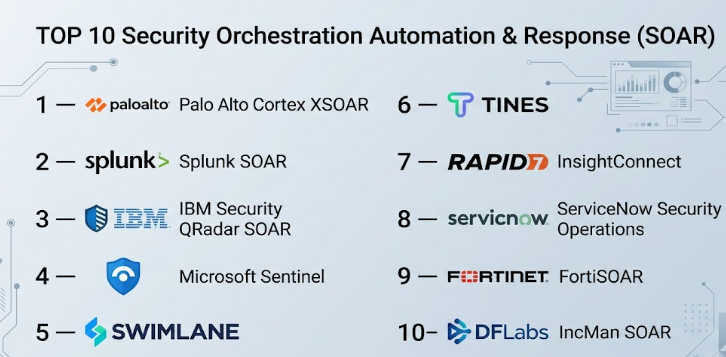
#1 — Palo Alto Cortex XSOAR
Short description: A leading enterprise-grade SOAR platform offering deep automation and integration capabilities, ideal for large SOC teams.
Key Features
- Advanced automation playbooks
- Incident management and case workflows
- Extensive integration marketplace
- Threat intelligence management
- AI-assisted investigations
- Collaboration tools for SOC teams
Pros
- Highly scalable for enterprises
- Extensive integrations
Cons
- Complex setup
- Steep learning curve
Platforms / Deployment
Cloud / Self-hosted / Hybrid
Security & Compliance
SSO, RBAC, encryption, audit logs; others Not publicly stated
Integrations & Ecosystem
Strong ecosystem with SIEM, EDR, and cloud tools
- Splunk
- AWS Security
- Microsoft Defender
- ServiceNow
Support & Community
Strong enterprise support; extensive documentation
#2 — Splunk SOAR
Short description: A powerful SOAR solution integrated within the Splunk ecosystem for advanced automation and analytics.
Key Features
- Visual playbook editor
- Event-driven automation
- Case management
- Threat intelligence integration
- Custom scripting support
Pros
- Seamless integration with Splunk SIEM
- Strong analytics capabilities
Cons
- Requires Splunk ecosystem for full value
- Pricing complexity
Platforms / Deployment
Cloud / Self-hosted
Security & Compliance
SSO, RBAC, encryption; others Not publicly stated
Integrations & Ecosystem
- Splunk Enterprise
- AWS
- CrowdStrike
- Okta
Support & Community
Large community; enterprise-level support
#3 — IBM Security QRadar SOAR
Short description: Enterprise SOAR platform designed for incident response automation and compliance-heavy industries.
Key Features
- Incident response workflows
- Threat intelligence integration
- Case management
- Compliance reporting
- Automation playbooks
Pros
- Strong compliance capabilities
- Enterprise reliability
Cons
- Complex UI
- Higher cost
Platforms / Deployment
Cloud / Self-hosted
Security & Compliance
GDPR alignment; others Not publicly stated
Integrations & Ecosystem
- QRadar SIEM
- Threat intelligence feeds
- Cloud security tools
Support & Community
Enterprise support; documentation available
#4 — Microsoft Sentinel (SOAR Capabilities)
Short description: Cloud-native SIEM with built-in SOAR capabilities leveraging Microsoft ecosystem.
Key Features
- Automated workflows (Logic Apps)
- AI-powered threat detection
- Cloud-native scalability
- Integration with Microsoft services
- Threat intelligence
Pros
- Strong cloud integration
- AI-driven insights
Cons
- Dependent on Azure ecosystem
- Limited standalone SOAR features
Platforms / Deployment
Cloud
Security & Compliance
MFA, RBAC, encryption; others Not publicly stated
Integrations & Ecosystem
- Azure services
- Microsoft Defender
- Office ecosystem
Support & Community
Strong documentation; large community
#5 — Swimlane
Short description: Low-code SOAR platform focusing on automation and analytics-driven security operations.
Key Features
- Low-code playbook builder
- Automation workflows
- Case management
- Data analytics integration
- Threat intelligence
Pros
- User-friendly interface
- Flexible automation
Cons
- Limited smaller ecosystem
- Requires customization
Platforms / Deployment
Cloud / Self-hosted
Security & Compliance
SSO, RBAC; others Not publicly stated
Integrations & Ecosystem
- SIEM tools
- Threat intelligence platforms
- APIs
Support & Community
Growing community; good support
#6 — Tines
Short description: Automation-first SOAR platform designed for flexibility and developer-friendly workflows.
Key Features
- Event-driven automation
- API-first architecture
- Low-code automation
- Scalable workflows
- Security automation
Pros
- Highly flexible
- Developer-friendly
Cons
- Requires technical expertise
- Less out-of-box templates
Platforms / Deployment
Cloud
Security & Compliance
Encryption, RBAC; others Not publicly stated
Integrations & Ecosystem
- APIs
- Security tools
- Custom integrations
Support & Community
Strong support; active user base
#7 — Rapid7 InsightConnect
Short description: SOAR platform integrated with Rapid7 ecosystem for automation and incident response.
Key Features
- Automation workflows
- Integration with Rapid7 tools
- Threat intelligence
- Case management
- Playbooks
Pros
- Strong integration with Rapid7
- Easy onboarding
Cons
- Limited outside ecosystem
- Moderate customization
Platforms / Deployment
Cloud
Security & Compliance
SSO, encryption; others Not publicly stated
Integrations & Ecosystem
- InsightIDR
- SIEM tools
- APIs
Support & Community
Good support; documentation available
#8 — ServiceNow Security Operations
Short description: SOAR capabilities embedded within ServiceNow for enterprise workflow automation.
Key Features
- Incident response workflows
- Automation playbooks
- Integration with ITSM
- Case management
- Threat intelligence
Pros
- Strong workflow automation
- ITSM integration
Cons
- Expensive
- Complex implementation
Platforms / Deployment
Cloud
Security & Compliance
RBAC, audit logs; others Not publicly stated
Integrations & Ecosystem
- ServiceNow ITSM
- Security tools
- APIs
Support & Community
Enterprise support; large ecosystem
#9 — Fortinet FortiSOAR
Short description: SOAR platform designed for automation and orchestration within Fortinet ecosystem.
Key Features
- Playbook automation
- Incident response
- Threat intelligence
- Integration with Fortinet tools
- Case management
Pros
- Strong Fortinet integration
- Scalable
Cons
- Ecosystem dependency
- Limited flexibility
Platforms / Deployment
Cloud / Self-hosted
Security & Compliance
Encryption, RBAC; others Not publicly stated
Integrations & Ecosystem
- Fortinet tools
- SIEM
- APIs
Support & Community
Vendor support available
#10 — DFLabs IncMan SOAR
Short description: SOAR platform focusing on incident response automation and orchestration.
Key Features
- Automated incident response
- Playbook automation
- Threat intelligence
- Case management
- Integration capabilities
Pros
- Strong automation focus
- Flexible workflows
Cons
- Smaller ecosystem
- Limited brand presence
Platforms / Deployment
Cloud / Self-hosted
Security & Compliance
Not publicly stated
Integrations & Ecosystem
- Security tools
- APIs
- Threat intelligence
Support & Community
Varies / Not publicly stated
Comparison Table (Top 10)
| Tool Name | Best For | Platform(s) Supported | Deployment | Standout Feature | Public Rating |
|---|---|---|---|---|---|
| Cortex XSOAR | Enterprise SOC | Web | Hybrid | Deep automation | N/A |
| Splunk SOAR | Splunk users | Web | Hybrid | Analytics integration | N/A |
| IBM QRadar SOAR | Compliance-heavy orgs | Web | Hybrid | Compliance workflows | N/A |
| Microsoft Sentinel | Cloud-first teams | Web | Cloud | AI-driven security | N/A |
| Swimlane | Low-code automation | Web | Hybrid | Easy playbooks | N/A |
| Tines | Developers | Web | Cloud | API-first automation | N/A |
| Rapid7 InsightConnect | Rapid7 users | Web | Cloud | Fast onboarding | N/A |
| ServiceNow SecOps | ITSM-driven orgs | Web | Cloud | Workflow automation | N/A |
| FortiSOAR | Fortinet users | Web | Hybrid | Ecosystem integration | N/A |
| DFLabs IncMan | Automation focus | Web | Hybrid | Incident automation | N/A |
Security Orchestration Automation & Response (SOAR)
| Tool Name | Core (25%) | Ease (15%) | Integrations (15%) | Security (10%) | Performance (10%) | Support (10%) | Value (15%) | Weighted Total |
|---|---|---|---|---|---|---|---|---|
| Cortex XSOAR | 9 | 7 | 9 | 8 | 9 | 9 | 7 | 8.4 |
| Splunk SOAR | 9 | 7 | 9 | 8 | 8 | 8 | 7 | 8.2 |
| IBM QRadar | 8 | 6 | 8 | 9 | 8 | 8 | 6 | 7.7 |
| Sentinel | 8 | 8 | 8 | 8 | 9 | 8 | 8 | 8.2 |
| Swimlane | 7 | 8 | 7 | 7 | 7 | 7 | 8 | 7.5 |
| Tines | 8 | 7 | 8 | 7 | 8 | 7 | 8 | 7.8 |
| InsightConnect | 7 | 8 | 7 | 7 | 7 | 7 | 8 | 7.5 |
| ServiceNow | 8 | 6 | 8 | 8 | 8 | 9 | 6 | 7.7 |
| FortiSOAR | 7 | 6 | 7 | 7 | 8 | 7 | 7 | 7.2 |
| DFLabs | 7 | 6 | 6 | 7 | 7 | 6 | 7 | 6.8 |
How to interpret scores:
These scores are comparative, not absolute. A higher score indicates better performance relative to others in this list. Enterprises may prioritize integration and security, while SMBs may focus on ease of use and value. Always validate based on your specific requirements.
Which Service Mesh Platforms Is Right for You?
Solo / Freelancer
- Not typically required
- Consider simpler security tools instead
SMB
- Best choices: Swimlane, InsightConnect
- Focus on ease of use and cost
Mid-Market
- Best choices: Tines, Sentinel
- Balance automation and scalability
Enterprise
- Best choices: Cortex XSOAR, Splunk SOAR, IBM QRadar
- Focus on integrations, compliance, scalability
Budget vs Premium
- Budget: InsightConnect, Swimlane
- Premium: Cortex XSOAR, ServiceNow
Feature Depth vs Ease of Use
- Feature-heavy: Cortex XSOAR, Splunk
- Easy-to-use: Swimlane, InsightConnect
Integrations & Scalability
- High integration: Splunk, Cortex XSOAR
- Moderate: Tines, Swimlane
Security & Compliance Needs
- High compliance: IBM QRadar, ServiceNow
- Moderate: Tines, InsightConnect
Security Orchestration Automation & Response (SOAR)
What is SOAR in cybersecurity?
SOAR platforms automate security workflows and incident response processes, improving efficiency and reducing manual effort.
How much do SOAR tools cost?
Pricing varies widely based on scale and features; typically enterprise pricing models apply.
Is SOAR only for large enterprises?
No, but it is most beneficial for organizations with complex security operations.
How long does implementation take?
Implementation can take weeks to months depending on complexity and integrations.
What are common mistakes when adopting SOAR?
Over-automation, poor playbook design, and lack of training are common issues.
Can SOAR replace SIEM?
No, SOAR complements SIEM by automating response rather than detection.
Are SOAR tools secure?
Most provide strong security features, but specifics vary by vendor.
Do SOAR tools support cloud environments?
Yes, many are cloud-native or support hybrid deployments.
How scalable are SOAR platforms?
Highly scalable, especially cloud-based solutions.
Can I switch SOAR tools easily?
Switching can be complex due to integrations and workflows.
Conclusion
Security Orchestration Automation & Response (SOAR) platforms have become essential for modern cybersecurity operations, helping organizations automate complex workflows and respond to threats faster. From enterprise-grade platforms like Cortex XSOAR and Splunk SOAR to flexible tools like Tines and Swimlane, the market offers solutions for different needs and scales. The “best” tool ultimately depends on your organization’s size, existing security stack, and automation maturity. Instead of chasing features alone, focus on integrations, ease of use, and long-term scalability. Start by shortlisting 2–3 tools that align with your environment, run a pilot, and validate how well they integrate with your current security ecosystem before making a final decision.
