Introduction
Multi-Factor Authentication (MFA) tools provide an additional layer of security by requiring users to verify their identity using two or more authentication factors—such as passwords, mobile devices, biometrics, or security tokens. This significantly reduces the risk of unauthorized access, even if credentials are compromised.
As cyber threats like phishing, credential stuffing, and account takeovers continue to rise, MFA has become a critical component of modern security strategies. Organizations rely on MFA to protect sensitive systems, ensure compliance, and maintain trust with users.
Common Use Cases
- Securing employee access to internal systems
- Protecting customer accounts in SaaS platforms
- Enabling secure remote work access
- Adding protection to financial and sensitive transactions
- Safeguarding APIs and cloud services
What Buyers Should Evaluate
- Supported authentication methods (OTP, biometrics, push notifications)
- Ease of deployment and user onboarding
- Integration with existing IAM or SSO systems
- Scalability across users and applications
- User experience and friction level
- Security features and compliance capabilities
- Device compatibility and platform support
- Reporting and monitoring features
- Pricing and licensing model
Best for: Enterprises, SaaS providers, financial institutions, and any organization handling sensitive data or requiring strong access security.
Not ideal for: Very small systems with minimal risk exposure or environments where user friction must be extremely low and risk is minimal.
Key Trends in Multi-Factor Authentication (MFA) Tools
- Passwordless authentication: Using biometrics or device-based login instead of passwords
- Push-based authentication: Simplifying user experience with mobile approvals
- Adaptive MFA: Risk-based authentication depending on user behavior
- Biometric authentication: Fingerprint and facial recognition integration
- Zero Trust integration: Continuous verification of identity
- Hardware security keys: Increased adoption for high-security environments
- Cloud-native MFA solutions: Designed for distributed systems
- AI-driven threat detection: Identifying unusual login patterns
- Seamless user experience improvements: Reducing login friction
How We Selected These Tools (Methodology)
- Market adoption and credibility
- Feature completeness across authentication methods
- Security strength and compliance readiness
- Integration capabilities with IAM and SSO systems
- Ease of use for both admins and end users
- Scalability across different environments
- Performance and reliability
- Support and documentation quality
- Innovation in authentication technologies
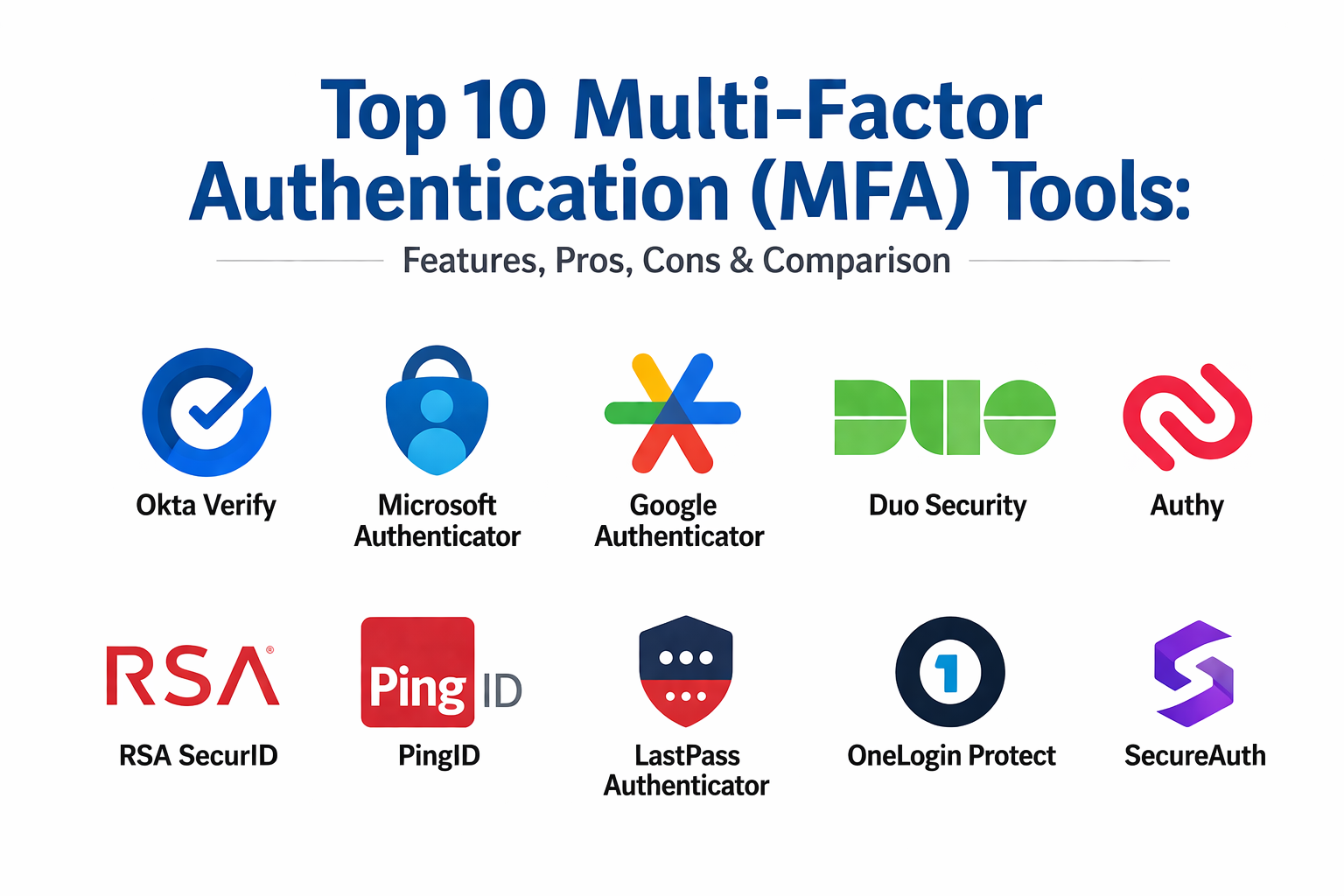
Top 10 Multi-Factor Authentication (MFA) Tools
#1 — Okta Verify
Short description: A widely used MFA solution integrated with Okta’s identity platform for secure authentication.
Key Features
- Push notifications
- One-time passwords (OTP)
- Biometric authentication
- Adaptive MFA
- Device trust management
Pros
- Strong integration with IAM systems
- Easy user experience
Cons
- Requires Okta ecosystem for full value
- Pricing can scale
Platforms / Deployment
Cloud / iOS / Android
Security & Compliance
MFA, encryption, RBAC. Additional details: Not publicly stated
Integrations & Ecosystem
- SaaS applications
- APIs
- Identity platforms
Support & Community
Strong enterprise support
#2 — Microsoft Authenticator
Short description: A widely adopted MFA app providing secure authentication within the Microsoft ecosystem.
Key Features
- Push authentication
- OTP generation
- Passwordless login
- Biometric support
- Account management
Pros
- Free and easy to use
- Strong Microsoft integration
Cons
- Best within Microsoft ecosystem
- Limited advanced customization
Platforms / Deployment
iOS / Android
Security & Compliance
Encryption, MFA. Additional details: Not publicly stated
Integrations & Ecosystem
- Microsoft services
- SaaS apps
Support & Community
Strong documentation
#3 — Google Authenticator
Short description: A simple and widely used OTP-based MFA tool for securing accounts.
Key Features
- Time-based OTP
- QR code setup
- Offline functionality
- Multi-account support
Pros
- Simple and reliable
- Works offline
Cons
- No push notifications
- Limited advanced features
Platforms / Deployment
iOS / Android
Security & Compliance
Not publicly stated
Integrations & Ecosystem
- Supports many services
Support & Community
Large user base
#4 — Duo Security
Short description: A comprehensive MFA solution offering strong security and user-friendly authentication.
Key Features
- Push authentication
- OTP
- Device trust
- Adaptive authentication
- Access policies
Pros
- Easy deployment
- Strong security features
Cons
- Pricing for advanced features
- Requires setup effort
Platforms / Deployment
Cloud / iOS / Android
Security & Compliance
MFA, encryption. Additional details: Not publicly stated
Integrations & Ecosystem
- SaaS apps
- APIs
- Security tools
Support & Community
Strong support and documentation
#5 — Authy
Short description: A user-friendly MFA app with multi-device support and cloud backup.
Key Features
- OTP generation
- Multi-device sync
- Cloud backup
- Offline access
- QR setup
Pros
- Easy to use
- Backup and recovery options
Cons
- Limited enterprise features
- Cloud dependency
Platforms / Deployment
iOS / Android / Desktop
Security & Compliance
Not publicly stated
Integrations & Ecosystem
- Supports multiple services
Support & Community
Strong user community
#6 — RSA SecurID
Short description: A hardware and software-based MFA solution for enterprise-grade security.
Key Features
- Hardware tokens
- Software tokens
- Risk-based authentication
- Identity assurance
- Access control
Pros
- High security
- Trusted in enterprises
Cons
- Expensive
- Complex deployment
Platforms / Deployment
Cloud / Hardware
Security & Compliance
Not publicly stated
Integrations & Ecosystem
- Enterprise systems
- APIs
Support & Community
Enterprise support
#7 — PingID
Short description: An MFA solution from Ping Identity offering adaptive authentication.
Key Features
- Push authentication
- OTP
- Biometric support
- Adaptive authentication
- Device trust
Pros
- Strong enterprise capabilities
- Flexible authentication methods
Cons
- Complex setup
- Premium pricing
Platforms / Deployment
Cloud / iOS / Android
Security & Compliance
Not publicly stated
Integrations & Ecosystem
- Identity platforms
- APIs
Support & Community
Enterprise support
#8 — LastPass Authenticator
Short description: An MFA tool offering OTP and push-based authentication with simple setup.
Key Features
- OTP generation
- Push authentication
- Backup options
- Multi-account support
Pros
- Easy to use
- Good integration with password manager
Cons
- Limited advanced features
- Security concerns historically
Platforms / Deployment
iOS / Android
Security & Compliance
Not publicly stated
Integrations & Ecosystem
- Password manager
- SaaS apps
Support & Community
Moderate support
#9 — OneLogin Protect
Short description: An MFA solution integrated with OneLogin identity platform.
Key Features
- Push authentication
- OTP
- Device fingerprinting
- Access policies
Pros
- Easy integration
- Good enterprise usability
Cons
- Limited standalone use
- Requires OneLogin
Platforms / Deployment
Cloud / iOS / Android
Security & Compliance
Not publicly stated
Integrations & Ecosystem
- SaaS apps
- Identity platform
Support & Community
Enterprise support
#10 — SecureAuth
Short description: An MFA platform focused on adaptive authentication and fraud prevention.
Key Features
- Adaptive MFA
- Risk-based authentication
- Biometric support
- Fraud detection
- Access control
Pros
- Strong security features
- Flexible authentication
Cons
- Complex setup
- Enterprise-focused pricing
Platforms / Deployment
Cloud / Hybrid
Security & Compliance
Not publicly stated
Integrations & Ecosystem
- APIs
- Security tools
Support & Community
Enterprise support
Comparison Table (Top 10)
| Tool Name | Best For | Platform(s) Supported | Deployment | Standout Feature | Public Rating |
|---|---|---|---|---|---|
| Okta Verify | Enterprise | Mobile | Cloud | Adaptive MFA | N/A |
| Microsoft Auth | Microsoft users | Mobile | Cloud | Passwordless login | N/A |
| Google Auth | Individuals | Mobile | Local | Offline OTP | N/A |
| Duo Security | SMB + Enterprise | Mobile | Cloud | Push authentication | N/A |
| Authy | Individuals | Mobile | Cloud | Backup support | N/A |
| RSA SecurID | Enterprise | Hardware | Hybrid | Hardware tokens | N/A |
| PingID | Enterprise | Mobile | Cloud | Adaptive authentication | N/A |
| LastPass Auth | SMB | Mobile | Cloud | Simple setup | N/A |
| OneLogin Protect | SMB | Mobile | Cloud | Identity integration | N/A |
| SecureAuth | Enterprise | Mobile | Hybrid | Risk-based MFA | N/A |
Evaluation & Scoring of Multi-Factor Authentication (MFA) Tools
| Tool Name | Core | Ease | Integrations | Security | Performance | Support | Value | Weighted Total |
|---|---|---|---|---|---|---|---|---|
| Okta Verify | 9 | 8 | 9 | 9 | 9 | 9 | 7 | 8.6 |
| Microsoft Auth | 8 | 9 | 8 | 8 | 8 | 8 | 9 | 8.4 |
| Google Auth | 7 | 10 | 7 | 7 | 8 | 7 | 10 | 8.0 |
| Duo Security | 9 | 8 | 8 | 9 | 9 | 9 | 7 | 8.5 |
| Authy | 7 | 9 | 7 | 7 | 8 | 7 | 9 | 7.9 |
| RSA SecurID | 9 | 6 | 8 | 9 | 8 | 8 | 6 | 8.0 |
| PingID | 9 | 7 | 8 | 9 | 8 | 8 | 7 | 8.1 |
| LastPass Auth | 7 | 9 | 7 | 7 | 7 | 7 | 9 | 7.8 |
| OneLogin Protect | 7 | 8 | 8 | 8 | 7 | 7 | 8 | 7.8 |
| SecureAuth | 9 | 6 | 8 | 9 | 8 | 8 | 6 | 8.0 |
How to interpret scores:
- Scores are comparative across tools
- Higher scores indicate stronger capabilities
- Enterprise tools excel in security
- Simpler tools excel in usability
- Choose based on your needs
Which Multi-Factor Authentication (MFA) Tool Is Right for You?
Solo / Freelancer
- Best: Google Authenticator, Authy
- Focus on simplicity
SMB
- Best: Duo Security, LastPass Authenticator
- Balance usability and features
Mid-Market
- Best: Okta Verify, PingID
- Need integrations and scalability
Enterprise
- Best: Duo Security, RSA SecurID, SecureAuth
- Advanced security requirements
Budget vs Premium
- Budget: Google Authenticator
- Premium: RSA SecurID
Feature Depth vs Ease of Use
- Deep features: RSA SecurID
- Easy use: Google Authenticator
Integrations & Scalability
- Strong integrations: Okta, Duo
- Moderate: Authy
Security & Compliance Needs
- Enterprise-grade: RSA, SecureAuth
- Basic: Google Authenticator
Frequently Asked Questions (FAQs)
What is MFA?
It requires multiple verification methods for login.
Why is MFA important?
It adds security beyond passwords.
Does MFA slow down login?
Modern MFA tools minimize delays.
Can MFA be bypassed?
Rare but possible with sophisticated attacks.
Is MFA expensive?
Some tools are free, others premium.
Can MFA work offline?
Some OTP-based tools can.
Is MFA required for compliance?
Often required in regulated industries.
Can I use multiple MFA tools?
Yes, depending on systems.
Does MFA work on mobile?
Yes, most tools are mobile-based.
When should I use MFA?
For any system requiring security.
Conclusion
Multi-Factor Authentication tools are a critical layer in modern security, helping organizations protect accounts and systems from unauthorized access. By combining multiple verification methods, MFA significantly reduces the risk of breaches caused by compromised credentials. The right solution depends on your environment—simple tools like Google Authenticator or Authy work well for individuals and small teams, while platforms like Duo Security, Okta Verify, and RSA SecurID provide advanced capabilities for enterprise environments. Choosing the right MFA tool involves balancing security, user experience, and integration needs, and the best approach is to test a solution that fits your workflow while ensuring strong protection without unnecessary complexity.
