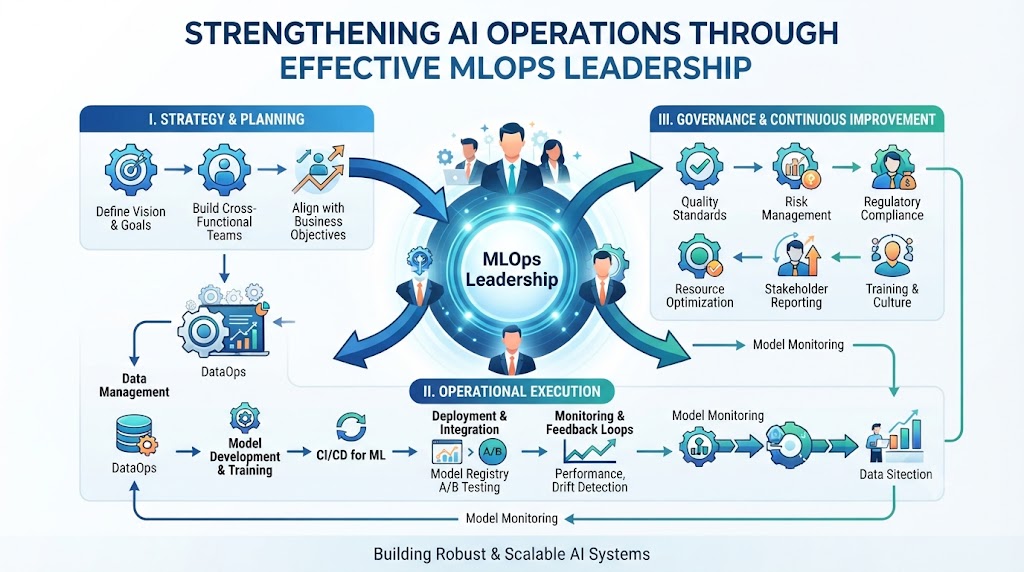
Introduction
In today’s fast-paced digital economy, software delivery requires robust automation, seamless infrastructure management, and intelligent operational workflows. To elevate your professional standing in this evolving domain, understanding specialized credentials is essential. This guide explores the Certified MLOps Manager framework, offering clarity on its value, structure, and career impact. Whether you are navigating platform engineering or cloud-native transformations, aiopsschool provides foundational resources to help you make informed career choices. For direct registration and official details, explore the Certified MLOps Manager page on aiopsschool.
What is the Certified MLOps Manager?
The Certified MLOps Manager represents a pinnacle of achievement in modern machine learning operations and infrastructure management. It exists to bridge the persistent gap between theoretical data science models and reliable, scalable production environments. This credential emphasizes real-world, production-focused learning over abstract academic theory to ensure operational excellence. It aligns seamlessly with modern engineering workflows, version control standards, and robust enterprise deployment practices. Professionals gain the exact methodologies needed to streamline model lifecycles and governance across complex cloud architectures.
Who Should Pursue Certified MLOps Manager?
This professional credential benefits software engineers, site reliability engineers, and cloud infrastructure professionals seeking specialization. It is equally valuable for data engineers, machine learning practitioners, and security specialists working within integrated enterprise teams. Beginners gain a structured roadmap into production AI, while experienced engineers validate their advanced architectural capabilities. Engineering managers and technical leaders also benefit by learning how to scale machine learning teams efficiently. Both global enterprises and fast-growing technology sectors in India recognize this credential as a mark of verified competency.
Why Certified MLOps Manager
Market demand for structured machine learning operations expertise continues to surge across global and regional enterprises. The longevity of this credential stems from its focus on foundational engineering principles rather than fleeting software tools. Enterprises rapidly adopt these practices to eliminate deployment bottlenecks, reduce operational risks, and maximize cloud investments. Earning this credential helps professionals stay relevant and adaptable despite rapid shifts in the technology toolchain. The high return on time and career investment makes it an indispensable asset for ambitious technical leaders.
Certified MLOps Manager Certification Overview
The program is delivered via Certified MLOps Manager and hosted on aiopsschool.com. Certification levels are structured logically to test both conceptual understanding and hands-on implementation capabilities. The assessment approach combines rigorous practical evaluations with comprehensive scenario-based questions to verify genuine competency. Ownership and program governance ensure high standards of curriculum relevance, alignment with industry changes, and technical accuracy. Candidates experience a transparent certification structure designed to support progressive skill acquisition from start to finish.
Certified MLOps Manager Certification Tracks & Levels
The foundation level establishes essential concepts in machine learning lifecycles, version control, and basic infrastructure automation. Professional levels dive deeper into continuous integration, continuous delivery pipelines, model monitoring, and automated retraining strategies. Advanced tracks focus on enterprise-wide governance, scaling distributed training systems, security compliance, and multi-cloud architectures. Specialized elective modules allow practitioners to tailor their learning toward infrastructure, security, or data pipelines. These progressive levels align directly with career progression from individual contributor to principal engineering and leadership roles.
Complete Certified MLOps Manager Certification Table
| Track | Level | Who it’s for | Prerequisites | Skills Covered | Recommended Order |
| Core MLOps | Foundation | Software and Data Engineers | Basic Python & Git | Pipeline Basics, CI/CD for ML | 1 |
| Production MLOps | Professional | MLOps and Cloud Engineers | Foundation Certificate | Model Monitoring, Feature Stores | 2 |
| Enterprise MLOps | Advanced | Technical Leads and Architects | Professional Certificate | Governance, Scalable Infrastructure | 3 |
Detailed Guide for Each Certified MLOps Manager Certification
Certified MLOps Manager – Foundation Certification
What it is
This entry-level certification validates foundational understanding of machine learning lifecycles and basic operational pipelines. It ensures candidates grasp version control for data and model artifacts effectively.
Who should take it
Software developers, junior data scientists, and cloud beginners seeking to enter the machine learning operations domain.
Skills you’ll gain
- Basic pipeline orchestration and automation principles
- Data versioning and artifact tracking techniques
- Containerization fundamentals for machine learning models
- Introductory continuous integration practices
Real-world projects you should be able to do
- Build a simple automated training pipeline using containerized scripts
- Implement basic data version control for a sample machine learning dataset
- Deploy a containerized model artifact to a staging environment
Preparation plan
- 7–14 days: Focus on foundational reading, terminology, and introductory pipeline concepts.
- 30 days: Complete hands-on coding labs, practice containerization, and review basic architecture diagrams.
- 60 days: Build end-to-end sample projects and participate in peer review study sessions.
Common mistakes
- Focusing solely on theoretical concepts without practicing hands-on coding and containerization.
- Ignoring data version control fundamentals while obsessing over complex deployment frameworks.
Best next certification after this
- Same-track option: Certified MLOps Manager Professional Level
- Cross-track option: Cloud Engineering Foundation Certificate
- Leadership option: Agile Engineering Management Certificate
Certified MLOps Manager – Professional Certification
What it is
This mid-level certification validates advanced capabilities in building robust production pipelines and automated monitoring systems. It proves a candidate can manage end-to-end model deployments in cloud environments.
Who should take it
Experienced DevOps engineers, MLOps practitioners, and cloud architects with hands-on production experience.
Skills you’ll gain
- Advanced continuous delivery pipelines for machine learning
- Automated model performance and data drift monitoring
- Feature store implementation and management
- Scalable model serving architecture design
Real-world projects you should be able to do
- Construct a fully automated CI/CD pipeline for model training and deployment
- Configure real-time alerts for data drift and model degradation in production
- Implement a centralized feature store for a multi-team data environment
Preparation plan
- 7–14 days: Review advanced monitoring strategies and automated deployment architecture patterns.
- 30 days: Implement complex CI/CD pipelines and configure mock monitoring alert systems.
- 60 days: Design, build, and stress-test a complete production-grade MLOps architecture from scratch.
Common mistakes
- Neglecting edge cases in model monitoring and data drift detection mechanisms.
- Overcomplicating pipeline architectures without establishing clear baseline performance metrics.
Best next certification after this
- Same-track option: Certified MLOps Manager Advanced Level
- Cross-track option: Certified Site Reliability Engineer Professional
- Leadership option: Director of Platform Engineering Credential
Choose Your Learning Path
DevOps Path
The DevOps path focuses on bridging software development and IT operations through robust automation practices. Practitioners learn to build reliable deployment pipelines, manage containerized infrastructure, and streamline software delivery lifecycles. This path serves as the essential bedrock for modern cloud-native engineering and platform scalability. Engineers following this route master continuous integration, configuration management, and system observability tools.
DevSecOps Path
The DevSecOps path embeds security seamlessly into every phase of the software development and deployment lifecycle. Professionals learn vulnerability assessment, automated compliance checking, and secure infrastructure-as-code management practices. This track equips teams to detect and mitigate security risks early in development pipelines. Graduates become vital assets in safeguarding enterprise applications against evolving cyber threats and vulnerabilities.
SRE Path
The Site Reliability Engineering path emphasizes system availability, latency reduction, performance optimization, and incident management. Engineers learn to apply software engineering principles to solve complex operational and infrastructure challenges. This track teaches error budgeting, service level objectives, and automated remediation strategies for large systems. Practitioners ensure enterprise applications maintain high resilience under massive production traffic loads.
AIOps / MLOps Path
The AIOps / MLOps path integrates machine learning workflows with robust operational automation and monitoring frameworks. Professionals master model versioning, automated training pipelines, drift detection, and scalable inference serving architectures. This track addresses the unique challenges of deploying and maintaining artificial intelligence models in production. Practitioners ensure machine learning systems deliver reliable, secure, and business-critical value at scale.
DataOps Path
The DataOps path applies agile and DevOps principles to data engineering and analytics pipeline management. Professionals learn to automate data integration, quality testing, storage optimization, and governance workflows. This track accelerates the delivery of clean, reliable data assets to downstream consumers and machine learning models. Graduates streamline enterprise data architectures for maximum operational efficiency and insight generation.
FinOps Path
The FinOps path introduces financial accountability and cloud cost optimization to engineering and management teams. Professionals learn to analyze cloud expenditure, allocate costs accurately, and implement resource efficiency strategies. This track bridges the gap between technical cloud usage and business financial goals. Practitioners help organizations maximize their cloud return on investment without sacrificing performance.
Role → Recommended Certified MLOps Manager Certifications
| Role | Recommended Certifications |
| DevOps Engineer | Certified MLOps Manager Foundation Level |
| SRE | Certified MLOps Manager Professional Level |
| Platform Engineer | Certified MLOps Manager Enterprise Level |
| Cloud Engineer | Certified MLOps Manager Foundation Level |
| Security Engineer | Certified MLOps Manager Professional Level |
| Data Engineer | Certified MLOps Manager Foundation Level |
| FinOps Practitioner | Certified MLOps Manager Enterprise Level |
| Engineering Manager | Certified MLOps Manager Advanced Leadership Track |
Next Certifications to Take After Certified MLOps Manager
Same Track Progression
Deep specialization allows professionals to master niche technical domains within their chosen career track. Candidates can advance from professional credentials to expert-level architecture and governance certifications. This progression deepens technical authority, enabling engineers to solve complex architectural challenges in enterprise settings. Continued specialization ensures sustained relevance and opens doors to principal engineering roles.
Cross-Track Expansion
Skill broadening enables professionals to diversify their expertise across complementary technical disciplines. An MLOps engineer might pursue security or site reliability certifications to build well-rounded operational capabilities. This multi-disciplinary approach enhances collaboration across different engineering silos within modern organizations. Cross-track expansion creates versatile leaders who understand the entire cloud-native ecosystem.
Leadership & Management Track
Transitioning to leadership involves moving from individual technical execution to strategic organizational management. Professionals can pursue executive technical management certifications focusing on team scaling, budgeting, and governance. This track prepares senior engineers to lead enterprise-wide digital transformations and manage high-performing technical departments. Leadership credentials validate managerial acumen alongside deep technical expertise.
Training & Certification Support Providers for Certified MLOps Manager
DevOpsSchool is a globally recognized training provider offering comprehensive educational programs across various technical domains. Their curriculum emphasizes hands-on practical learning, real-world scenario execution, and expert-led mentorship. Students benefit from structured learning paths designed to prepare them thoroughly for professional certification assessments. The institution maintains high training standards to support career growth for engineers worldwide.
Cotocus delivers specialized technology training and consulting services tailored for modern enterprise engineering teams. They focus on bridging theoretical knowledge with practical implementation skills in cloud-native technologies. Their expert instructors bring extensive industry experience to help students master complex operational workflows. Cotocus supports professionals in achieving career milestones through rigorous, industry-aligned certification programs.
Scmgalaxy serves as a premier community and learning hub for software configuration management and automation. They provide targeted educational resources, tutorials, and certification preparation courses for technical professionals. Their programs highlight best practices in version control, pipeline automation, and collaborative development. Scmgalaxy empowers engineers to build efficient, scalable workflows in diverse corporate environments.
BestDevOps offers focused training programs designed to accelerate professional growth in modern engineering practices. Their courses cover essential topics including continuous integration, containerization, and infrastructure automation. The platform prioritizes practical, job-ready skills that candidates can immediately apply in production environments. BestDevOps helps bridge the skills gap for aspiring cloud and operations professionals globally.
devsecopsschool specializes in security-focused training programs integrated directly into software development pipelines. They educate professionals on vulnerability management, automated compliance, and secure coding practices. Their curriculum equips engineers to build resilient, threat-resistant architectures across cloud platforms. Devsecopsschool plays a vital role in fostering security-first mindsets within modern technical teams.
sreschool provides dedicated training for site reliability engineering and production system resilience. Their courses cover incident management, performance monitoring, error budgeting, and automation strategies. Instructors emphasize practical problem-solving to help engineers maintain high system availability. Sreschool prepares technical professionals to handle complex enterprise infrastructure challenges with confidence.
aiopsschool focuses on advanced training in artificial intelligence operations and machine learning lifecycle management. Their programs teach automated model deployment, performance monitoring, and scalable infrastructure design. The platform bridges the gap between data science and reliable production engineering workflows. Aiopsschool equips professionals to lead successful machine learning initiatives in enterprise environments.
dataopsschool offers specialized education in agile data engineering and pipeline automation practices. Their curriculum covers data integration, quality testing, storage management, and governance frameworks. Students learn to build efficient, reliable data pipelines for downstream analytics and machine learning. Dataopsschool empowers data professionals to maximize the operational value of corporate information assets.
finopsschool delivers targeted training on cloud financial management and cost optimization strategies. Their programs teach engineers and managers how to analyze, allocate, and optimize cloud expenditure effectively. The curriculum bridges technical cloud utilization with business financial accountability and governance. Finopsschool helps organizations achieve sustainable cloud economics without compromising system performance.
Frequently Asked Questions (General)
1. How difficult are these certification exams?
The certification exams are rigorous and designed to test both conceptual knowledge and practical problem-solving abilities. Candidates with relevant hands-on experience generally find them manageable with dedicated preparation.
2. What is the recommended time commitment for preparation?
Preparation times vary based on prior experience, typically ranging from two to eight weeks of consistent study. Dedicating one to two hours daily yields optimal retention and skill mastery.
3. Are there strict prerequisites for taking these exams?
Some foundation levels have minimal prerequisites, while professional and advanced tiers require foundational certification or equivalent experience. Reviewing specific track guidelines ensures candidates meet all necessary criteria before enrolling.
4. What is the return on investment for these credentials?
Certifications validate verified competency, often leading to career advancement, salary increments, and expanded leadership opportunities. Employers highly value certified professionals for their demonstrated ability to handle production environments.
5. How should candidates sequence multiple certifications?
Candidates should start with foundation tracks before progressing to professional and specialized enterprise levels. This logical sequencing builds a strong, cohesive knowledge base over time.
6. Do these certifications hold value globally?
Yes, these credentials are recognized and respected by international enterprises and technology leaders across various regions. They provide a universal benchmark of technical proficiency.
7. Can beginners with no prior experience pursue these paths?
Beginners can start with foundation-level courses designed to teach essential terminology and basic operational principles. Consistent hands-on practice helps bridge initial knowledge gaps effectively.
8. How often are the exam syllabi updated?
Syllabi are reviewed and updated regularly to reflect emerging industry tools, security standards, and architectural best practices. This ensures certified professionals remain relevant in a fast-changing technology landscape.
9. What format do the certification assessments follow?
Assessments typically combine multiple-choice conceptual questions with scenario-based practical evaluations. This hybrid format ensures a comprehensive assessment of candidate capabilities.
10. How do these credentials help in daily engineering tasks?
The structured learning approach equips engineers with standardized methodologies to troubleshoot issues faster and build robust pipelines. Practical labs translate directly into improved efficiency on the job.
11. Are study materials provided upon registration?
Official registration includes access to comprehensive study guides, practice labs, and resource documentation. These materials support structured preparation throughout the learning journey.
12. How can engineering managers benefit from these programs?
Managers gain a clear framework to evaluate team capabilities, standardize operational practices, and guide strategic technology adoption. This leadership knowledge improves overall departmental productivity and alignment.
FAQs on Certified MLOps Manager
1. What core competencies does Certified MLOps Manager validate?
It validates expertise in managing machine learning lifecycles, automated model deployment, monitoring, and scalable infrastructure governance.
2. How does this credential differ from standard data science certifications?
While data science certifications focus on model accuracy and algorithms, this credential emphasizes production operations, reliability, and automation.
3. Is programming experience required to pursue this certification?
Basic programming knowledge, particularly in Python and version control systems, is recommended for successful completion.
4. What role do automated monitoring modules play in the curriculum?
Automated monitoring modules teach candidates how to detect data drift, model degradation, and pipeline failures proactively in production.
5. How does the certification address model governance and compliance?
It covers standardized practices for tracking model lineage, audit trails, and regulatory compliance across enterprise deployments.
6. Can teams use these guidelines for internal corporate training?
Organizations frequently utilize these structured tracks to upskill their internal engineering teams and standardize operational workflows.
7. What infrastructure tools are typically covered in the labs?
Labs cover industry-standard containerization, orchestration, version control, and CI/CD tools commonly used in enterprise cloud environments.
8. How do employers verify the authenticity of the certification?
Employers can easily verify credentials through official digital badges and registry verification links provided upon successful completion.
Final Thoughts: Is Certified MLOps Manager Worth It?
Investing time and effort into professional credentials requires careful evaluation of your career goals and current skill set. The Certified MLOps Manager framework provides a structured, unbiased path to mastering production-grade machine learning operations. It cuts through marketing hype to focus on practical, enterprise-tested engineering principles that endure tool changes. If you are serious about elevating your technical authority and delivering scalable AI solutions, this credential offers substantial value. Approach your learning journey with dedication, embrace hands-on practice, and position yourself for long-term career growth.
