Introduction
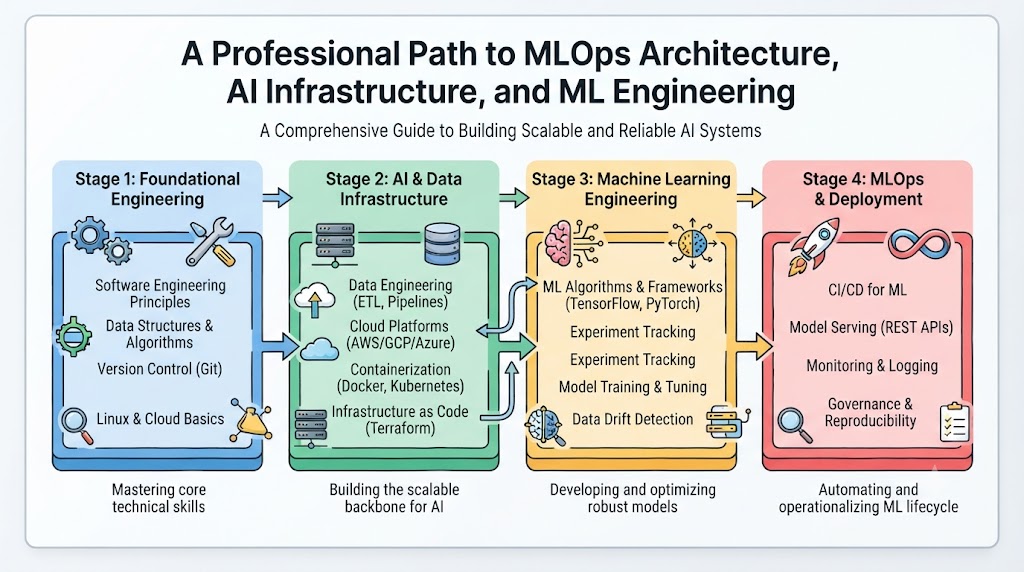
Certified MLOps Architect is a premier professional credential built to validate advanced competence in designing, building, and operating production-grade machine learning systems. This guide is crafted for software developers, site reliability engineers, and technical leaders who want to bridge the gap between experimental data science and resilient enterprise infrastructure. In modern cloud-native environments, moving artificial intelligence models from local laptops to reliable production pipelines demands cross-functional collaboration. This guide helps professionals make confident career decisions by breaking down what the certification involves, who it benefits most, and how it accelerates long-term platform engineering journeys. You can explore the official program details directly at aiopsschool hosted on aiopsschool.
What is the Certified MLOps Architect?
Certified MLOps Architect stands as the definitive benchmark for proving practical mastery in machine learning operations and pipeline automation. It exists to solve the widespread industry hurdle where machine learning models stall in isolated environments instead of reaching reliable production. The curriculum prioritizes hands-on, production-grade execution over abstract concepts, ensuring candidates master continuous delivery, integration, and training cycles. It integrates seamlessly with modern cloud-native patterns, infrastructure-as-code automation, and stringent enterprise security standards. By concentrating on scalability, observability, and cost management, it equips engineers to oversee the entire lifecycle of enterprise AI applications.
Who Should Pursue Certified MLOps Architect?
This credential empowers software developers pivoting into specialized infrastructure roles, as well as seasoned DevOps and SRE professionals expanding into artificial intelligence. Cloud architects, security analysts, and data practitioners will discover immense value in learning how to govern and secure distributed machine learning workloads. Technical leaders and engineering managers pursuing this path can guide their teams through complex automation and model deployment strategies with confidence. The syllabus offers profound global relevance while addressing the rapid acceleration of AI initiatives across enterprises in India and worldwide. Beginners with strong system administration fundamentals alongside veteran architects will find clear pathways to validate their expertise.
Why Certified MLOps Architect
The soaring demand for dependable artificial intelligence applications has turned production-grade operations into one of today’s most vital technical disciplines. This credential delivers enduring career longevity by anchoring itself in core architectural principles rather than fleeting tools or vendor-specific platforms. Enterprise adoption of machine learning is scaling rapidly, creating an acute shortage of practitioners who understand both application reliability and data workflows. Holding this certification keeps you relevant despite shifting industry trends by proving deep comprehension of system design and automation. The return on investment in time and energy is outstanding, placing certified leaders at the forefront of modern platform engineering transformations.
Certified MLOps Architect Certification Overview
The program is delivered via aiopsschool and hosted on aiopsschool. It features multiple certification levels structured to evaluate both conceptual understanding and practical implementation capabilities. The testing model includes rigorous lab challenges, architectural reviews, and scenario-based problem-solving evaluations. Ownership and curriculum design are driven by working practitioners who tackle production machine learning hurdles daily. The structure guarantees that successful graduates possess the exact competencies required to build fault-tolerant, scalable, and secure operational environments for enterprise AI.
Certified MLOps Architect Certification Tracks & Levels
The foundation level establishes core competencies in model containerization, basic pipeline versioning, and introductory infrastructure automation. The professional level dives deep into advanced pipeline orchestration, automated testing suites, and robust model monitoring frameworks. The advanced level targets multi-cloud architectures, enterprise governance, security hardening, and large-scale distributed training clusters. Specialization tracks branch into infrastructure automation, platform reliability, and data governance to accommodate diverse career trajectories. These progressive tiers map directly to professional growth, guiding engineers from individual contributors to principal architects and directors.
Complete Certified MLOps Architect Certification Table
| Track | Level | Who it’s for | Prerequisites | Skills Covered | Recommended Order |
| MLOps Infrastructure | Foundation | Junior DevOps and Data Engineers | Basic Linux and Python | Model packaging, basic CI/CD, containerization | 1 |
| MLOps Engineering | Professional | Experienced Software and DevOps Engineers | Foundation Level or 2 years experience | Pipeline automation, model registry, monitoring | 2 |
| MLOps Architecture | Advanced | Lead Architects and Technical Managers | Professional Level or 5 years experience | Multi-cloud scaling, governance, security | 3 |
Detailed Guide for Each Certified MLOps Architect Certification
Certified MLOps Architect – Foundation Level
What it is
This entry-level certification validates your foundational grasp of machine learning containerization, basic pipeline versioning, and deployment principles. It ensures you understand how software engineering practices intersect with machine learning workflows in straightforward environments.
Who should take it
Software developers moving into data platforms, junior DevOps engineers, and data scientists seeking to understand production deployment basics should pursue this. Required experience is minimal, focusing on basic command-line and programming fluency.
Skills you’ll gain
- Packaging machine learning models using Docker containers
- Managing code and data version control using Git and DVC
- Establishing basic continuous integration pipelines for scripts
- Deploying simple inference APIs using lightweight frameworks
Real-world projects you should be able to do
- Containerize a regression model and expose it as a REST API
- Set up a basic version-controlled data pipeline for a compact dataset
- Automate code linting and testing for a machine learning repository
Preparation plan
- 7 to 14 days: Review Linux fundamentals, Docker containerization basics, and introductory Python scripting.
- 30 days: Build small end-to-end local pipelines connecting model training with a containerized inference endpoint.
- 60 days: Practice mock assessments, review container security basics, and study foundational version control workflows.
Common mistakes
- Treating machine learning code identically to standard web code without accounting for data dependencies.
- Disregarding environment reproducibility in favor of local machine configurations.
- Skipping practical lab exercises in favor of reading theoretical documentation.
Best next certification after this
- Same-track option: Certified MLOps Architect Professional Level
- Cross-track option: Certified DevOps Engineer Professional
- Leadership option: Certified Engineering Manager in AI
Certified MLOps Architect – Professional Level
What it is
This credential validates advanced proficiency in designing automated machine learning pipelines, implementing robust model monitoring, and managing feature stores. It centers on scalability, reproducibility, and operational efficiency in production.
Who should take it
Mid-to-senior DevOps engineers, machine learning engineers, and platform architects with solid experience in cloud platforms. The goal is to prove your capacity to manage complex, end-to-end production machine learning systems.
Skills you’ll gain
- Architecting automated continuous training and delivery pipelines
- Implementing comprehensive model drift and data quality monitoring
- Managing centralized feature stores and model registries at scale
- Integrating security scanning into machine learning artifacts
Real-world projects you should be able to do
- Build a fully automated training and deployment pipeline using orchestrators like Kubeflow or Airflow
- Implement automated drift detection that triggers retraining alerts in production
- Configure a secure enterprise model registry with granular access controls
Preparation plan
- 7 to 14 days: Deep dive into pipeline orchestration tools and model monitoring concepts.
- 30 days: Build and deploy a multi-stage machine learning pipeline with automated testing and rollback mechanisms.
- 60 days: Study advanced distributed training concepts, caching strategies, and large-scale infrastructure troubleshooting.
Common mistakes
- Failing to establish automated testing for data schemas alongside code testing.
- Neglecting resource optimization, leading to excessively high cloud compute costs for training.
- Overcomplicating pipeline architectures before establishing basic monitoring baselines.
Best next certification after this
- Same-track option: Certified MLOps Architect Advanced Level
- Cross-track option: Certified SRE Professional
- Leadership option: Certified Enterprise AI Director
Certified MLOps Architect – Advanced Level
What it is
This expert-level credential validates mastery in designing multi-region, highly available, secure, and cost-effective machine learning platforms at enterprise scale. It emphasizes governance, compliance, and architectural leadership.
Who should take it
Principal architects, lead platform engineers, and technical directors responsible for enterprise AI strategy. Ideal candidates possess extensive experience deploying and managing large-scale distributed systems.
Skills you’ll gain
- Architecting multi-cloud and hybrid machine learning platforms
- Designing robust governance, auditing, and compliance frameworks for AI
- Optimizing enterprise infrastructure costs for heavy GPU workloads
- Leading cross-functional teams through complex AI infrastructure migrations
Real-world projects you should be able to do
- Design a multi-region disaster recovery architecture for enterprise inference endpoints
- Implement an automated compliance and auditing framework for sensitive data usage in models
- Optimize large cluster resource allocation to reduce GPU idle time by significant margins
Preparation plan
- 7 to 14 days: Review multi-cloud networking, enterprise governance standards, and advanced cost management frameworks.
- 30 days: Design comprehensive enterprise reference architectures for high-throughput AI workloads.
- 60 days: Engage in advanced architectural reviews, failure mode analysis, and security hardening workshops.
Common mistakes
- Designing overly complex architectures that ignore developer experience and operational overhead.
- Neglecting compliance and data privacy regulations during multi-region expansion.
- Failing to align infrastructure scalability plans with business ROI projections.
Best next certification after this
- Same-track option: Certified AI Infrastructure Principal
- Cross-track option: Certified FinOps Cloud Architect
- Leadership option: Certified Chief Technology Officer Track
Choose Your Learning Path
DevOps Path
The DevOps path focuses on mastering infrastructure automation, continuous integration, and continuous delivery pipelines tailored for software and data systems. Professionals learn to provision scalable cloud environments using infrastructure-as-code tools like Terraform and Ansible. This path builds a strong foundation in containerization, system reliability, and configuration management across diverse deployment targets. Engineers gain the expertise required to streamline release cycles and maintain high availability in enterprise production environments. Completing this path ensures seamless collaboration between development, testing, and operational teams.
DevSecOps Path
The DevSecOps path integrates rigorous security practices directly into every stage of the software and machine learning development lifecycle. Practitioners learn to automate vulnerability scanning, manage secrets securely, and implement strict identity and access management controls. This track emphasizes compliance as code, ensuring that infrastructure and model artifacts meet stringent regulatory requirements from inception. Professionals master threat modeling, security monitoring, and incident response procedures specific to cloud-native ecosystems. This path creates security champions capable of safeguarding complex distributed architectures against modern cyber threats.
SRE Path
The Site Reliability Engineering path equips professionals with the skills needed to design ultra-reliable, scalable, and fault-tolerant production systems. Learners focus on defining service level objectives, error budgets, and implementing comprehensive observability through metrics, logs, and traces. This track teaches advanced incident management, automated remediation, and chaotic engineering practices to stress-test live environments. Engineers learn to eliminate toil through automation and capacity planning for unpredictable workload spikes. This path is essential for organizations demanding continuous uptime and exceptional user experience across global platforms.
AIOps / MLOps Path
The AIOps / MLOps path bridges the gap between data science experimentation and enterprise-grade infrastructure reliability and automation. Learners focus on model packaging, automated feature engineering, pipeline orchestration, and continuous training frameworks. This track addresses unique challenges like data drift, model degradation, and GPU resource optimization in production. Professionals master tools that enable rapid, safe iteration of machine learning models without compromising system stability. This path empowers engineers to build scalable platforms that accelerate artificial intelligence delivery securely.
DataOps Path
The DataOps path focuses on improving the quality, speed, and collaboration of data analytics and data engineering pipelines. Practitioners learn to apply agile development and automated testing principles to data ingestion, transformation, and storage workflows. This track emphasizes data observability, lineage tracking, and efficient storage management across enterprise data lakes and warehouses. Professionals gain expertise in orchestrating complex data flows that feed downstream analytics and machine learning systems. This path ensures organizations maintain reliable, high-integrity data assets ready for enterprise consumption.
FinOps Path
The FinOps path empowers engineers and financial leaders to master cloud financial management and cost optimization strategies. Learners discover how to allocate cloud costs accurately, identify idle resources, and implement tagging governance across enterprise accounts. This track teaches advanced budgeting, forecasting, and rate optimization techniques for complex compute and storage workloads. Professionals learn to foster a culture of financial accountability without slowing down engineering velocity or innovation. This path is crucial for maximizing return on cloud investment in rapidly scaling modern enterprises.
Role → Recommended Certified MLOps Architect Certifications
| Role | Recommended Certifications |
| DevOps Engineer | Certified MLOps Architect Foundation Level |
| SRE | Certified MLOps Architect Professional Level |
| Platform Engineer | Certified MLOps Architect Professional Level |
| Cloud Engineer | Certified MLOps Architect Foundation Level |
| Security Engineer | Certified MLOps Architect Professional Level |
| Data Engineer | Certified MLOps Architect Foundation Level |
| FinOps Practitioner | Certified MLOps Architect Advanced Level |
| Engineering Manager | Certified MLOps Architect Advanced Level |
Next Certifications to Take After Certified MLOps Architect
Same Track Progression
Progressing along the same track involves moving from professional implementations to advanced enterprise architectures and specialized domains. You can dive deeper into specialized sub-fields such as distributed model training infrastructure, edge AI operations, or secure federated learning systems. This vertical growth solidifies your standing as a subject matter expert capable of solving the most complex industry challenges. It prepares you to lead technical standardization and architectural governance across large enterprise engineering departments.
Cross-Track Expansion
Cross-track expansion allows you to broaden your skill set by acquiring credentials in complementary disciplines like Site Reliability Engineering, FinOps, or Cloud Security. Understanding how machine learning infrastructure interacts with cloud cost management and platform reliability makes you a more versatile architect. This horizontal growth enables you to bridge communication gaps between disparate engineering teams and drive holistic operational excellence. Employers highly value multi-disciplinary architects who can oversee complex, interconnected cloud-native ecosystems.
Leadership and Management Track
Transitioning to the leadership and management track enables you to steer organizational AI strategy, engineering culture, and talent development. Certifications in this tier focus on enterprise budgeting, risk management, stakeholder communication, and high-level technical governance. You will learn to align engineering roadmaps with overarching business objectives and drive large-scale digital transformations. This path is ideal for senior architects stepping into director, VP, or Chief Technology Officer roles.
Training & Certification Support Providers for Certified MLOps Architect
DevOpsSchool delivers comprehensive training programs and expert-led mentorship tailored for professionals aiming to master modern software delivery and infrastructure automation. Their curriculum combines rigorous theoretical foundations with extensive hands-on lab exercises designed to simulate real-world enterprise production challenges. Participants benefit from experienced instructors who bring decades of industry knowledge directly into the virtual or classroom learning environment.
Cotocus provides specialized enterprise coaching and certification bootcamps focused on cloud-native technologies, automation, and reliability engineering. Their programs are meticulously designed to help working professionals upskill efficiently while balancing demanding daily responsibilities and project deadlines. Cotocus emphasizes practical project execution, ensuring candidates gain confidence in handling complex distributed systems.
Scmgalaxy stands out as a premier hub for community-driven learning, resource sharing, and professional development in configuration management and DevOps practices. They offer structured guidance and curated learning paths that help engineers navigate the overwhelming landscape of modern tooling. Their collaborative approach fosters continuous growth and peer-to-peer knowledge exchange.
BestDevOps delivers targeted training modules and certification preparation courses focused on bridging skill gaps in modern software operations. Their courses are structured for maximum clarity, breaking down intricate architectural concepts into digestible, practical lessons. Learners appreciate the focus on industry best practices and reproducible engineering patterns.
devsecopsschool focuses exclusively on embedding security into the core of software and platform engineering pipelines. Their training empowers engineers to master vulnerability management, compliance automation, and threat modeling in cloud-native environments. The curriculum bridges the traditional divide between development and security teams effectively.
sreschool provides deep, specialized training in site reliability engineering, observability, and incident management methodologies. Their programs teach engineers how to build resilient systems, define meaningful error budgets, and automate operational toil away. The practical labs reflect real production outages and recovery scenarios.
aiopsschool is the premier destination for advanced training in machine learning operations, artificial intelligence infrastructure, and automated pipelines. Their expert-led courses guide professionals through the entire lifecycle of enterprise AI deployment, monitoring, and scaling. The programs ensure participants stay ahead in the rapidly evolving landscape of intelligent automation.
dataopsschool offers specialized instruction in streamlining data engineering workflows, data quality assurance, and pipeline orchestration. Their training helps organizations build robust, reliable data foundations required for advanced analytics and artificial intelligence applications. Participants learn industry-standard patterns for data observability.
finopsschool delivers expert guidance on cloud financial management, cost allocation, and resource optimization for modern enterprises. Their training programs teach engineers and financial leaders how to balance innovation velocity with strict budgetary control. Learners gain actionable strategies for maximizing cloud return on investment.
Frequently Asked Questions
1. How challenging is the Certified MLOps Architect examination to pass?
The examination is rigorous and designed to test practical problem-solving skills rather than rote memorization. Candidates with solid hands-on experience in cloud infrastructure and machine learning pipelines will find it challenging yet achievable with proper preparation.
2. What formal prerequisites are required prior to registration?
Basic proficiency in Linux, Python programming, containerization tools like Docker, and fundamental cloud concepts are strongly recommended before starting your preparation journey.
3. What is the average timeframe needed to prepare for the certification?
Preparation time varies based on your existing experience, but most working professionals dedicate between four to eight weeks of consistent study and lab practice to feel fully prepared.
4. What tangible return on investment can one expect from this credential?
Certified professionals frequently report accelerated career advancement, higher earning potential, and enhanced credibility when leading critical enterprise artificial intelligence initiatives.
5. Are the certification exams administered online or at a testing center?
All certification assessments are conducted online through secure proctoring platforms, allowing candidates to complete their examinations remotely with flexible scheduling options.
6. How frequently is the certification curriculum reviewed and refreshed?
The curriculum undergoes regular quarterly reviews and annual updates to incorporate emerging industry standards, new tool integrations, and evolving enterprise best practices.
7. Can beginners lacking a data science background enroll in this certification?
While basic familiarity with machine learning concepts helps, the primary focus is on infrastructure, operations, and architecture, making it accessible to experienced DevOps engineers.
8. What style of practical labs are integrated into the curriculum?
Labs cover building automated CI/CD pipelines for models, configuring drift monitoring systems, setting up feature stores, and securing multi-node training clusters.
9. How does this credential compare against standard cloud certifications?
Unlike general cloud credentials, this program focuses specifically on the intersection of machine learning workflows, data dependencies, and robust production infrastructure.
10. Is ongoing professional development required to maintain active certification status?
Yes, maintaining the credential requires earning continuing education credits or passing a renewal assessment every two years to ensure up-to-date knowledge.
11. What assistance channels are accessible if preparation roadblocks arise?
Enrolled participants gain access to dedicated mentor channels, peer discussion forums, and comprehensive troubleshooting guides provided throughout the learning journey.
12. How can prospective employers verify the validity of earned credentials?
Upon successful completion, you receive a secure digital badge and a unique verification link that employers can use to instantly validate your credential.
FAQs on Certified MLOps Architect
1. Why does architectural design outweigh tool familiarity in MLOps success?
Tools evolve rapidly, but foundational architectural principles like reproducibility, scalability, and modularity remain constant and ensure long-term career stability.
2. How does the program address multi-cloud deployment strategies?
The curriculum includes dedicated modules on abstracting infrastructure layers to enable seamless model deployment across AWS, GCP, and Azure environments.
3. What part does data governance play at the advanced certification tier?
Data governance is treated as a core pillar, covering lineage tracking, privacy compliance, access controls, and auditability for sensitive enterprise datasets.
4. Can this certification facilitate a pivot from software engineering to AI infrastructure?
Yes, it provides a structured pathway that leverages your existing software engineering skills and applies them directly to machine learning system reliability.
5. How are GPU cost reduction strategies taught during the training?
Labs teach efficient scheduling, spot instance utilization, model quantization techniques, and autoscaling configurations to minimize heavy infrastructure expenses.
6. What differentiates model monitoring from conventional application monitoring?
Model monitoring requires tracking data drift, concept drift, and prediction accuracy metrics in addition to standard CPU, memory, and latency metrics.
7. How does the syllabus address security vulnerabilities unique to machine learning?
It covers protecting against data poisoning, adversarial attacks, model inversion, and securing serialized model artifacts against unauthorized tampering.
8. How should technical managers utilize this certification for team growth?
Engineering managers use the framework to establish standardized deployment workflows, improve cross-functional collaboration, and elevate overall system reliability.
Final Thoughts: Is Certified MLOps Architect Worth It?
Investing your time and energy into the Certified MLOps Architect program is a pragmatic decision for anyone serious about mastering enterprise artificial intelligence infrastructure. The industry is flooded with surface-level tutorials, but true production success requires deep architectural rigor, reliability engineering, and robust automation. This credential cuts through the marketing noise and focuses entirely on practical skills that solve real-world engineering bottlenecks. If you want to future-proof your career, command high-value projects, and lead the next wave of intelligent system design, this certification provides an unmatched roadmap. Approach your studies with dedication, focus on hands-on lab execution, and apply these principles directly to elevate your engineering career.
