Introduction
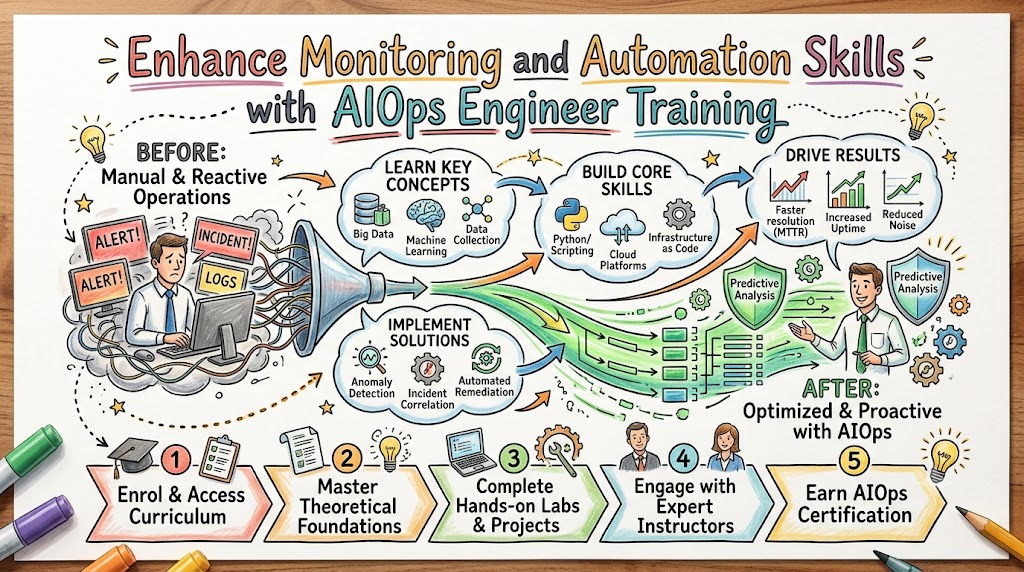
The modern IT landscape is scaling beyond human capacity, making automated, intelligent operations an absolute necessity. This guide on the Certified AIOps Engineer program is designed for software engineers, site reliability engineers, and technical leaders who need to navigate this shift. By integrating artificial intelligence and machine learning into traditional deployment pipelines, professionals can drastically reduce mean time to resolution and eliminate operational noise. This comprehensive walkthrough provides the clarity needed to evaluate the certification, align it with your career goals, and map out an actionable learning trajectory.
The entire educational program is officially hosted on the aiopsschool platform, which serves as the central hub for training and assessment. Navigating your career through DevOps, cloud-native frameworks, and platform engineering requires a clear understanding of where intelligent automation fits into your existing skill set. This guide acts as an unbiased roadmap to help you invest your time and resources into skills that yield long-term professional returns.
What is the Certified AIOps Engineer?
The Certified AIOps Engineer designation represents a professional benchmark for engineers who design, implement, and maintain intelligent operations pipelines. It exists because traditional, static threshold alerting cannot keep pace with dynamic, ephemeral microservices running in cloud-native environments. This program prioritizes real-world, production-focused learning over abstract academic theory, ensuring that candidates understand how to manage live enterprise infrastructure.
By focusing on practical implementation, the certification validates an engineer’s ability to ingest massive streams of telemetry data and derive actionable insights. It aligns directly with modern enterprise workflows by teaching professionals how to deploy machine learning models that predict system degradation before it impacts end users. This shift from reactive firefighting to proactive, automated remediation is the core philosophy driving the creation of this certification standard.
Who Should Pursue Certified AIOps Engineer?
This certification program is built specifically for systems engineers, site reliability professionals, cloud architects, and data engineers who manage complex infrastructure. Infrastructure beginners can use it to build a modern foundation, while seasoned engineers can leverage it to transition out of manual scripting into intelligent system architecture. Technical managers and enterprise leaders will also benefit by gaining the vocabulary and strategic overview needed to steer organizational digital transformation initiatives.
From a global perspective, the demand for automated operations spans across every major tech hub, with massive adoption observed across both Western enterprises and the rapidly expanding tech ecosystem in India. Organizations globally are looking to optimize their engineering overhead, making these skills highly relevant across geographic boundaries. Anyone responsible for system uptime, infrastructure cost optimization, or deployment velocity will find direct value in this curriculum.
Why Certified AIOps Engineer
The sheer volume of logs, metrics, and traces generated by modern distributed systems has made manual analysis obsolete, ensuring long-term enterprise demand for this skill set. Attaining this certification proves that a professional can outlast shifting tool trends by mastering the underlying architecture of data ingestion, anomaly detection, and automated incident response. It offers a sustainable career buffer against commoditization by focusing on high-level architectural intelligence rather than simple script configuration.
The return on time and career investment is realized through increased operational efficiency, reduced system downtime, and a clear differentiation in the job market. Enterprises are actively seeking engineers who can lower operational overhead through algorithmic noise reduction rather than hiring linear headcounts. By aligning your capabilities with this enterprise need, you position yourself for high-impact roles that directly influence organizational profitability and engineering velocity.
Certified AIOps Engineer Certification Overview
The structured educational program is delivered completely through the official online platform hosted on the aiopsschool website. The certification process utilizes a rigorous, practical assessment approach designed to verify hands-on troubleshooting capabilities alongside conceptual architectural knowledge. This ensures that a certified individual is fully prepared to handle real-world infrastructure anomalies immediately upon earning the credential.
The ownership of the curriculum is maintained by industry practitioners who regularly update the material to mirror evolving operational standards and open-source advancements. The structure is broken down into modular phases, allowing candidates to master telemetry ingestion before moving on to complex algorithmic correlation and automated remediation loops. This systematic approach guarantees a comprehensive understanding of the entire intelligent operations lifecycle.
Certified AIOps Engineer Certification Tracks & Levels
The certification framework is divided into distinct operational tiers, starting with foundation tracks that establish core concepts surrounding telemetry data and basic statistical modeling. The professional level builds upon these fundamentals by introducing multi-source data correlation, predictive alerting, and complex root-cause analysis engines. Advanced tracks push into deep architectural design, autonomous self-healing workflows, and large-scale model orchestration across multi-cloud environments.
These specialized levels are designed to align closely with standard engineering career progression, mapping out a clear path from execution-focused roles to strategic leadership. Engineers can choose tracks that emphasize specific domains such as performance monitoring, security orchestration, or financial cloud optimization. This flexibility allows professionals to customize their educational journey based on their day-to-day organizational responsibilities and long-term career aspirations.
Complete Certified AIOps Engineer Certification Table
| Track | Level | Who it’s for | Prerequisites | Skills Covered | Recommended Order |
| Operations Foundation | Associate | Systems Administrators, Junior DevOps | Basic Linux, Python, Monitoring concepts | Telemetry collection, Log aggregation, Basic alerting | First |
| Intelligent SRE | Professional | Site Reliability Engineers, Cloud Engineers | Operations Foundation, 2+ Years Cloud experience | Anomaly detection, Event correlation, Root-cause analysis | Second |
| Enterprise Architecture | Advanced | Principal Engineers, Infrastructure Architects | Intelligent SRE, Deep distributed systems knowledge | Autonomous self-healing, ML model lifecycle, Multi-cloud scale | Third |
Detailed Guide for Each Certified AIOps Engineer Certification
Certified AIOps Engineer – Associate Level
What it is
This certification validates an engineer’s foundational ability to configure modern observability pipelines and handle basic event ingestion patterns. It proves that the candidate understands how to transform raw infrastructure logs and metrics into structured data streams ready for algorithmic processing.
Who should take it
This track is ideal for junior operations engineers, system administrators, and application developers who want to understand the foundational shift from static monitoring to intelligent observability.
Skills you’ll gain
- Configuration of open-source data collectors and shippers.
- Structured log parsing and metrics normalization techniques.
- Implementation of dynamic thresholding baselines.
- Basic Python scripting for telemetry data manipulation.
Real-world projects you should be able to do
- Build a centralized logging pipeline that aggregates data from a distributed microservices application and filters out operational noise.
- Establish a dynamic monitoring dashboard that adjusts alerting thresholds based on historical weekly time-series patterns.
Preparation plan
- 7 Days: Focus exclusively on mastering core observability concepts, understanding the pillars of telemetry (metrics, logs, traces), and practicing basic data serialization formats.
- 30 Days: Set up local sandboxes using open-source telemetry tools, practice writing scripts to parse unstructured logs, and complete all fundamental lab assignments.
- 60 Days: Conduct mock examinations, review edge-case scenarios in data ingestion failures, and validate lab architectures against performance best practices.
Common mistakes
- Relying too heavily on theoretical definitions without configuring actual data ingestion pipelines in a lab environment.
- Neglecting the fundamentals of regular expressions and data parsing, which leads to broken telemetry streams during practical testing.
Best next certification after this
- Same-track option: Certified AIOps Engineer – Professional Level
- Cross-track option: Cloud Infrastructure Specialist
- Leadership option: Technical Team Lead Foundations
Certified AIOps Engineer – Professional Level
What it is
This certification validates a professional’s expertise in deploying machine learning models for real-time anomaly detection, event correlation, and root-cause analysis. It serves as proof that the engineer can drastically reduce alert fatigue within complex, high-velocity production environments.
Who should take it
This level is designed for experienced DevOps engineers, site reliability practitioners, and cloud architects who manage multi-tiered application environments and complex alerting systems.
Skills you’ll gain
- Deployment and tuning of unsupervised machine learning models for anomaly detection.
- Implementation of event correlation engines to group related alerts into single incidents.
- Automated root-cause analysis mapping using topology graphs.
- Development of automated webhook triggers for initial incident response.
Real-world projects you should be able to do
- Deploy an anomaly detection system that identifies subtle memory leaks in a cluster before standard threshold alerts trigger.
- Build an automated event suppression pipeline that collapses thousands of cascading network alerts into a single actionable ticket.
Preparation plan
- 7 Days: Deep dive into algorithmic operational theories, focusing on time-series clustering, correlation algorithms, and topology mapping principles.
- 30 Days: Implement real-time correlation engines in a test environment, feeding simulated incident storms to validate the suppression logic.
- 60 Days: Optimize model parameters to reduce false positives, practice complex troubleshooting scenarios, and review enterprise architectural patterns.
Common mistakes
- Failing to understand the math behind correlation algorithms, leading to poorly tuned models that generate excessive false negatives.
- Overlooking the importance of clean, normalized metadata across different infrastructure layers when building topology maps.
Best next certification after this
- Same-track option: Certified AIOps Engineer – Advanced Level
- Cross-track option: Advanced MLOps Architect
- Leadership option: Engineering Manager Operations
Certified AIOps Engineer – Advanced Level
What it is
This certification validates a candidate’s mastery over autonomous self-healing infrastructure design and enterprise-wide operational data strategy. It proves the ability to architect resilient, self-correcting systems that run across heterogeneous multi-cloud environments.
Who should take it
This program is reserved for principal engineers, infrastructure architects, and senior technical leaders who dictate operational strategy and design planetary-scale systems.
Skills you’ll gain
- Designing closed-loop automated remediation workflows for complex distributed systems failures.
- Orchestrating large-scale machine learning model lifecycles optimized for streaming operational data.
- Architecting distributed, high-throughput streaming telemetry grids that process petabytes of operational data.
- Establishing operational governance, cost management, and system compliance through algorithmic guardrails.
Real-world projects you should be able to do
- Architect a fully automated self-healing system that detects regional cloud outages, shifts traffic, and spins up optimized replacement infrastructure without human intervention.
- Design an enterprise telemetry lake that ingests, cleans, and stores global infrastructure data while maintaining strict data governance and optimizing storage tiers.
Preparation plan
- 7 Days: Review high-level enterprise design patterns, focusing on distributed systems consensus, event streaming architectures, and model governance frameworks.
- 30 Days: Build end-to-end closed-loop remediation workflows in a multi-cloud lab environment, testing failure scenarios across edge cases.
- 60 Days: Fine-tune system performance under high data loads, perform rigorous architectural reviews of complex case studies, and complete advanced simulation drills.
Common mistakes
- Creating brittle remediation scripts that introduce feedback loops, which can inadvertently accelerate or worsen systemic infrastructure failures.
- Disregarding the cost and storage implications of storing massive volumes of long-term telemetry data within cloud environments.
Best next certification after this
- Same-track option: Continuous Architectural Innovation Research
- Cross-track option: Enterprise Cloud FinOps Director
- Leadership option: Director of Infrastructure Engineering
Choose Your Learning Path
DevOps Path
The integration of intelligent operations into the continuous integration and deployment pipeline transforms how software delivery is managed. Engineers on this path focus on embedding telemetry collection and automated testing analytics directly into the software build cycle. This ensures that performance anomalies are caught during canary deployments or staging phases before they reach the general user base. By automating feedback loops from production back to development, engineers can drastically increase release velocity while maintaining system stability.
DevSecOps Path
Security operations benefit immensely from the pattern recognition and behavioral analysis inherent in intelligent infrastructure frameworks. This path emphasizes the ingestion of security logs, access traces, and compliance audits into real-time analytical engines to identify malicious actors. Instead of waiting for static signature matches, professionals learn to detect subtle behavioral deviations that indicate zero-day exploits or credential compromise. Automated remediation plays are then structured to isolate compromised nodes or revoke tokens instantaneously upon detection.
SRE Path
Site reliability engineering relies heavily on maintaining strict service level objectives while managing complex, distributed architectures. This learning path focuses directly on reducing the mean time to resolution through automated event correlation and deep incident root-cause analysis. SREs learn to move away from static dashboard monitoring into algorithmic health indexing, allowing them to predict failures before they impact consumers. The path centers on building resilient infrastructure that utilizes automated, closed-loop remediation strategies to maintain system availability.
AIOps Path
This specific pathway guides professionals through the intricacies of building, deploying, and maintaining machine learning models tailored exclusively for operational data. Candidates focus deeply on time-series forecasting, algorithmic noise reduction, and the management of streaming telemetry lakes at scale. The emphasis is placed on selecting the right statistical models for varied infrastructure topologies and ensuring model accuracy over extended timeframes. This path bridges the gap between pure data science and practical, real-world systems engineering.
MLOps Path
Managing the lifecycle of machine learning models in production requires robust, repeatable engineering pipelines that match standard software delivery models. This track teaches engineers how to automate the training, deployment, versioning, and monitoring of models used across the enterprise. It addresses critical production issues such as data drift, concept drift, and model performance degradation over time within live microservices clusters. Professionals completing this path ensure that the underlying intelligent infrastructure supporting business logic remains accurate and reliable.
DataOps Path
Intelligent operations are entirely dependent on the quality, velocity, and reliability of the underlying data pipelines feeding the analytical engines. This path centers on building high-throughput, fault-tolerant telemetry data streams capable of handling massive volumes of unstructured log and metric data. Engineers learn to implement real-time data cleansing, transformation, and schema enforcement across distributed ingestion layers. This guarantees that the machine learning models receive consistent, high-fidelity inputs, preventing flawed conclusions derived from corrupted data.
FinOps Path
Cloud financial management requires real-time visibility into resource utilization, waste identification, and allocation anomalies across multi-cloud environments. This pathway teaches professionals how to apply algorithmic analysis to cloud billing metrics and resource consumption patterns simultaneously. Engineers learn to automatically identify underutilized infrastructure, predict future spend trajectories, and flag unexpected cost spikes caused by misconfigured services. This ensures that organizations can optimize their infrastructure footprints dynamically without compromising application performance.
Role → Recommended Certified AIOps Engineer Certifications
| Role | Recommended Certifications |
| DevOps Engineer | Certified AIOps Engineer – Associate Level, Operations Foundation Track |
| SRE | Certified AIOps Engineer – Professional Level, Intelligent SRE Track |
| Platform Engineer | Certified AIOps Engineer – Professional Level, Intelligent SRE Track |
| Cloud Engineer | Certified AIOps Engineer – Associate Level, Operations Foundation Track |
| Security Engineer | Certified AIOps Engineer – Professional Level, DevSecOps Integration Track |
| Data Engineer | Certified AIOps Engineer – Professional Level, DataOps Infrastructure Track |
| FinOps Practitioner | Certified AIOps Engineer – Associate Level, Cloud Cost Optimization Track |
| Engineering Manager | Certified AIOps Engineer – Advanced Level, Enterprise Architecture Track |
Next Certifications to Take After Certified AIOps Engineer
Same Track Progression
After achieving initial benchmarks, deep specialization within intelligent operations involves mastering advanced algorithmic model orchestration and large-scale telemetry stream processing. This involves moving deeply into custom machine learning architecture design, where models are tailored specifically to unique, highly proprietary corporate infrastructure setups. Professionals pursuing this route focus on optimizing algorithmic performance, minimizing computing overhead for analytical engines, and advancing long-term architectural scaling strategies.
Cross-Track Expansion
Broadening your engineering impact requires combining operational intelligence with complementary disciplines such as advanced cloud architecture, secure service meshes, or data engineering pipelines. Earning adjacent credentials allows you to bridge structural gaps within engineering organizations, ensuring that telemetry and automated insights are native to every layer of the technology stack. This cross-pollination of skills creates a highly versatile professional capable of leading complex multi-disciplinary cloud initiatives.
Leadership & Management Track
Transitioning from pure technical execution to strategic leadership requires a focus on operational governance, risk mitigation, and team scaling methodologies. Professionals moving down this path learn to translate technical operational metrics—such as noise reduction percentages and incident mitigation speeds—into clear business metrics like capital expenditure savings and customer retention numbers. The focus shifts toward building efficient engineering cultures, managing vendor relationships, and directing comprehensive digital transformation roadmaps.
Training & Certification Support Providers for Certified AIOps Engineer
DevOpsSchool offers deep structured bootcamps and guided laboratory environments designed to help engineers transition traditional deployment methodologies into highly automated infrastructure pipelines. The curriculum focuses heavily on hands-on tool validation, continuous integration adjustments, and real-world delivery patterns required across modern enterprise setups.
Cotocus provides targeted, experience-driven training programs focused on cloud-native migrations, containerization orchestration strategies, and high-velocity platform engineering techniques. Their educational approach emphasizes direct system debugging, infrastructure configuration mastery, and architectural implementation scenarios built for production scales.
Scmgalaxy serves as an extensive knowledge repository and training center catering to professionals seeking mastery over configuration management, build automation, and version control systems. Their instructional modules focus on creating repeatable, robust software supply chains and optimizing delivery mechanics.
BestDevOps delivers practical, hands-on educational courses designed to upskill traditional infrastructure teams into modern, code-driven delivery units. Their training structures focus on real-world case studies, implementation best practices, and the daily tooling operations used across leading modern technology enterprises.
devsecopsschool focuses exclusively on embedding comprehensive security compliance, vulnerability analysis, and automated threat detection mechanisms directly into standard engineering pipelines. Their programs ensure that security becomes an automated, continuous process rather than a late-stage architectural bottleneck.
sreschool specializes in reliability engineering mechanics, teaching professionals how to establish resilient system designs, manage error budgets effectively, and construct robust incident mitigation paths. The curriculum centers on maximizing system uptime across highly unpredictable distributed cloud-native environments.
aiopsschool acts as the core foundational platform delivering specific instructional blueprints, streaming data lab exercises, and model deployment strategies tailored to intelligent system orchestration. The provider focuses entirely on algorithmic operational patterns, telemetry normalization, and automated remediation.
dataopsschool focuses on the complex engineering required to build, manage, and scale high-throughput data delivery pipelines for analytics and machine learning applications. Their instruction ensures data high availability, schema validation, and real-time processing stability across enterprise operations.
finopsschool delivers structured financial cloud management educational frameworks that bridge the operational gap between cloud architecture decisions and enterprise finance strategies. Their training modules teach professionals how to dynamically track, analyze, and optimize infrastructure spend across complex cloud footprints.
Frequently Asked Questions (General)
- What is the primary difference between standard infrastructure monitoring and intelligent operations engineering?Standard monitoring relies entirely on static, pre-configured thresholds that trigger alerts when specific limits are breached. Intelligent operations utilize machine learning algorithms to analyze historical patterns, automatically adjusting alert baselines and identifying anomalies based on behavioral deviations rather than rigid numbers.
- How much programming experience is required to successfully clear this certification assessment?Candidates should possess a solid working knowledge of programming, with Python being the preferred language for most operational scripting. You need to be comfortable writing scripts to parse data streams, interact with web APIs, and manipulate JSON or YAML data structures efficiently.
- Can an infrastructure beginner directly attempt the professional-level certification tracks?It is highly recommended to start with the associate level or possess at least two years of direct cloud operations experience before attempting professional tracks. The higher-level assessments assume a deep familiarity with real-world infrastructure failures that beginners typically have not encountered.
- How long does it typically take an experienced systems engineer to prepare for the final evaluation?An engineer with a strong background in standard DevOps practices can comfortably prepare for the certification assessment within forty-five to sixty days of consistent, dedicated study and laboratory practice.
- Are the laboratory environments provided during the training phase representative of actual enterprise scale?Yes, the training labs simulate multi-tier microservices architectures experiencing artificial incident storms, network latency, and resource degradation to mimic real-world production issues.
- Does this certification focus on specific proprietary software tools or open-source solutions?The curriculum focuses heavily on open-source standards and vendor-neutral architectural patterns, ensuring that the skills gained are fully transferable across various proprietary enterprise platforms.
- How frequently are the certification exam blueprints updated to match industry shifts?The operational exam blueprints are reviewed and revised annually by a committee of active industry practitioners to incorporate emerging cloud-native methodologies and streaming data advancements.
- What is the passing score requirement for the practical and theoretical components of the exam?Candidates must achieve a minimum score of seventy percent on both the conceptual knowledge exam and the hands-on practical troubleshooting lab to earn the credential.
- Is there a renewal requirement to keep the certification active over an extended career?Yes, the certification remains valid for a period of three years, after which professionals must complete a recertification assessment or submit proof of continuing professional education.
- How does this certification directly benefit an engineering manager who no longer writes daily production code?It provides technical managers with the strategic framework and vocabulary needed to evaluate automation tooling, estimate operational resource needs, and lead large-scale digital transformation initiatives.
- Are there specific prerequisites regarding cloud platform certifications before attempting this program?There are no formal vendor-specific prerequisites, but a solid understanding of fundamental cloud concepts (AWS, Azure, or GCP) is highly beneficial for the infrastructure components.
- What style of questions can candidates expect to encounter during the theoretical phase of testing?The theoretical exam consists of scenario-based multiple-choice questions that require you to analyze architectural failures, interpret telemetry data snippets, and select appropriate algorithmic solutions.
FAQs on Certified AIOps Engineer
- How does the Certified AIOps Engineer curriculum specifically address the issue of alert fatigue in large enterprise environments?The training program focuses extensively on teaching engineers how to deploy event correlation engines and algorithmic noise reduction frameworks. Candidates learn to group thousands of disparate downstream alerts into single, clear structural incidents based on time-series proximity and system topology. This methodology filters out the ambient operational noise that causes engineering burnout, allowing response teams to focus exclusively on systemic root causes rather than chasing individual symptomatic alerts across disparate dashboards.
- Does the program include training on building autonomous self-healing workflows for cloud infrastructure?Yes, advanced levels of the program detail the construction of closed-loop automated remediation systems. Engineers learn how to safely map specific analytical outputs to automated deployment scripts, webhooks, and orchestration commands. This enables the infrastructure to resolve common, predictable issues—such as disk clearing, service restarts, and traffic rerouting—without requiring manual human intervention during off-hours operations.
- What specific machine learning concepts must a Certified AIOps Engineer master to pass the examinations?Candidates do not need to be pure data scientists, but they must master the practical application of unsupervised machine learning models. This includes understanding time-series forecasting, clustering algorithms, principal component analysis for dimensionality reduction, and behavioral anomaly detection models. The focus is entirely on selecting, deploying, tuning, and monitoring these models against streaming operational infrastructure telemetry data.
- How are topology graphs used within the technical frameworks taught throughout this certification?Topology graphs serve as the foundational map for real-time root-cause analysis within distributed applications. The curriculum teaches engineers how to dynamically generate and maintain dependency maps across microservices, databases, and network layers. When an anomaly occurs, the analytical engines trace the failure propagation path through the topology graph to pinpoint the exact originating source component.
- Can the skills learned during this course be applied directly to legacy on-premise infrastructure setups?While the curriculum is designed with cloud-native, containerized architectures in mind, the underlying principles of telemetry ingestion and data correlation apply universally. Any infrastructure environment capable of exporting structured log streams, time-series metrics, and trace data can be integrated into the intelligent operations pipelines taught throughout the certification program.
- What role does real-time streaming data processing play in the daily responsibilities of a certified individual?Streaming data processing is central to the role, as intelligent operations rely on real-time insights rather than batch processing. Engineers are trained to design high-throughput ingestion pipelines that process metrics and log streams instantly as they occur. This minimal latency ensures that anomalies are caught within seconds of emergence, preventing widespread system degradation.
- How does the certification validate an engineer’s ability to manage machine learning model drift over time?The professional and advanced assessment paths include specific scenarios testing a candidate’s ability to detect data and concept drift. Engineers must demonstrate how to monitor model accuracy against live infrastructure shifts and establish automated retraining pipelines to ensure alerting precision remains high as application baselines evolve naturally.
- Is this certification recognized by global technology enterprises and consulting firms?Yes, enterprises globally recognize the credential because it bridges the critical skills gap between traditional infrastructure engineering and practical data science application. Organizations value the rigorous, hands-on testing structure, which ensures that certified individuals can immediately contribute to complex corporate automation and reliability initiatives.
Final Thoughts: Is Certified AIOps Engineer Worth It?
Navigating the transition from traditional infrastructure management to intelligent, automated systems is a significant milestone in an engineer’s career. This certification offers a structured, production-focused path to mastering the complex intersection of telemetry data, machine learning, and systems architecture. By avoiding short-term tool hype and focusing deeply on core algorithmic principles, the program provides long-term professional utility.
For engineers looking to elevate their daily operations out of repetitive firefighting, or managers aiming to optimize enterprise engineering velocity, this credential serves as a clear, validated roadmap. The investment in understanding intelligent operations pays direct dividends by aligning your technical capabilities with the modern scale of global enterprise infrastructure.
