Introduction
An Electronic Lab Notebook (ELN) is a digital platform used by scientists, researchers, and lab teams to record, organize, and manage experimental data. Instead of writing notes in paper notebooks, ELNs allow users to store structured data, protocols, results, and observations in a searchable and secure digital format.
In today’s research-driven environment, ELNs are becoming essential. Labs are generating massive amounts of data, collaborating across geographies, and facing strict compliance requirements. ELNs help streamline workflows, ensure data integrity, and enable better collaboration. With AI-driven features and integrations becoming common, ELNs are evolving into full research data platforms.
Common use cases include:
- Pharmaceutical R&D documentation and compliance tracking
- Academic research data recording and sharing
- Quality control and testing labs
- Biotech experiment tracking and collaboration
- Industrial R&D and product development
Key evaluation criteria buyers should consider:
- Ease of use and learning curve
- Data organization and search capabilities
- Security and compliance support
- Integration with lab instruments and systems
- Collaboration and sharing features
- Scalability and performance
- Customization and workflow automation
- Cost and licensing model
Best for: Research scientists, lab managers, pharma companies, biotech startups, academic institutions, and regulated industries handling complex experimental data.
Not ideal for: Small teams with minimal documentation needs, or environments where simple spreadsheets or note-taking tools are sufficient.
Key Trends in Electronic Lab Notebook (ELN)
- AI-powered experiment insights: Automated data analysis, anomaly detection, and recommendations.
- Cloud-first adoption: Increased shift to cloud ELNs for remote collaboration and scalability.
- Regulatory compliance focus: Strong emphasis on audit trails, data integrity, and electronic signatures.
- Integration with LIMS and instruments: Seamless connection with lab systems and IoT devices.
- Collaboration-first design: Real-time sharing, commenting, and version control.
- Mobile accessibility: Access and data entry via tablets and smartphones.
- Data standardization: Structured templates for consistent experiment recording.
- API-driven ecosystems: Open APIs for integration with enterprise systems.
- Subscription pricing models: Shift from perpetual licenses to SaaS-based pricing.
- Security-first architecture: Encryption, role-based access, and compliance frameworks.
How We Selected These Tools (Methodology)
- Evaluated market adoption and brand recognition across industries
- Assessed feature completeness for research workflows
- Reviewed performance and reliability indicators
- Analyzed security and compliance readiness
- Checked integration capabilities and ecosystem maturity
- Considered ease of use and onboarding experience
- Ensured coverage across enterprise and SMB segments
- Evaluated customer feedback trends (qualitative)
- Included tools with active development and innovation focus
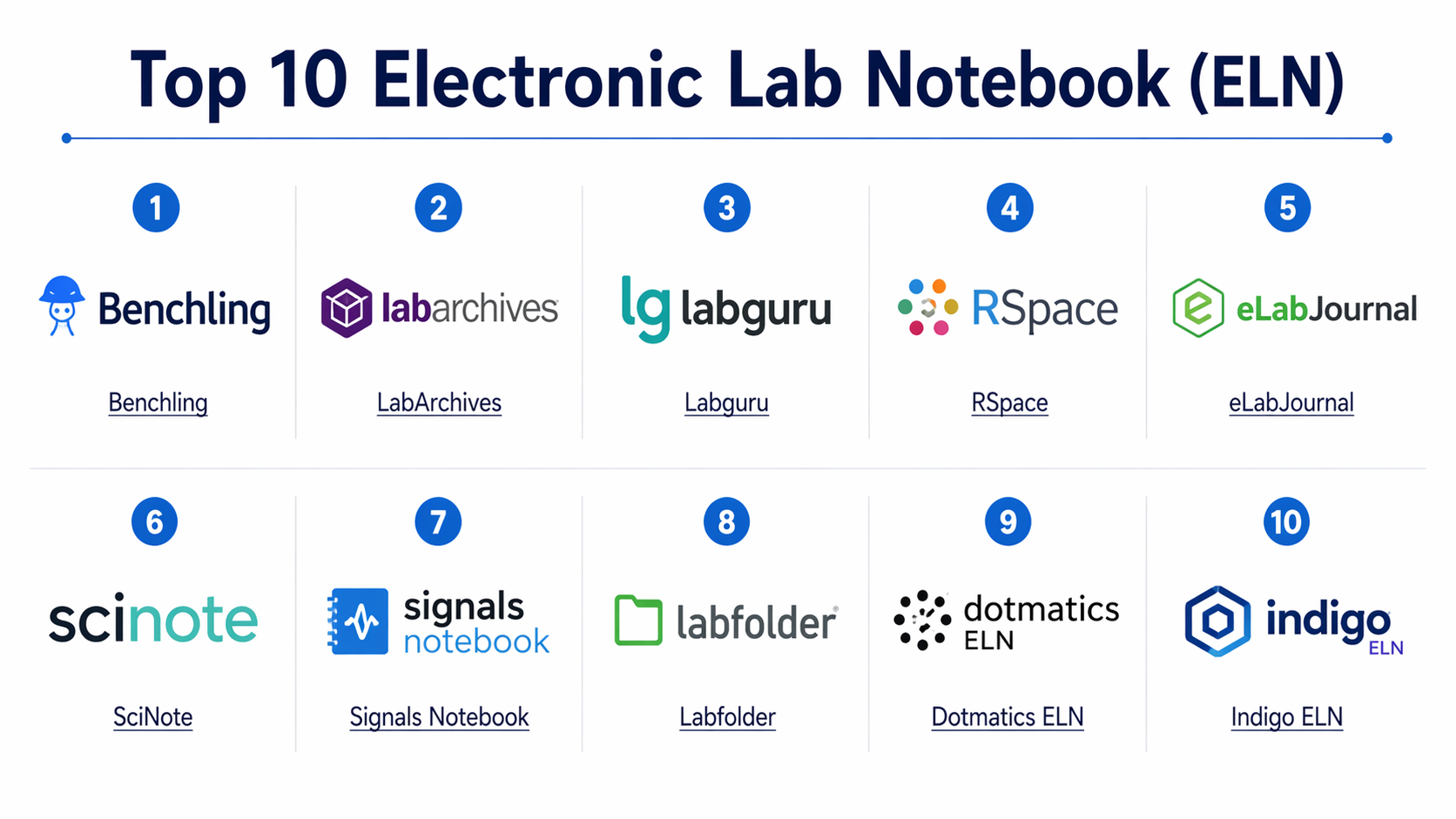
Top 10 Electronic Lab Notebook (ELN)
#1 — Benchling
Short description :
Benchling is a modern cloud-based ELN designed for biotech and life sciences teams. It combines experiment tracking, molecular biology tools, and collaboration features in one platform. Widely used in biotech startups and enterprises, it focuses on data-driven research workflows. Its intuitive interface makes it popular among scientists. It also supports advanced data management and integrations.
Key Features
- Experiment tracking and structured notebooks
- Molecular biology design tools
- Real-time collaboration
- Data versioning and audit trails
- Workflow automation
- Cloud-native architecture
Pros
- Strong biotech-specific capabilities
- Highly intuitive interface
Cons
- Can be expensive for small teams
- Limited offline capabilities
Platforms / Deployment
Web / Cloud
Security & Compliance
SSO, encryption, audit logs; additional certifications Not publicly stated
Integrations & Ecosystem
Benchling integrates with lab instruments, data pipelines, and enterprise systems.
- APIs for custom workflows
- Integration with LIMS
- Data export tools
Support & Community
Strong documentation and enterprise support; active user base
#2 — LabArchives
Short description :
LabArchives is a widely used ELN platform in academia and research institutions. It provides secure data storage, experiment documentation, and collaboration tools. Known for its simplicity, it is suitable for both students and researchers. It supports regulatory compliance and long-term data archiving.
Key Features
- Secure cloud storage
- Data sharing and collaboration
- Templates and structured notebooks
- Audit trails
- File attachment support
Pros
- Easy to use
- Strong academic adoption
Cons
- Limited advanced automation
- Basic UI design
Platforms / Deployment
Web / Cloud
Security & Compliance
Encryption, audit logs; certifications Not publicly stated
Integrations & Ecosystem
- LMS integration
- File storage tools
- API support
Support & Community
Good academic support and onboarding resources
#3 — Labguru
Short description :
Labguru combines ELN and LIMS capabilities into a single platform. It is designed for life science labs needing both experiment tracking and inventory management. It helps streamline workflows and improve lab efficiency. Suitable for growing labs and mid-sized organizations.
Key Features
- ELN + LIMS integration
- Inventory tracking
- Workflow automation
- Data visualization
- Collaboration tools
Pros
- All-in-one platform
- Strong workflow automation
Cons
- Learning curve for new users
- Interface can feel complex
Platforms / Deployment
Web / Cloud
Security & Compliance
RBAC, audit logs; certifications Not publicly stated
Integrations & Ecosystem
- Instrument integration
- APIs
- Data export/import
Support & Community
Responsive support; enterprise onboarding available
#4 — RSpace
Short description :
RSpace is a flexible ELN designed for research labs and academic institutions. It offers integration with data repositories and supports compliance requirements. Its open architecture makes it suitable for institutions with custom workflows.
Key Features
- Flexible data organization
- Repository integration
- Collaboration tools
- Audit trails
- Custom templates
Pros
- Highly customizable
- Strong compliance support
Cons
- UI not very modern
- Requires setup effort
Platforms / Deployment
Cloud / Self-hosted
Security & Compliance
Encryption, audit logs; certifications Not publicly stated
Integrations & Ecosystem
- Repository integrations
- APIs
- Third-party tools
Support & Community
Academic-focused support; moderate community
#5 — eLabJournal
Short description :
eLabJournal is an ELN platform with integrated LIMS capabilities. It supports experiment tracking, inventory, and sample management. Suitable for labs seeking structured workflows and compliance-ready systems.
Key Features
- ELN + LIMS
- Inventory management
- Sample tracking
- Workflow templates
- Reporting tools
Pros
- Strong compliance features
- Structured workflows
Cons
- UI can feel dated
- Limited flexibility
Platforms / Deployment
Web / Cloud
Security & Compliance
RBAC, audit logs; certifications Not publicly stated
Integrations & Ecosystem
- APIs
- Instrument integration
- Data export
Support & Community
Enterprise support; documentation available
#6 — SciNote
Short description :
SciNote is a popular ELN with open-source roots. It is designed for compliance-heavy environments and supports structured experiment tracking. It is widely used in academia and regulated industries.
Key Features
- Experiment tracking
- Task management
- Audit trails
- Compliance support
- Collaboration tools
Pros
- Compliance-friendly
- Open-source flexibility
Cons
- Limited advanced features
- UI improvements needed
Platforms / Deployment
Cloud / Self-hosted
Security & Compliance
Audit logs, RBAC; certifications Not publicly stated
Integrations & Ecosystem
- APIs
- Data export
- Custom integrations
Support & Community
Active community; enterprise support available
#7 — Signals Notebook
Short description :
Signals Notebook is an enterprise-grade ELN designed for large R&D organizations. It offers advanced data management, analytics, and integration capabilities. It is widely used in pharma and chemical industries.
Key Features
- Advanced data analytics
- Experiment tracking
- Collaboration tools
- Compliance features
- Integration ecosystem
Pros
- Enterprise-ready
- Strong analytics
Cons
- Expensive
- Complex setup
Platforms / Deployment
Cloud
Security & Compliance
SSO, encryption, audit logs; certifications Not publicly stated
Integrations & Ecosystem
- Enterprise integrations
- APIs
- Data pipelines
Support & Community
Enterprise support with SLAs
#8 — Labfolder
Short description :
Labfolder is a simple and collaborative ELN platform. It focuses on usability and real-time data sharing. Suitable for small labs and research teams.
Key Features
- Real-time collaboration
- Data documentation
- Templates
- File attachments
- Mobile access
Pros
- Easy to use
- Good collaboration
Cons
- Limited advanced features
- Not ideal for large enterprises
Platforms / Deployment
Web / Cloud
Security & Compliance
Encryption, audit logs; certifications Not publicly stated
Integrations & Ecosystem
- APIs
- File integrations
- Data export
Support & Community
Basic support; growing user base
#9 — Dotmatics ELN
Short description :
Dotmatics ELN is part of a broader scientific R&D platform. It offers advanced data management, analytics, and integration capabilities. Designed for large organizations with complex workflows.
Key Features
- Data analytics
- Experiment tracking
- Integration tools
- Workflow automation
- Reporting
Pros
- Powerful analytics
- Enterprise scalability
Cons
- Complex implementation
- High cost
Platforms / Deployment
Cloud / Hybrid
Security & Compliance
RBAC, encryption; certifications Not publicly stated
Integrations & Ecosystem
- Enterprise integrations
- APIs
- Data systems
Support & Community
Enterprise-grade support
#10 — Indigo ELN
Short description :
Indigo ELN is an open-source electronic lab notebook platform. It is designed for customization and flexibility. Suitable for developers and labs needing tailored solutions.
Key Features
- Open-source architecture
- Custom workflows
- Data management
- Integration support
- Experiment tracking
Pros
- Highly customizable
- Cost-effective
Cons
- Requires technical expertise
- Limited enterprise features
Platforms / Deployment
Self-hosted
Security & Compliance
Varies / Not publicly stated
Integrations & Ecosystem
- APIs
- Custom integrations
- Developer tools
Support & Community
Community-driven support
Comparison Table (Top 10)
| Tool Name | Best For | Platform(s) Supported | Deployment | Standout Feature | Public Rating |
|---|---|---|---|---|---|
| Benchling | Biotech teams | Web | Cloud | Molecular tools | N/A |
| LabArchives | Academia | Web | Cloud | Ease of use | N/A |
| Labguru | Growing labs | Web | Cloud | ELN + LIMS | N/A |
| RSpace | Research labs | Web | Hybrid | Custom workflows | N/A |
| eLabJournal | Compliance labs | Web | Cloud | Structured workflows | N/A |
| SciNote | Regulated labs | Web | Hybrid | Compliance focus | N/A |
| Signals Notebook | Enterprises | Web | Cloud | Advanced analytics | N/A |
| Labfolder | Small teams | Web | Cloud | Collaboration | N/A |
| Dotmatics ELN | Large enterprises | Web | Hybrid | Data analytics | N/A |
| Indigo ELN | Developers | Web | Self-hosted | Open-source | N/A |
Evaluation & Electronic Lab Notebook (ELN)
| Tool Name | Core | Ease | Integrations | Security | Performance | Support | Value | Weighted Total |
|---|---|---|---|---|---|---|---|---|
| Benchling | 9 | 8 | 9 | 8 | 9 | 8 | 7 | 8.4 |
| LabArchives | 7 | 9 | 6 | 7 | 8 | 7 | 8 | 7.6 |
| Labguru | 8 | 7 | 8 | 8 | 8 | 8 | 7 | 7.9 |
| RSpace | 7 | 6 | 8 | 7 | 7 | 7 | 7 | 7.1 |
| eLabJournal | 8 | 7 | 7 | 8 | 8 | 7 | 7 | 7.6 |
| SciNote | 7 | 7 | 7 | 8 | 7 | 7 | 8 | 7.4 |
| Signals Notebook | 9 | 7 | 9 | 9 | 9 | 9 | 6 | 8.5 |
| Labfolder | 6 | 9 | 6 | 7 | 7 | 6 | 8 | 7.2 |
| Dotmatics ELN | 9 | 6 | 9 | 9 | 9 | 9 | 6 | 8.3 |
| Indigo ELN | 6 | 5 | 7 | 6 | 7 | 5 | 9 | 6.6 |
How to interpret scores:
- Scores are comparative across tools, not absolute benchmarks.
- Higher weighted totals indicate better overall balance across features and usability.
- Enterprise tools score higher in features and integrations but may lose points in value.
- Simpler tools score higher in ease of use but lower in advanced capabilities.
Which Electronic Lab Notebook (ELN)
Solo / Freelancer
Simple tools like LabArchives or Labfolder are ideal due to ease of use and lower cost.
SMB
Labguru or SciNote offer balanced features and scalability for growing teams.
Mid-Market
RSpace and eLabJournal provide customization and compliance support.
Enterprise
Signals Notebook, Benchling, and Dotmatics ELN are best for large-scale operations.
Budget vs Premium
- Budget: Indigo ELN, SciNote
- Premium: Benchling, Signals Notebook
Feature Depth vs Ease of Use
- Feature-rich: Signals Notebook, Dotmatics
- Easy-to-use: LabArchives, Labfolder
Integrations & Scalability
- Strong integrations: Benchling, Dotmatics
- Moderate: Labguru, SciNote
Security & Compliance Needs
- High compliance: Signals Notebook, SciNote
- Moderate: LabArchives, Labfolder
Frequently Asked Questions (FAQs)
1. What is an ELN used for?
ELNs are used to digitally record, manage, and share experimental data in labs.
2. Are ELNs better than paper notebooks?
Yes, they offer better searchability, collaboration, and data security.
3. How much do ELNs cost?
Pricing varies widely depending on features and deployment models.
4. Can ELNs integrate with lab instruments?
Many modern ELNs support integrations via APIs or direct connections.
5. Are ELNs secure?
Most offer encryption and access controls; compliance varies by vendor.
6. Do ELNs support collaboration?
Yes, real-time collaboration is a core feature.
7. Can I switch ELNs easily?
Migration is possible but may require data transformation.
8. Are open-source ELNs reliable?
They can be reliable but require technical expertise to manage.
9. What industries use ELNs?
Pharma, biotech, academia, chemicals, and manufacturing.
10. What is the difference between ELN and LIMS?
ELN focuses on experiment documentation, while LIMS manages lab operations.
Conclusion
Electronic Lab Notebooks have become a foundational tool for modern research environments. As labs generate more data and operate in increasingly regulated and collaborative settings, the need for structured, secure, and scalable documentation systems is only growing. Each ELN in this list serves a different purpose—some prioritize ease of use, while others focus on deep integrations, compliance, or enterprise scalability.
