Introduction
A Student Information System (SIS) is a centralized software platform used by schools, colleges, and universities to manage student data, academic records, attendance, admissions, grades, and administrative workflows. In simple terms, it acts as the digital backbone of an educational institution, connecting students, teachers, administrators, and parents.
In the modern education landscape, SIS platforms have evolved far beyond record-keeping. They now include automation, analytics, AI-powered insights, and integrations with learning management systems (LMS), finance tools, and communication platforms. As institutions scale digitally, SIS becomes critical for efficiency, compliance, and student experience.
Real-world use cases:
- Managing admissions and enrollment workflows
- Tracking attendance and academic performance
- Automating fee collection and billing
- Parent-teacher communication portals
- Data-driven decision-making for institutions
What buyers should evaluate:
- Ease of use for staff and students
- Integration with LMS and ERP tools
- Security and compliance features
- Customization and scalability
- Reporting and analytics capabilities
- Mobile accessibility
- Cost and deployment flexibility
- Support and onboarding experience
Best for: Educational institutions (K-12, colleges, universities), EdTech organizations, training institutes, and administrative teams managing large student data.
Not ideal for: Very small coaching centers or individual tutors who may benefit more from lightweight tools or spreadsheets instead of a full SIS.
Key Trends in Student Information Systems (SIS)
- AI-powered analytics for student performance prediction and retention tracking
- Cloud-first deployment models replacing on-premise systems
- Mobile-first interfaces for students, parents, and teachers
- Integration with LMS platforms for unified learning ecosystems
- Automation of administrative workflows like admissions and fee processing
- Data privacy and compliance focus (GDPR, FERPA-like regulations)
- Self-service portals for students and parents
- API-first architectures for extensibility and integrations
- Subscription-based pricing models replacing perpetual licenses
- Real-time dashboards and reporting tools for decision-makers
How We Selected These Tools (Methodology)
- Evaluated market adoption and brand recognition in the education sector
- Assessed feature completeness across academic and administrative needs
- Reviewed performance and reliability signals from enterprise usage
- Considered security posture and compliance readiness
- Analyzed integration capabilities and ecosystem support
- Looked at fit across institution sizes (K-12, higher education, global universities)
- Reviewed ease of onboarding and usability
- Compared deployment flexibility (cloud vs hybrid)
- Evaluated support quality and community presence
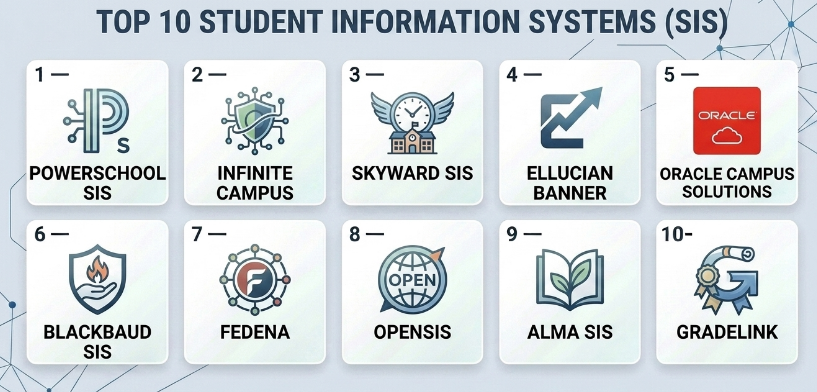
Top 10 Student Information Systems (SIS)
#1 — PowerSchool SIS
Short description :
PowerSchool is one of the most widely adopted SIS platforms, especially in K-12 education. It offers a comprehensive suite covering enrollment, grading, attendance, and communication. The platform is designed for scalability and supports large school districts. It also integrates with multiple educational tools, making it a strong ecosystem player. Ideal for institutions looking for a mature and proven solution.
Key Features
- Unified student data management
- Gradebook and attendance tracking
- Parent and student portals
- Reporting and analytics
- Scheduling and enrollment tools
- Mobile access support
Pros
- Strong adoption in K-12 segment
- Comprehensive feature set
Cons
- Can be complex to implement
- Pricing not transparent
Platforms / Deployment
- Web / iOS / Android
- Cloud
Security & Compliance
- SSO, RBAC, encryption
- Compliance: Not publicly stated
Integrations & Ecosystem
Supports LMS integrations and third-party EdTech tools.
- Google Classroom
- Canvas
- Microsoft tools
- API support
Support & Community
Strong documentation and enterprise support. Large user community.
#2 — Infinite Campus
Short description:
Infinite Campus is a robust SIS designed for K-12 districts. It focuses on real-time data management and compliance reporting. Known for its scalability, it supports large student populations and complex workflows.
Key Features
- Real-time data updates
- Attendance and grading
- State compliance reporting
- Messaging system
- Custom dashboards
Pros
- Strong reporting features
- Scalable architecture
Cons
- UI can feel outdated
- Learning curve for new users
Platforms / Deployment
- Web
- Cloud
Security & Compliance
- RBAC, encryption
- Compliance: Not publicly stated
Integrations & Ecosystem
- LMS integrations
- API support
- Data export tools
Support & Community
Enterprise-level support; moderate community presence.
#3 — Skyward SIS
Short description:
Skyward is a popular SIS used by school districts for administrative and academic management. It focuses on efficiency and simplicity while offering essential features for schools.
Key Features
- Student records management
- Attendance tracking
- Financial management tools
- Family access portals
- Reporting tools
Pros
- User-friendly interface
- Reliable performance
Cons
- Limited advanced analytics
- Customization constraints
Platforms / Deployment
- Web
- Cloud / Hybrid
Security & Compliance
- MFA, encryption
- Compliance: Not publicly stated
Integrations & Ecosystem
- LMS integrations
- Financial systems
- APIs available
Support & Community
Good support and onboarding assistance.
#4 — Ellucian Banner
Short description:
Ellucian Banner is designed for higher education institutions. It offers deep functionality for universities managing large datasets and complex academic structures.
Key Features
- Academic lifecycle management
- Financial aid tracking
- Enrollment and admissions
- Reporting tools
- ERP integration
Pros
- Enterprise-grade capabilities
- Strong higher education focus
Cons
- High implementation cost
- Complex setup
Platforms / Deployment
- Web
- Cloud / Self-hosted
Security & Compliance
- SSO, RBAC
- Compliance: Not publicly stated
Integrations & Ecosystem
- ERP systems
- LMS tools
- API integrations
Support & Community
Strong enterprise support; widely adopted in universities.
#5 — Oracle Campus Solutions
Short description:
Oracle Campus Solutions is a comprehensive SIS for higher education. It integrates deeply with Oracle’s ecosystem and supports large-scale institutions.
Key Features
- Enrollment and student lifecycle
- Financial aid management
- Analytics and reporting
- Integration with Oracle ERP
- Workflow automation
Pros
- Highly scalable
- Strong enterprise integrations
Cons
- Expensive
- Requires technical expertise
Platforms / Deployment
- Web
- Cloud / Hybrid
Security & Compliance
- Enterprise-grade security
- Compliance: Not publicly stated
Integrations & Ecosystem
- Oracle Cloud
- ERP systems
- APIs
Support & Community
Enterprise support with global reach.
#6 — Blackbaud SIS
Short description:
Blackbaud SIS is tailored for private schools and nonprofits. It combines SIS with fundraising and financial tools.
Key Features
- Student records
- Tuition management
- Communication tools
- Reporting dashboards
- Donor management
Pros
- Strong for private schools
- Integrated financial tools
Cons
- Limited for public institutions
- Pricing complexity
Platforms / Deployment
- Web
- Cloud
Security & Compliance
- Encryption, RBAC
- Compliance: Not publicly stated
Integrations & Ecosystem
- Financial tools
- CRM integrations
- APIs
Support & Community
Good support; niche community.
#7 — Fedena
Short description:
Fedena is a flexible SIS used globally by schools and colleges. It supports customization and multiple deployment options.
Key Features
- Student data management
- Attendance and grading
- Finance modules
- Custom workflows
- Mobile apps
Pros
- Affordable
- Customizable
Cons
- Limited enterprise features
- UI can vary
Platforms / Deployment
- Web / Mobile
- Cloud / Self-hosted
Security & Compliance
- Basic security features
- Compliance: Not publicly stated
Integrations & Ecosystem
- LMS integrations
- APIs
- Third-party plugins
Support & Community
Moderate support; growing community.
#8 — OpenSIS
Short description:
OpenSIS is an open-source SIS solution for schools looking for flexibility and cost control.
Key Features
- Student records
- Scheduling
- Attendance tracking
- Reporting
- Open-source customization
Pros
- Cost-effective
- Highly customizable
Cons
- Requires technical expertise
- Limited support
Platforms / Deployment
- Web
- Self-hosted
Security & Compliance
- Varies based on setup
- Compliance: Not publicly stated
Integrations & Ecosystem
- Custom integrations
- APIs
- LMS support
Support & Community
Community-driven support.
#9 — Alma SIS
Short description:
Alma is a modern SIS focused on usability and analytics. It is designed for K-12 schools.
Key Features
- Real-time dashboards
- Attendance tracking
- Parent/student portals
- Analytics tools
- Cloud-based system
Pros
- Modern UI
- Easy to use
Cons
- Limited enterprise scalability
- Feature gaps for large institutions
Platforms / Deployment
- Web
- Cloud
Security & Compliance
- Encryption, RBAC
- Compliance: Not publicly stated
Integrations & Ecosystem
- LMS integrations
- APIs
- Reporting tools
Support & Community
Good onboarding; responsive support.
#10 — Gradelink
Short description:
Gradelink is a simple SIS for small schools and private institutions. It focuses on ease of use and affordability.
Key Features
- Gradebook
- Attendance tracking
- Parent communication
- Reporting
- Mobile access
Pros
- Easy to use
- Affordable
Cons
- Limited scalability
- Fewer advanced features
Platforms / Deployment
- Web
- Cloud
Security & Compliance
- Basic security
- Compliance: Not publicly stated
Integrations & Ecosystem
- Limited integrations
- Basic APIs
Support & Community
Good support for small institutions.
Comparison Table (Top 10)
| Tool Name | Best For | Platform(s) Supported | Deployment | Standout Feature | Public Rating |
|---|---|---|---|---|---|
| PowerSchool | K-12 districts | Web, Mobile | Cloud | Comprehensive ecosystem | N/A |
| Infinite Campus | Large districts | Web | Cloud | Real-time data | N/A |
| Skyward | Schools | Web | Cloud/Hybrid | Ease of use | N/A |
| Ellucian Banner | Universities | Web | Hybrid | Enterprise features | N/A |
| Oracle Campus Solutions | Universities | Web | Hybrid | Oracle ecosystem | N/A |
| Blackbaud SIS | Private schools | Web | Cloud | Financial integration | N/A |
| Fedena | SMB schools | Web/Mobile | Hybrid | Customization | N/A |
| OpenSIS | Open-source users | Web | Self-hosted | Flexibility | N/A |
| Alma | K-12 schools | Web | Cloud | Modern UI | N/A |
| Gradelink | Small schools | Web | Cloud | Simplicity | N/A |
Evaluation & Student Information Systems (SIS)
| Tool Name | Core | Ease | Integrations | Security | Performance | Support | Value | Weighted Total |
|---|---|---|---|---|---|---|---|---|
| PowerSchool | 9 | 7 | 9 | 8 | 9 | 8 | 7 | 8.4 |
| Infinite Campus | 9 | 7 | 8 | 8 | 9 | 7 | 7 | 8.2 |
| Skyward | 8 | 8 | 7 | 7 | 8 | 8 | 8 | 7.9 |
| Ellucian Banner | 10 | 6 | 9 | 9 | 9 | 8 | 6 | 8.3 |
| Oracle Campus Solutions | 10 | 6 | 10 | 9 | 9 | 8 | 6 | 8.4 |
| Blackbaud SIS | 8 | 8 | 7 | 7 | 8 | 8 | 7 | 7.8 |
| Fedena | 7 | 8 | 6 | 6 | 7 | 7 | 8 | 7.2 |
| OpenSIS | 6 | 6 | 6 | 6 | 7 | 6 | 9 | 6.8 |
| Alma | 7 | 9 | 7 | 7 | 7 | 8 | 8 | 7.6 |
| Gradelink | 6 | 9 | 5 | 6 | 7 | 8 | 9 | 7.1 |
How to interpret scores:
These scores are comparative and reflect relative strengths across tools. A higher score does not mean universal superiority—it indicates better alignment with enterprise requirements. Smaller institutions may prefer tools with lower scores but better usability and cost efficiency.
Which Student Information Systems (SIS)
Solo / Freelancer
Not recommended. Use simple tools like spreadsheets or lightweight apps.
SMB
- Best options: Gradelink, Fedena, Alma
- Focus on ease of use and affordability
Mid-Market
- Best options: Skyward, Blackbaud SIS
- Balance between features and usability
Enterprise
- Best options: Oracle Campus Solutions, Ellucian Banner, PowerSchool
- Focus on scalability and integrations
Budget vs Premium
- Budget: OpenSIS, Gradelink
- Premium: Oracle, Ellucian
Feature Depth vs Ease of Use
- Feature depth: Oracle, Ellucian
- Ease of use: Alma, Gradelink
Integrations & Scalability
- High: PowerSchool, Oracle
- Moderate: Skyward, Blackbaud
Security & Compliance Needs
- Enterprise: Oracle, Ellucian
- Basic: OpenSIS, Gradelink
Frequently Asked Questions (FAQs)
1. What is a Student Information System (SIS)?
A SIS is software that manages student data, academic records, attendance, and administrative processes in educational institutions.
2. How much does SIS software cost?
Pricing varies widely depending on institution size and features. Many vendors use subscription-based models.
3. How long does implementation take?
Implementation can take weeks to months depending on complexity and customization requirements.
4. Can SIS integrate with LMS platforms?
Yes, most modern SIS tools support integrations with LMS platforms for seamless learning management.
5. Is SIS secure?
Most SIS platforms offer encryption and access controls, but compliance levels vary by vendor.
6. Can small schools use SIS?
Yes, lightweight options like Gradelink or Fedena are suitable for small institutions.
7. What are common mistakes when choosing SIS?
Ignoring integration needs, underestimating training requirements, and focusing only on price.
8. Can SIS handle financial operations?
Some SIS platforms include fee management, but full financial systems may require ERP integration.
9. Is cloud-based SIS better?
Cloud systems offer scalability and easier maintenance, but self-hosted options provide more control.
10. Can you switch SIS platforms easily?
Switching can be complex due to data migration and training, so careful planning is required.
Conclusion
Student Information Systems are no longer just administrative tools—they are the core digital infrastructure of modern education institutions. From managing student records to enabling data-driven decisions, SIS platforms play a critical role in improving operational efficiency and student outcomes. However, there is no one-size-fits-all solution. Large universities may prioritize scalability and integrations, while smaller schools focus on simplicity and cost.
