Introduction
Business Continuity Planning (BCP) tools are specialized software platforms that help organizations prepare for disruptions, maintain critical operations, and recover quickly from incidents such as cyberattacks, natural disasters, system failures, or supply chain breakdowns. These tools provide structured planning, risk assessment, scenario simulation, and recovery workflows to ensure resilience.
In today’s interconnected and risk-heavy environment, disruptions are not a matter of “if” but “when.” With increasing regulatory pressure, hybrid work environments, and digital dependency, organizations must ensure continuity across IT systems, operations, and workforce processes.
Real-world use cases include:
- Disaster recovery planning for IT infrastructure
- Ensuring operational continuity during outages
- Compliance with regulatory standards
- Managing supply chain disruptions
- Crisis response planning and testing
What buyers should evaluate:
- Business impact analysis (BIA) capabilities
- Risk assessment and scenario modeling
- Automation of recovery workflows
- Integration with ITSM, security, and monitoring tools
- Ease of updating and maintaining plans
- Reporting and compliance features
- Mobile access and real-time alerts
- Scalability across departments
- Data security and audit trails
Best for: Enterprises, financial institutions, healthcare providers, IT teams, compliance officers, and organizations with critical uptime requirements.
Not ideal for: Freelancers or very small businesses that can manage continuity using manual plans or simple documentation tools.
Key Trends in Business Continuity Planning (BCP) Tools
- AI-driven risk prediction: Tools now analyze patterns and suggest potential risks before incidents occur.
- Automation of recovery workflows: Reduced manual intervention during disruptions.
- Integration with DevOps and ITSM platforms: Seamless coordination between operations and recovery.
- Cloud-first architecture: Faster deployment and scalability.
- Real-time collaboration features: Teams can coordinate across locations instantly.
- Compliance automation: Built-in support for regulatory frameworks.
- Mobile-first access: Plans and alerts accessible from anywhere.
- Scenario simulation and testing: Organizations can run drills digitally.
- Data-driven insights: Analytics to improve future response strategies.
How We Selected These Tools (Methodology)
- Evaluated market adoption and industry usage
- Assessed completeness of BCP lifecycle features
- Considered reliability and scalability
- Reviewed security and compliance capabilities
- Analyzed integration ecosystem and APIs
- Included tools suitable for SMB to enterprise
- Checked ease of use during planning and crisis situations
- Evaluated vendor reputation and product maturity
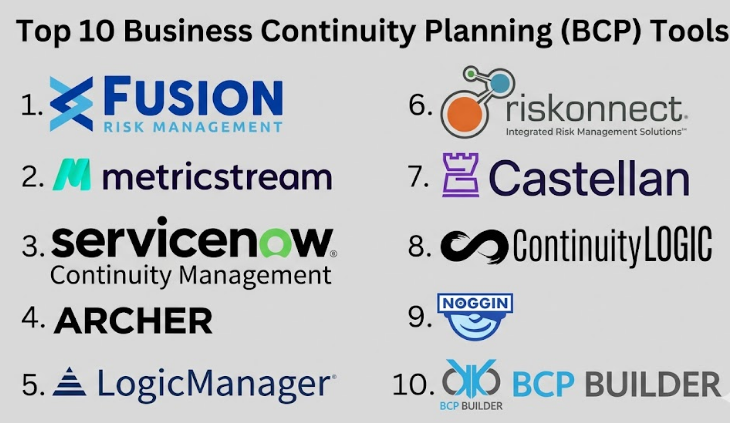
Top 10 Business Continuity Planning (BCP) Tools
#1 — Fusion Framework System
Short description:
Fusion Framework System is a comprehensive enterprise resilience platform that covers business continuity, risk management, and crisis response. It is widely used by large enterprises to manage complex continuity strategies. The platform provides strong analytics and planning capabilities. It is ideal for organizations with strict compliance needs and large-scale operations.
Key Features
- Business impact analysis
- Risk assessment tools
- Scenario planning
- Workflow automation
- Reporting and dashboards
- Data visualization
Pros
- Comprehensive enterprise features
- Strong analytics and reporting
Cons
- High cost
- Complex implementation
Platforms / Deployment
Cloud
Security & Compliance
SSO, RBAC, audit logs (Certifications not publicly stated)
Integrations & Ecosystem
Fusion integrates with enterprise systems and IT tools to centralize resilience planning.
- ITSM tools
- Risk management systems
- APIs for customization
Support & Community
Enterprise-level support with onboarding assistance and detailed documentation.
#2 — MetricStream
Short description:
MetricStream is a well-known governance, risk, and compliance (GRC) platform with strong business continuity capabilities. It helps organizations manage risks and ensure compliance while maintaining operational continuity. It is commonly used in regulated industries.
Key Features
- Risk management
- Business continuity planning
- Compliance tracking
- Workflow automation
- Reporting dashboards
Pros
- Strong compliance focus
- Scalable platform
Cons
- Complex UI
- Requires training
Platforms / Deployment
Cloud / Hybrid
Security & Compliance
Not publicly stated
Integrations & Ecosystem
- Enterprise systems
- APIs
- Compliance tools
Support & Community
Strong enterprise support, moderate community presence.
#3 — ServiceNow Business Continuity Management
Short description:
ServiceNow offers BCP capabilities integrated within its broader ITSM ecosystem. It provides structured workflows and automation for continuity planning. Best suited for organizations already using ServiceNow.
Key Features
- Workflow automation
- Incident and continuity management
- Risk analysis
- Compliance tracking
- Dashboards
Pros
- Deep IT integration
- Highly customizable
Cons
- Expensive
- Complex setup
Platforms / Deployment
Cloud
Security & Compliance
SSO, RBAC (Certifications not publicly stated)
Integrations & Ecosystem
- ITSM tools
- DevOps systems
- Security platforms
Support & Community
Extensive documentation and enterprise support.
#4 — Archer (RSA Archer)
Short description:
Archer is a GRC platform that includes business continuity planning modules. It helps organizations manage risk and resilience with structured frameworks. It is widely used in large enterprises.
Key Features
- Risk assessment
- Continuity planning
- Compliance tracking
- Reporting tools
- Workflow automation
Pros
- Strong risk management features
- Enterprise-grade platform
Cons
- Complex interface
- High implementation effort
Platforms / Deployment
Cloud / On-premise
Security & Compliance
Not publicly stated
Integrations & Ecosystem
- Enterprise applications
- APIs
Support & Community
Enterprise-level support available.
#5 — LogicManager
Short description:
LogicManager provides a risk-based approach to business continuity planning. It focuses on simplifying complex risk and continuity processes for organizations.
Key Features
- Risk management
- Business continuity planning
- Compliance tools
- Reporting
- Workflow automation
Pros
- User-friendly interface
- Strong risk integration
Cons
- Limited customization
- Smaller ecosystem
Platforms / Deployment
Cloud
Security & Compliance
Not publicly stated
Integrations & Ecosystem
- APIs
- Enterprise tools
Support & Community
Responsive support, moderate documentation.
#6 — Riskonnect
Short description:
Riskonnect is a unified risk management platform that includes business continuity capabilities. It helps organizations manage risk, compliance, and resilience in one place.
Key Features
- Risk and compliance management
- Business continuity planning
- Incident tracking
- Reporting dashboards
- Workflow automation
Pros
- Unified platform
- Scalable
Cons
- Complex interface
- Learning curve
Platforms / Deployment
Cloud
Security & Compliance
Not publicly stated
Integrations & Ecosystem
- Enterprise systems
- APIs
Support & Community
Enterprise-level support.
#7 — Castellan Solutions
Short description:
Castellan focuses specifically on business continuity and operational resilience. It offers tools for planning, testing, and reporting continuity strategies.
Key Features
- Business continuity planning
- Risk analysis
- Scenario testing
- Reporting tools
- Workflow automation
Pros
- Dedicated BCP focus
- Easy to use
Cons
- Limited integrations
- Smaller vendor
Platforms / Deployment
Cloud
Security & Compliance
Not publicly stated
Integrations & Ecosystem
- APIs
- Basic integrations
Support & Community
Good support, smaller community.
#8 — Continuity Logic (ClearView)
Short description:
Continuity Logic provides a platform for business continuity and emergency management. It focuses on planning, compliance, and risk management.
Key Features
- Continuity planning
- Risk assessment
- Compliance tools
- Reporting dashboards
- Workflow automation
Pros
- Strong compliance features
- Structured workflows
Cons
- UI limitations
- Moderate integrations
Platforms / Deployment
Cloud
Security & Compliance
Not publicly stated
Integrations & Ecosystem
- Enterprise tools
- APIs
Support & Community
Moderate support and documentation.
#9 — Noggin
Short description:
Noggin provides resilience and crisis management capabilities, including business continuity planning. It is widely used in industries like utilities and infrastructure.
Key Features
- Risk management
- Continuity planning
- Incident tracking
- Compliance tools
- Reporting
Pros
- Strong industry use cases
- Comprehensive platform
Cons
- Complex interface
- Higher cost
Platforms / Deployment
Cloud
Security & Compliance
Not publicly stated
Integrations & Ecosystem
- Enterprise systems
- APIs
Support & Community
Enterprise-level support.
#10 — BCP Builder
Short description:
BCP Builder is a simpler tool designed for organizations that need structured continuity planning without enterprise complexity. It is suitable for small to mid-sized businesses.
Key Features
- Plan creation tools
- Risk assessment
- Reporting
- Templates
- Workflow support
Pros
- Easy to use
- Cost-effective
Cons
- Limited advanced features
- Basic integrations
Platforms / Deployment
Cloud
Security & Compliance
Not publicly stated
Integrations & Ecosystem
- Limited integrations
- Basic API support
Support & Community
Basic support, smaller user base.
Comparison Table (Top 10)
| Tool Name | Best For | Platform(s) Supported | Deployment | Standout Feature | Public Rating |
|---|---|---|---|---|---|
| Fusion Framework System | Enterprises | Web | Cloud | Advanced analytics | N/A |
| MetricStream | Compliance-heavy orgs | Web | Cloud/Hybrid | GRC integration | N/A |
| ServiceNow BCM | IT-driven orgs | Web | Cloud | Workflow automation | N/A |
| Archer (RSA Archer) | Large enterprises | Web | Cloud/On-prem | Risk frameworks | N/A |
| LogicManager | SMB to mid-market | Web | Cloud | Risk-based approach | N/A |
| Riskonnect | Enterprises | Web | Cloud | Unified risk platform | N/A |
| Castellan Solutions | Mid-market | Web | Cloud | BCP specialization | N/A |
| Continuity Logic | Compliance orgs | Web | Cloud | Structured planning | N/A |
| Noggin | Critical industries | Web | Cloud | Resilience focus | N/A |
| BCP Builder | SMBs | Web | Cloud | Simplicity | N/A |
Evaluation & Business Continuity Planning Tools
| Tool Name | Core (25%) | Ease (15%) | Integrations (15%) | Security (10%) | Performance (10%) | Support (10%) | Value (15%) | Weighted Total |
|---|---|---|---|---|---|---|---|---|
| Fusion Framework System | 9 | 6 | 8 | 8 | 9 | 8 | 6 | 8.0 |
| MetricStream | 9 | 6 | 8 | 8 | 8 | 7 | 6 | 7.8 |
| ServiceNow BCM | 9 | 6 | 9 | 8 | 9 | 8 | 6 | 8.1 |
| Archer | 8 | 5 | 7 | 8 | 8 | 7 | 6 | 7.3 |
| LogicManager | 7 | 8 | 6 | 7 | 7 | 7 | 8 | 7.3 |
| Riskonnect | 8 | 6 | 7 | 7 | 8 | 7 | 7 | 7.5 |
| Castellan | 7 | 8 | 6 | 6 | 7 | 7 | 8 | 7.2 |
| Continuity Logic | 7 | 7 | 6 | 6 | 7 | 6 | 7 | 6.9 |
| Noggin | 8 | 6 | 7 | 7 | 8 | 7 | 6 | 7.4 |
| BCP Builder | 6 | 9 | 5 | 6 | 6 | 6 | 9 | 6.9 |
How to interpret:
- Scores are relative comparisons, not absolute benchmarks
- Higher scores indicate stronger overall capability
- Enterprises should prioritize core features and integrations
- SMBs should focus on ease of use and value
- Choose based on your operational complexity and risk exposure
Which Business Continuity Planning Tools
Solo / Freelancer
Basic documentation tools and spreadsheets are sufficient.
SMB
LogicManager or BCP Builder are good starting points.
Mid-Market
Castellan or Riskonnect offer balance between features and complexity.
Enterprise
Fusion, ServiceNow, or MetricStream provide full-scale resilience capabilities.
Budget vs Premium
- Budget: BCP Builder, Castellan
- Premium: Fusion, ServiceNow
Feature Depth vs Ease of Use
- Deep features: Fusion, MetricStream
- Easy to use: LogicManager, BCP Builder
Integrations & Scalability
- Best integrations: ServiceNow, MetricStream
- Moderate: Castellan
Security & Compliance Needs
- High compliance: MetricStream, Archer
- Standard: LogicManager, BCP Builder
Frequently Asked Questions (FAQs)
1. What is a BCP tool?
A BCP tool helps organizations plan and maintain operations during disruptions using structured workflows and risk analysis.
2. How much do BCP tools cost?
Costs vary based on features, users, and scale. Enterprise tools are typically more expensive.
3. How long does implementation take?
Small tools can be deployed quickly, while enterprise solutions may take months.
4. Are BCP tools only for large companies?
No, there are solutions for SMBs as well.
5. Do these tools support compliance?
Yes, many include compliance tracking and reporting features.
6. Can BCP tools integrate with IT systems?
Most platforms support integrations with ITSM, monitoring, and security tools.
7. How often should plans be updated?
Continuity plans should be reviewed and updated regularly.
8. What are common mistakes?
Ignoring testing, poor documentation, and lack of training.
9. Are these tools cloud-based?
Most modern tools are cloud-based, with some hybrid options.
10. Can organizations switch tools easily?
Switching requires planning, data migration, and retraining.
Conclusion
Business Continuity Planning tools are essential for organizations that need to ensure operational resilience in an unpredictable world. Whether dealing with IT outages, cyber incidents, or operational disruptions, these platforms provide the structure and automation needed to respond effectively and recover quickly. However, there is no one-size-fits-all solution. Enterprises may require comprehensive platforms like Fusion or ServiceNow, while smaller organizations can benefit from simpler tools like LogicManager or BCP Builder. The key is to align the tool with your organization’s complexity, risk exposure, and compliance needs.
