Introduction
Rail Operations Management Software is a specialized digital platform used to manage, monitor, and optimize railway operations. It helps rail operators coordinate trains, track assets, manage schedules, handle maintenance, and ensure safety across complex rail networks. Instead of relying on manual processes or disconnected systems, this software provides centralized control, real-time visibility, and data-driven decision-making.
With increasing demand for efficient public transport and freight logistics, rail networks are becoming more complex. Modern rail systems must handle high traffic volumes, strict safety regulations, and real-time passenger expectations. This is where rail operations software plays a crucial role—improving punctuality, reducing downtime, and enhancing operational efficiency.
Real-world use cases:
- Train scheduling and dispatch management
- Real-time tracking of trains and rail assets
- Predictive maintenance of locomotives and tracks
- Passenger information systems and delay alerts
- Freight logistics coordination and tracking
What buyers should evaluate:
- Real-time monitoring and control capabilities
- Integration with signaling and legacy rail systems
- AI-based predictive maintenance features
- Scalability across routes and regions
- Safety and compliance support
- User interface and ease of adoption
- Deployment flexibility (cloud vs on-premise)
- Data analytics and reporting capabilities
- Vendor reliability and support
- Cost vs operational ROI
Best for: Railway authorities, metro systems, freight rail operators, logistics companies, and government transport agencies.
Not ideal for: Small logistics firms or organizations that do not operate rail networks; simpler fleet or logistics tools may be sufficient.
Key Trends in Rail Operations Management Software
- AI-powered predictive maintenance to reduce breakdowns and downtime
- Real-time train tracking using IoT and GPS integration
- Cloud-based rail management platforms replacing legacy systems
- Digital twin simulations for optimizing rail network performance
- Automation in scheduling and dispatch operations
- Integration with smart city infrastructure and mobility platforms
- Advanced analytics for delay prediction and optimization
- Cybersecurity enhancements due to critical infrastructure risks
- Mobile-first dashboards for field teams and operators
- Sustainability tracking (fuel efficiency, emissions monitoring)
How We Selected These Tools (Methodology)
- Evaluated global adoption across major rail networks
- Assessed feature completeness (scheduling, tracking, maintenance)
- Reviewed performance and reliability in high-volume operations
- Considered security and compliance capabilities
- Analyzed integration with signaling, ERP, and IoT systems
- Examined vendor ecosystem and partnerships
- Evaluated scalability for large rail infrastructures
- Prioritized future-ready technologies (AI, automation, cloud)
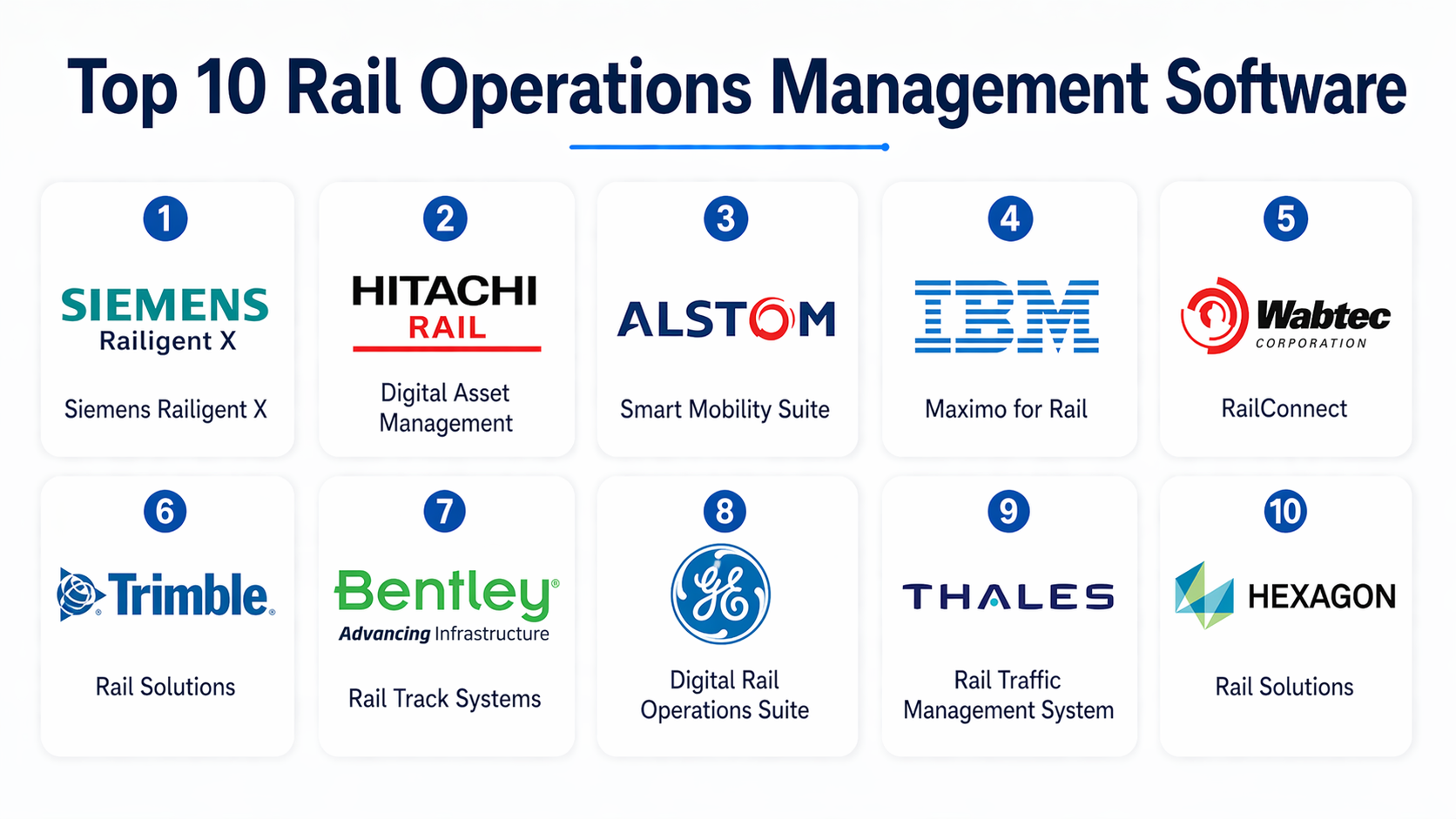
Top 10 Rail Operations Management Software
#1 — Siemens Railigent X
Short description:
Railigent X is a comprehensive rail operations platform designed for predictive maintenance and real-time monitoring. It leverages AI and IoT to improve asset reliability and operational efficiency.
Key Features
- Predictive maintenance analytics
- Real-time asset monitoring
- AI-based fault detection
- Data integration across systems
- Performance dashboards
- Fleet optimization tools
Pros
- Strong AI capabilities
- Enterprise-grade reliability
Cons
- High implementation cost
- Requires technical expertise
Platforms / Deployment
Web / Cloud / Hybrid
Security & Compliance
Encryption, RBAC
Integrations & Ecosystem
Integrates with rail infrastructure and IoT systems.
- APIs for third-party integration
- ERP and maintenance systems
- Sensor data platforms
Support & Community
Enterprise-level support with structured onboarding.
#2 — Hitachi Rail Digital Asset Management
Short description:
Hitachi Rail offers a digital asset and operations management platform focused on improving asset lifecycle and operational efficiency.
Key Features
- Asset lifecycle management
- Predictive maintenance
- Real-time monitoring
- Data analytics
- Workflow automation
Pros
- Strong asset management features
- Reliable performance
Cons
- Complex deployment
- Limited SMB focus
Platforms / Deployment
Web / Cloud / Hybrid
Security & Compliance
Not publicly stated
Integrations & Ecosystem
Supports integration with rail systems.
- API connectivity
- ERP systems
Support & Community
Strong enterprise support.
#3 — Alstom Smart Mobility Suite
Short description:
Alstom provides a suite of digital solutions for rail operations, focusing on smart mobility and network optimization.
Key Features
- Traffic management systems
- Real-time scheduling
- Passenger information systems
- Analytics dashboards
- Network optimization tools
Pros
- Comprehensive solution suite
- Strong global presence
Cons
- High cost
- Complex customization
Platforms / Deployment
Web / Cloud
Security & Compliance
Not publicly stated
Integrations & Ecosystem
Integrates with mobility platforms.
- APIs
- Transport systems
Support & Community
Enterprise-grade support.
#4 — IBM Maximo for Rail
Short description:
IBM Maximo is a widely used asset management platform adapted for rail operations, focusing on maintenance and reliability.
Key Features
- Asset management
- Predictive maintenance
- Work order management
- Analytics and reporting
- IoT integration
Pros
- Mature platform
- Strong analytics
Cons
- Requires customization
- Licensing cost
Platforms / Deployment
Web / Cloud / Hybrid
Security & Compliance
RBAC, audit logs
Integrations & Ecosystem
Large ecosystem support.
- ERP integration
- IoT platforms
Support & Community
Extensive documentation and support.
#5 — Wabtec RailConnect
Short description:
RailConnect is a digital platform by Wabtec focused on optimizing rail operations and fleet performance.
Key Features
- Fleet monitoring
- Performance analytics
- Predictive maintenance
- Data dashboards
- Operational insights
Pros
- Strong performance analytics
- Industry-focused solution
Cons
- Limited customization
- Premium pricing
Platforms / Deployment
Web / Cloud
Security & Compliance
Not publicly stated
Integrations & Ecosystem
Supports integration with rail systems.
- APIs
- Data platforms
Support & Community
Good enterprise support.
#6 — Trimble Rail Solutions
Short description:
Trimble offers rail solutions focusing on positioning, tracking, and operational efficiency.
Key Features
- GPS-based tracking
- Asset monitoring
- Data analytics
- Mapping and visualization
- Fleet management
Pros
- Accurate tracking capabilities
- Easy integration
Cons
- Limited advanced analytics
- UI could be improved
Platforms / Deployment
Web / Cloud
Security & Compliance
Not publicly stated
Integrations & Ecosystem
Integrates with logistics systems.
- APIs
- GIS platforms
Support & Community
Moderate support.
#7 — Bentley Rail Track Systems
Short description:
Bentley provides rail infrastructure and track management solutions for planning and operations.
Key Features
- Track design and monitoring
- Asset management
- Simulation tools
- Data analytics
- Infrastructure planning
Pros
- Strong engineering capabilities
- Detailed simulation tools
Cons
- Not focused on operations alone
- Complex usage
Platforms / Deployment
Web / Desktop / Cloud
Security & Compliance
Not publicly stated
Integrations & Ecosystem
Supports engineering integrations.
- CAD tools
- Data platforms
Support & Community
Strong technical support.
#8 — GE Digital Rail Operations Suite
Short description:
GE Digital provides a platform for optimizing rail operations with analytics and automation.
Key Features
- Operations analytics
- Predictive maintenance
- Workflow automation
- Data visualization
- Asset optimization
Pros
- Strong analytics
- Reliable performance
Cons
- High cost
- Complex setup
Platforms / Deployment
Web / Cloud
Security & Compliance
Not publicly stated
Integrations & Ecosystem
Supports industrial integrations.
- APIs
- IoT systems
Support & Community
Enterprise support available.
#9 — Thales Rail Traffic Management System
Short description:
Thales offers a traffic management system for optimizing rail operations and safety.
Key Features
- Traffic control
- Real-time monitoring
- Scheduling optimization
- Safety management
- Analytics
Pros
- Strong safety features
- High reliability
Cons
- Expensive
- Complex deployment
Platforms / Deployment
Web / Hybrid
Security & Compliance
Not publicly stated
Integrations & Ecosystem
Integrates with signaling systems.
- APIs
- Rail infrastructure
Support & Community
Enterprise-level support.
#10 — Hexagon Rail Solutions
Short description:
Hexagon provides rail solutions focusing on asset monitoring and operational intelligence.
Key Features
- Asset tracking
- Data analytics
- Visualization tools
- Operational insights
- Risk management
Pros
- Strong analytics
- Good visualization
Cons
- Limited global adoption
- Requires integration work
Platforms / Deployment
Web / Cloud
Security & Compliance
Not publicly stated
Integrations & Ecosystem
Supports integration with industrial systems.
- APIs
- Data platforms
Support & Community
Moderate support.
Comparison Table (Top 10)
| Tool Name | Best For | Platform(s) Supported | Deployment | Standout Feature | Public Rating |
|---|---|---|---|---|---|
| Siemens Railigent X | Enterprise rail networks | Web | Cloud/Hybrid | Predictive maintenance AI | N/A |
| Hitachi Rail Digital Asset Management | Asset-heavy operations | Web | Cloud/Hybrid | Lifecycle management | N/A |
| Alstom Smart Mobility Suite | Smart mobility systems | Web | Cloud | Network optimization | N/A |
| IBM Maximo for Rail | Maintenance-focused operations | Web | Cloud/Hybrid | Asset management | N/A |
| Wabtec RailConnect | Fleet performance | Web | Cloud | Performance analytics | N/A |
| Trimble Rail Solutions | Tracking & positioning | Web | Cloud | GPS tracking | N/A |
| Bentley Rail Track Systems | Infrastructure planning | Web/Desktop | Cloud | Simulation tools | N/A |
| GE Digital Rail Operations Suite | Analytics-driven operations | Web | Cloud | Data analytics | N/A |
| Thales Rail Traffic Management System | Safety & traffic control | Web | Hybrid | Traffic management | N/A |
| Hexagon Rail Solutions | Operational intelligence | Web | Cloud | Visualization tools | N/A |
Evaluation & Scoring of Rail Operations Management Software
| Tool Name | Core (25%) | Ease (15%) | Integrations (15%) | Security (10%) | Performance (10%) | Support (10%) | Value (15%) | Weighted Total |
|---|---|---|---|---|---|---|---|---|
| Siemens Railigent X | 9 | 7 | 9 | 8 | 9 | 8 | 7 | 8.4 |
| Hitachi Rail | 9 | 6 | 8 | 7 | 9 | 8 | 7 | 8.0 |
| Alstom Suite | 9 | 6 | 8 | 7 | 9 | 8 | 6 | 7.9 |
| IBM Maximo | 9 | 6 | 9 | 8 | 8 | 9 | 7 | 8.2 |
| Wabtec RailConnect | 8 | 7 | 8 | 7 | 8 | 7 | 7 | 7.8 |
| Trimble Rail | 7 | 8 | 7 | 7 | 7 | 7 | 8 | 7.4 |
| Bentley Rail | 8 | 6 | 7 | 7 | 8 | 7 | 7 | 7.5 |
| GE Digital Rail | 9 | 6 | 8 | 7 | 9 | 8 | 6 | 7.9 |
| Thales Rail TMS | 9 | 6 | 8 | 8 | 9 | 8 | 6 | 8.0 |
| Hexagon Rail | 8 | 7 | 7 | 7 | 8 | 7 | 7 | 7.6 |
How to interpret scores:
These scores are comparative across tools based on capabilities and market positioning. Higher scores indicate stronger overall performance, but selection should depend on your specific operational needs and constraints.
Which Rail Operations Management Software
Solo / Freelancer
Not applicable; these systems are enterprise-grade.
SMB
Consider Trimble Rail or Hexagon for simpler deployments.
Mid-Market
Wabtec RailConnect or Kale-like platforms offer balance.
Enterprise
Siemens, IBM Maximo, Alstom, and Thales are ideal.
Budget vs Premium
- Budget: Trimble, Hexagon
- Premium: Siemens, IBM, Alstom
Feature Depth vs Ease of Use
- Feature-rich: Siemens, IBM
- Easier use: Trimble
Integrations & Scalability
- Strong: Siemens, IBM
- Moderate: Trimble, Hexagon
Security & Compliance Needs
- Strong: IBM, Siemens
- Moderate: Others
Frequently Asked Questions (FAQs)
1. What is Rail Operations Management Software?
It is a system used to manage train operations, assets, scheduling, and maintenance.
2. How much does it cost?
Costs vary widely depending on deployment size and features.
3. How long does implementation take?
Typically several months to over a year for large networks.
4. Does it support real-time tracking?
Yes, most modern systems support real-time monitoring.
5. Can it integrate with legacy systems?
Yes, via APIs and custom integrations.
6. Is it secure?
Most platforms include security features, but compliance varies.
7. Who uses this software?
Rail operators, governments, and logistics companies.
8. What are common mistakes?
Ignoring integration and training requirements.
9. Can it scale?
Yes, enterprise systems are highly scalable.
10. What are alternatives?
Fleet management or logistics platforms for smaller use cases.
Conclusion
Rail Operations Management Software plays a vital role in modernizing railway systems by improving efficiency, safety, and reliability. As rail networks become more complex and demand increases, these platforms provide the tools needed to manage operations at scale while reducing costs and delays. However, choosing the right solution depends on your specific operational requirements, budget, and integration needs. Enterprise systems like Siemens, IBM, and Alstom offer deep capabilities, while simpler tools like Trimble provide easier adoption. The best approach is to shortlist a few options, conduct pilot testing, and evaluate real-world performance before making a final decision.
