Introduction
Building Energy Management Systems (BEMS) are software-driven platforms designed to monitor, control, and optimize energy usage across buildings such as offices, factories, hospitals, and campuses. In simple terms, BEMS act as the “brain” of a building’s energy ecosystem—connecting HVAC, lighting, meters, and IoT sensors into a unified system that helps reduce waste and improve efficiency.
In today’s environment of rising energy costs, stricter sustainability mandates, and smart building adoption, BEMS has shifted from a “nice-to-have” to a strategic necessity. Organizations are under pressure to reduce carbon emissions while maintaining operational efficiency, and BEMS plays a central role in achieving both.
Real-world use cases:
- Monitoring HVAC systems to reduce energy waste
- Real-time energy consumption tracking across facilities
- Automated lighting and occupancy control
- Predictive maintenance for equipment
- Sustainability reporting and compliance
What buyers should evaluate:
- Real-time monitoring and analytics capabilities
- AI-driven optimization and automation
- Integration with IoT devices and legacy systems
- Scalability across multiple buildings
- Security and data privacy controls
- Reporting and compliance features
- Deployment flexibility (cloud vs on-prem)
- Ease of use and dashboard experience
Best for: Facility managers, energy managers, sustainability teams, operations leaders, and enterprises managing large or multi-site infrastructures.
Not ideal for: Small businesses with minimal infrastructure or buildings without automation systems—simpler energy monitoring tools may be sufficient in those cases.
Key Trends in Building Energy Management Systems (BEMS)
- AI-powered energy optimization with predictive analytics and automated decision-making
- Integration with IoT ecosystems for real-time device-level monitoring
- Cloud-first architectures replacing traditional on-prem deployments
- Carbon tracking and ESG reporting becoming standard features
- Digital twins for buildings enabling simulation and forecasting
- Edge computing adoption for faster response and local control
- Interoperability standards (BACnet, Modbus) gaining importance
- Subscription-based pricing models replacing large upfront investments
- Cybersecurity enhancements due to increased connectivity
- Mobile-first dashboards for remote facility management
How We Selected These Tools (Methodology)
- Evaluated market presence and adoption across enterprise and SMB segments
- Assessed feature completeness, including automation, analytics, and reporting
- Considered performance and reliability signals from real-world deployments
- Reviewed security capabilities such as access control and encryption
- Analyzed integration ecosystems with IoT, ERP, and facility systems
- Checked scalability across multi-building environments
- Compared ease of use and UI/UX maturity
- Evaluated vendor support and onboarding experience
- Included tools suitable for diverse industries and geographies
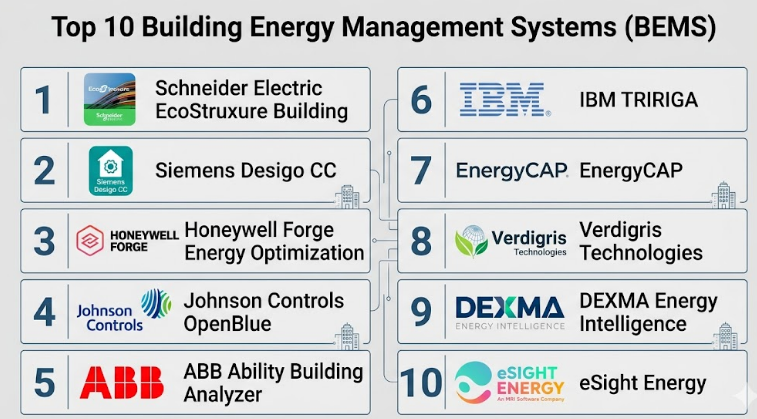
Top 10 Building Energy Management Systems (BEMS)
#1 — Schneider Electric EcoStruxure Building
Short description (5-6 lines):
EcoStruxure Building is a comprehensive smart building platform designed for large enterprises and campuses. It integrates energy management, automation, and analytics into a single system. Known for strong IoT capabilities, it supports digital transformation initiatives across industries. It is widely used in commercial buildings, hospitals, and industrial facilities. The platform emphasizes sustainability and operational efficiency.
Key Features
- Real-time energy monitoring and analytics
- AI-driven automation and optimization
- Digital twin capabilities
- Integration with IoT sensors and devices
- Advanced reporting and ESG tracking
- Scalable architecture for multi-site deployments
Pros
- Highly scalable and enterprise-grade
- Strong ecosystem and integrations
Cons
- Complex implementation
- Higher cost compared to SMB tools
Platforms / Deployment
Cloud / Hybrid
Security & Compliance
RBAC, encryption, audit logs; certifications not publicly stated
Integrations & Ecosystem
Supports wide integration with IoT devices, ERP systems, and building automation systems.
- BACnet, Modbus
- API-based integrations
- Third-party analytics tools
Support & Community
Strong enterprise support with global presence; extensive documentation
#2 — Siemens Desigo CC
Short description (5-6 lines):
Desigo CC is a building management platform focused on energy efficiency and operational intelligence. It offers centralized control of building systems and advanced analytics. Designed for complex infrastructures, it supports large-scale facilities. It combines automation with sustainability insights.
Key Features
- Centralized building control
- Energy analytics dashboards
- HVAC optimization
- Alarm and event management
- Scalability across campuses
Pros
- Strong automation capabilities
- Reliable performance
Cons
- Steep learning curve
- Requires expert setup
Platforms / Deployment
Windows / Hybrid
Security & Compliance
Not publicly stated
Integrations & Ecosystem
Integrates with industrial systems and IoT platforms.
- BACnet
- SCADA integrations
- API support
Support & Community
Enterprise-level support; moderate community presence
#3 — Honeywell Forge Energy Optimization
Short description (5-6 lines):
Honeywell Forge provides AI-driven energy optimization solutions for commercial buildings. It focuses on predictive insights and automation to reduce costs. The platform is suited for enterprises looking to improve sustainability. It delivers actionable intelligence through dashboards.
Key Features
- AI-based energy forecasting
- Predictive maintenance
- Real-time monitoring
- Carbon tracking
- Automated control systems
Pros
- Strong AI capabilities
- Good visualization tools
Cons
- Premium pricing
- Requires data maturity
Platforms / Deployment
Cloud
Security & Compliance
Not publicly stated
Integrations & Ecosystem
Integrates with enterprise systems and IoT platforms.
- APIs
- Sensor integrations
- Data platforms
Support & Community
Enterprise support; limited public community
#4 — Johnson Controls OpenBlue
Short description (5-6 lines):
OpenBlue is a digital platform for smart building management and energy optimization. It combines AI, IoT, and cloud technologies. Designed for enterprises, it provides insights into building performance. It focuses heavily on sustainability and occupant experience.
Key Features
- AI-powered analytics
- IoT device integration
- Energy optimization tools
- ESG reporting
- Smart building automation
Pros
- Strong innovation focus
- Integrated platform
Cons
- Complex deployment
- Vendor dependency
Platforms / Deployment
Cloud
Security & Compliance
Not publicly stated
Integrations & Ecosystem
Broad ecosystem for building systems.
- IoT integrations
- APIs
- Enterprise software
Support & Community
Strong enterprise support
#5 — ABB Ability Building Analyzer
Short description (5-6 lines):
ABB Ability focuses on energy efficiency and performance monitoring. It provides insights into building energy usage and optimization opportunities. The platform is suitable for industrial and commercial facilities. It emphasizes reliability and analytics.
Key Features
- Energy monitoring
- Performance analytics
- Fault detection
- Reporting tools
- Integration with ABB systems
Pros
- Reliable and stable
- Strong analytics
Cons
- Limited UI flexibility
- Niche ecosystem
Platforms / Deployment
Cloud
Security & Compliance
Not publicly stated
Integrations & Ecosystem
Works best within ABB ecosystem.
- IoT devices
- Industrial systems
Support & Community
Enterprise support; limited community
#6 — IBM TRIRIGA
Short description (5-6 lines):
IBM TRIRIGA is an integrated workplace management system that includes energy management capabilities. It helps organizations optimize building operations and sustainability. It is widely used in enterprise environments.
Key Features
- Energy tracking
- Space management
- Asset lifecycle management
- Analytics dashboards
- ESG reporting
Pros
- Comprehensive platform
- Strong enterprise features
Cons
- Complex setup
- High cost
Platforms / Deployment
Cloud / On-prem
Security & Compliance
Not publicly stated
Integrations & Ecosystem
Extensive integrations with enterprise tools.
- ERP systems
- APIs
- IoT integrations
Support & Community
Strong enterprise support
#7 — EnergyCAP
Short description (5-6 lines):
EnergyCAP is a utility bill and energy management platform focused on cost tracking and sustainability reporting. It is suitable for organizations managing utility data across multiple sites. It emphasizes financial insights.
Key Features
- Utility bill tracking
- Energy cost analysis
- Reporting tools
- Carbon tracking
- Data visualization
Pros
- Easy to use
- Strong reporting
Cons
- Limited automation
- Less IoT integration
Platforms / Deployment
Cloud
Security & Compliance
Not publicly stated
Integrations & Ecosystem
Focuses on data integrations.
- Utility data feeds
- APIs
Support & Community
Good customer support; smaller community
#8 — Verdigris Technologies
Short description (5-6 lines):
Verdigris uses AI to monitor energy usage at device-level granularity. It focuses on real-time insights and predictive analytics. Suitable for modern smart buildings. It emphasizes machine learning capabilities.
Key Features
- AI-driven analytics
- Device-level monitoring
- Predictive maintenance
- Real-time dashboards
- Energy optimization
Pros
- Advanced AI insights
- Granular monitoring
Cons
- Requires IoT sensors
- Limited legacy integration
Platforms / Deployment
Cloud
Security & Compliance
Not publicly stated
Integrations & Ecosystem
Modern integrations with IoT platforms.
- APIs
- Sensor integrations
Support & Community
Moderate support; growing ecosystem
#9 — DEXMA Energy Intelligence (Spacewell)
Short description (5-6 lines):
DEXMA is an energy intelligence platform designed for real-time monitoring and optimization. It supports energy audits and sustainability initiatives. Suitable for SMEs and enterprises.
Key Features
- Energy monitoring
- Benchmarking
- Alerts and automation
- Reporting tools
- Multi-site management
Pros
- User-friendly
- Good analytics
Cons
- Limited customization
- Fewer enterprise features
Platforms / Deployment
Cloud
Security & Compliance
Not publicly stated
Integrations & Ecosystem
Supports common integrations.
- APIs
- IoT devices
Support & Community
Good documentation; moderate support
#10 — eSight Energy
Short description (5-6 lines):
eSight Energy is a flexible energy management platform focused on monitoring and reporting. It helps organizations track energy performance and reduce costs. Suitable for various industries.
Key Features
- Energy monitoring
- Data visualization
- Reporting tools
- Cost analysis
- Multi-site support
Pros
- Flexible deployment
- Strong reporting
Cons
- Limited AI features
- UI could be improved
Platforms / Deployment
Cloud / On-prem
Security & Compliance
Not publicly stated
Integrations & Ecosystem
Supports integration with building systems.
- APIs
- Meter integrations
Support & Community
Reliable support; smaller community
Comparison Table (Top 10)
| Tool Name | Best For | Platform(s) Supported | Deployment | Standout Feature | Public Rating |
|---|---|---|---|---|---|
| Schneider Electric EcoStruxure | Enterprises | Web | Hybrid | Digital twin capabilities | N/A |
| Siemens Desigo CC | Large facilities | Windows | Hybrid | Centralized control | N/A |
| Honeywell Forge | AI optimization | Web | Cloud | AI forecasting | N/A |
| Johnson Controls OpenBlue | Smart buildings | Web | Cloud | AI + IoT integration | N/A |
| ABB Ability | Industrial facilities | Web | Cloud | Performance analytics | N/A |
| IBM TRIRIGA | Enterprise ops | Web | Hybrid | Integrated management | N/A |
| EnergyCAP | Utility tracking | Web | Cloud | Cost analytics | N/A |
| Verdigris | AI monitoring | Web | Cloud | Device-level insights | N/A |
| DEXMA | SMEs | Web | Cloud | Benchmarking | N/A |
| eSight Energy | Reporting | Web | Hybrid | Flexible deployment | N/A |
Evaluation & Scoring of Building Energy Management Systems (BEMS)
| Tool Name | Core (25%) | Ease (15%) | Integrations (15%) | Security (10%) | Performance (10%) | Support (10%) | Value (15%) | Weighted Total |
|---|---|---|---|---|---|---|---|---|
| EcoStruxure | 9 | 7 | 9 | 8 | 9 | 9 | 7 | 8.4 |
| Desigo CC | 8 | 6 | 8 | 7 | 9 | 8 | 7 | 7.8 |
| Honeywell Forge | 9 | 7 | 8 | 7 | 8 | 8 | 7 | 8.0 |
| OpenBlue | 9 | 7 | 9 | 7 | 8 | 8 | 7 | 8.1 |
| ABB Ability | 8 | 7 | 7 | 7 | 8 | 7 | 7 | 7.5 |
| IBM TRIRIGA | 9 | 6 | 9 | 8 | 8 | 9 | 6 | 8.0 |
| EnergyCAP | 7 | 8 | 6 | 6 | 7 | 7 | 8 | 7.1 |
| Verdigris | 8 | 7 | 7 | 6 | 8 | 7 | 7 | 7.4 |
| DEXMA | 7 | 8 | 7 | 6 | 7 | 7 | 8 | 7.3 |
| eSight | 7 | 7 | 6 | 6 | 7 | 7 | 7 | 6.9 |
How to interpret scores:
These scores are comparative across this list, not absolute. A difference of 0.5–1.0 can represent meaningful capability gaps. Enterprise tools score higher in features but may lag in ease of use. SMB tools may rank higher in usability and value but lower in scalability.
Which Building Energy Management Systems (BEMS)
Solo / Freelancer
Most BEMS tools are overkill. Consider lightweight energy monitoring tools instead.
SMB
DEXMA, EnergyCAP are good starting points due to ease of use and affordability.
Mid-Market
Verdigris and ABB Ability offer a balance between analytics and scalability.
Enterprise
EcoStruxure, OpenBlue, Siemens Desigo CC, and IBM TRIRIGA are top choices.
Budget vs Premium
Budget tools prioritize reporting; premium tools provide automation and AI.
Feature Depth vs Ease of Use
Advanced tools require training; simpler tools offer faster onboarding.
Integrations & Scalability
Enterprises should prioritize API-rich platforms and IoT compatibility.
Security & Compliance Needs
Large organizations should validate encryption, RBAC, and compliance standards.
Frequently Asked Questions (FAQs)
1. What is a BEMS system?
A BEMS system monitors and optimizes building energy usage through software and connected devices. It helps reduce energy costs and improve efficiency.
2. How much do BEMS tools cost?
Pricing varies widely. Enterprise platforms are premium, while SMB tools offer subscription-based pricing.
3. How long does implementation take?
Implementation can range from weeks to months depending on building complexity and integrations.
4. Do BEMS systems require IoT devices?
Most modern systems rely on IoT sensors for accurate data, but some can integrate with existing infrastructure.
5. Are BEMS tools secure?
Security varies by vendor. Look for encryption, RBAC, and audit logging capabilities.
6. Can BEMS integrate with existing systems?
Yes, most platforms support APIs and standard protocols like BACnet and Modbus.
7. What industries benefit most?
Commercial real estate, healthcare, manufacturing, and education sectors benefit the most.
8. Can small businesses use BEMS?
Yes, but they should choose lightweight and cost-effective solutions.
9. How does AI help in BEMS?
AI enables predictive analytics, automation, and optimization of energy usage.
10. Is it difficult to switch BEMS platforms?
Switching can be complex due to integrations and data migration requirements.
Conclusion
Building Energy Management Systems have evolved into strategic platforms that go far beyond simple monitoring. They now combine AI, automation, IoT integration, and sustainability reporting into unified solutions that directly impact operational efficiency and environmental goals. However, the “best” system depends heavily on your organization’s size, infrastructure maturity, and long-term objectives. Enterprise environments will benefit from deeply integrated platforms like EcoStruxure or OpenBlue, while smaller organizations may find more value in simpler tools like DEXMA or EnergyCAP. The most effective approach is to shortlist two or three solutions, run pilot implementations, and validate real-world performance—especially around integrations, usability, and measurable energy savings.
