Introduction
Hotel Revenue Management Systems (RMS) are specialized software platforms that help hotels optimize room pricing, demand forecasting, and revenue strategies using data-driven insights. In simple terms, an RMS analyzes booking patterns, market demand, competitor pricing, and historical data to recommend the best price at the right time to maximize revenue.
In today’s competitive hospitality environment, especially with fluctuating travel demand and dynamic pricing expectations, RMS tools have become essential. With the rise of AI, automation, and predictive analytics, modern RMS platforms are moving beyond static pricing into intelligent, self-learning systems that adapt in real time.
Real-world use cases include:
- Adjusting room rates dynamically based on demand trends
- Forecasting occupancy and revenue for upcoming periods
- Optimizing pricing across different distribution channels
- Managing promotions and discounts intelligently
- Identifying high-value customer segments
What buyers should evaluate:
- Forecasting accuracy and AI capabilities
- Pricing automation and rules engine
- Integration with PMS and channel managers
- Ease of use and reporting dashboards
- Scalability for multi-property portfolios
- Customization and control over pricing strategies
- Real-time data processing
- Security and access controls
- Support and onboarding quality
Best for: Hotels, resorts, chains, and property management groups that want to maximize revenue through dynamic pricing and data-driven decision-making.
Not ideal for: Very small properties with fixed pricing strategies or those relying only on manual pricing; simpler tools or spreadsheets may suffice.
Key Trends in Hotel Revenue Management Systems
- AI-driven demand forecasting becoming standard across platforms
- Real-time dynamic pricing automation replacing manual rate updates
- Integration with channel managers and PMS for unified workflows
- Cloud-based deployment models dominating the market
- Granular segmentation and personalization for pricing strategies
- Automation of promotions and discounts
- Advanced analytics dashboards with predictive insights
- API-first architectures for extensibility
- Mobile-friendly dashboards for real-time decision-making
- Subscription-based pricing models with tiered features
How We Selected These Tools (Methodology)
- Reviewed global adoption and industry recognition
- Evaluated core revenue optimization capabilities
- Assessed forecasting accuracy and AI sophistication
- Analyzed integration depth with PMS and distribution systems
- Compared ease of use and onboarding experience
- Reviewed performance reliability and scalability
- Examined security posture and compliance signals
- Considered fit across SMB, mid-market, and enterprise users
- Assessed value for cost across different segments
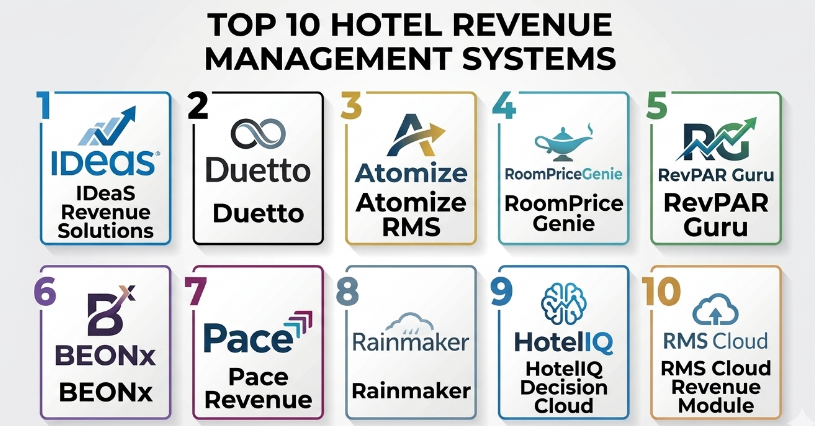
Top 10 Hotel Revenue Management Systems
#1 — IDeaS Revenue Solutions
Short description:
IDeaS is a leading enterprise-grade RMS platform widely used by large hotel chains. It leverages advanced analytics and machine learning for demand forecasting and pricing optimization. Known for its accuracy and scalability, it supports complex revenue strategies. It is best suited for enterprise and large multi-property organizations. Offers deep integration capabilities.
Key Features
- AI-driven demand forecasting
- Dynamic pricing optimization
- Multi-property management
- Advanced analytics dashboards
- Scenario planning tools
- Rate recommendation engine
Pros
- Highly accurate forecasting
- Enterprise-level scalability
Cons
- Expensive for small hotels
- Complex implementation
Platforms / Deployment
- Web
- Cloud
Security & Compliance
- Not publicly stated
Integrations & Ecosystem
Strong integration with hospitality ecosystem tools.
- PMS systems
- Channel managers
- BI platforms
Support & Community
Enterprise-grade support with onboarding assistance.
#2 — Duetto
Short description:
Duetto is a modern RMS platform known for its open pricing approach and cloud-native architecture. It is widely adopted by hotels and casinos. The platform provides real-time insights and flexible pricing strategies. Ideal for mid-market to enterprise users.
Key Features
- Open pricing model
- Real-time demand analytics
- Forecasting tools
- Segmentation capabilities
- API-driven integrations
Pros
- Flexible pricing strategies
- Strong analytics
Cons
- Learning curve for beginners
- Premium pricing
Platforms / Deployment
- Web
- Cloud
Security & Compliance
- Not publicly stated
Integrations & Ecosystem
- PMS integrations
- Channel managers
- APIs
Support & Community
Strong documentation and customer support.
#3 — Atomize RMS
Short description:
Atomize RMS is an AI-powered revenue management platform focused on automation. It is known for real-time pricing updates and ease of use. Suitable for small to mid-sized hotels.
Key Features
- Real-time price optimization
- AI-driven recommendations
- Automated pricing updates
- Performance analytics
- Demand forecasting
Pros
- Easy to use
- Strong automation
Cons
- Limited enterprise features
- Fewer integrations
Platforms / Deployment
- Web
- Cloud
Security & Compliance
- Not publicly stated
Integrations & Ecosystem
- PMS systems
- Channel managers
Support & Community
Good support for SMB users.
#4 — RoomPriceGenie
Short description:
RoomPriceGenie is designed for small hotels looking for simple and effective revenue optimization. It focuses on ease of use and automation. Ideal for independent properties.
Key Features
- Automated pricing
- Demand forecasting
- Easy setup
- Performance tracking
- Simple dashboard
Pros
- Beginner-friendly
- Affordable
Cons
- Limited advanced features
- Not suitable for large chains
Platforms / Deployment
- Web
- Cloud
Security & Compliance
- Not publicly stated
Integrations & Ecosystem
- PMS integrations
- Channel managers
Support & Community
Strong onboarding support.
#5 — RevPAR Guru
Short description:
RevPAR Guru focuses on automated revenue optimization and forecasting. It is suitable for hotels of various sizes. Known for simplicity and actionable insights.
Key Features
- Automated rate optimization
- Forecasting tools
- Market analysis
- Reporting dashboards
- Multi-property support
Pros
- Simple interface
- Good forecasting
Cons
- Limited customization
- Smaller ecosystem
Platforms / Deployment
- Web
- Cloud
Security & Compliance
- Not publicly stated
Integrations & Ecosystem
- PMS
- Channel managers
Support & Community
Decent support availability.
#6 — BEONx (formerly Beonprice)
Short description:
BEONx offers AI-powered revenue optimization with a focus on total profitability. It combines pricing with cost and demand analysis. Suitable for mid-market hotels.
Key Features
- AI-based pricing
- Profit optimization
- Demand forecasting
- Data analytics
- Market insights
Pros
- Focus on profitability
- Strong analytics
Cons
- Learning curve
- Limited SMB focus
Platforms / Deployment
- Web
- Cloud
Security & Compliance
- Not publicly stated
Integrations & Ecosystem
- PMS
- Revenue tools
Support & Community
Reliable support.
#7 — Pace Revenue
Short description:
Pace Revenue is a newer RMS platform emphasizing modern pricing strategies and automation. It is designed for forward-thinking hotels.
Key Features
- Dynamic pricing
- Demand forecasting
- Real-time insights
- Automation tools
- API-first design
Pros
- Modern UI
- Flexible pricing
Cons
- Newer platform
- Smaller ecosystem
Platforms / Deployment
- Web
- Cloud
Security & Compliance
- Not publicly stated
Integrations & Ecosystem
- APIs
- PMS
Support & Community
Growing support ecosystem.
#8 — Rainmaker (Cendyn)
Short description:
Rainmaker is a revenue optimization platform focused on large hotel groups. It combines analytics with marketing insights.
Key Features
- Forecasting models
- Pricing automation
- Customer segmentation
- Analytics tools
- Marketing integration
Pros
- Strong analytics
- Enterprise-ready
Cons
- Complex setup
- Expensive
Platforms / Deployment
- Web
- Cloud
Security & Compliance
- Not publicly stated
Integrations & Ecosystem
- CRM
- PMS
- Marketing tools
Support & Community
Enterprise-level support.
#9 — HotelIQ Decision Cloud
Short description:
HotelIQ combines revenue management with business intelligence. It provides deep analytics and forecasting capabilities.
Key Features
- Advanced analytics
- Forecasting tools
- BI dashboards
- Multi-property support
- Data visualization
Pros
- Strong BI capabilities
- Good reporting
Cons
- Requires training
- Complex interface
Platforms / Deployment
- Web
- Cloud
Security & Compliance
- Not publicly stated
Integrations & Ecosystem
- PMS
- Data platforms
Support & Community
Moderate support.
#10 — RMS Cloud Revenue Module
Short description:
RMS Cloud includes revenue management as part of its broader PMS platform. It is suitable for hotels looking for an integrated solution.
Key Features
- Integrated RMS
- Pricing automation
- Forecasting
- Analytics
- Multi-property support
Pros
- Unified system
- Scalable
Cons
- Less specialized RMS features
- Learning curve
Platforms / Deployment
- Web
- Cloud
Security & Compliance
- Not publicly stated
Integrations & Ecosystem
- PMS
- APIs
Support & Community
Comprehensive support resources.
Comparison Table (Top 10)
| Tool Name | Best For | Platform(s) Supported | Deployment | Standout Feature | Public Rating |
|---|---|---|---|---|---|
| IDeaS | Enterprise | Web | Cloud | Advanced AI forecasting | N/A |
| Duetto | Mid-market/Enterprise | Web | Cloud | Open pricing model | N/A |
| Atomize RMS | SMB | Web | Cloud | Real-time automation | N/A |
| RoomPriceGenie | Small hotels | Web | Cloud | Easy setup | N/A |
| RevPAR Guru | SMB | Web | Cloud | Simple forecasting | N/A |
| BEONx | Mid-market | Web | Cloud | Profit optimization | N/A |
| Pace Revenue | Modern hotels | Web | Cloud | API-first design | N/A |
| Rainmaker | Enterprise | Web | Cloud | Marketing + revenue | N/A |
| HotelIQ | Enterprise | Web | Cloud | BI analytics | N/A |
| RMS Cloud | SMB/Mid | Web | Cloud | Integrated solution | N/A |
Evaluation & Scoring of Hotel Revenue Management Systems
| Tool Name | Core (25%) | Ease (15%) | Integrations (15%) | Security (10%) | Performance (10%) | Support (10%) | Value (15%) | Weighted Total |
|---|---|---|---|---|---|---|---|---|
| IDeaS | 9 | 7 | 9 | 7 | 9 | 8 | 7 | 8.2 |
| Duetto | 9 | 8 | 9 | 7 | 9 | 8 | 7 | 8.4 |
| Atomize RMS | 8 | 9 | 7 | 6 | 8 | 7 | 8 | 7.9 |
| RoomPriceGenie | 7 | 9 | 6 | 6 | 7 | 7 | 9 | 7.6 |
| RevPAR Guru | 7 | 8 | 7 | 6 | 7 | 7 | 8 | 7.4 |
| BEONx | 8 | 7 | 8 | 6 | 8 | 7 | 7 | 7.6 |
| Pace Revenue | 8 | 8 | 7 | 6 | 8 | 7 | 7 | 7.6 |
| Rainmaker | 9 | 6 | 9 | 7 | 9 | 8 | 6 | 8.1 |
| HotelIQ | 8 | 6 | 8 | 6 | 8 | 7 | 7 | 7.4 |
| RMS Cloud | 7 | 7 | 7 | 6 | 7 | 7 | 8 | 7.2 |
How to interpret scores:
- Scores are comparative across tools in this list
- Enterprise tools rank higher in performance and integrations
- SMB tools score higher in ease of use and value
- No single tool is best for all scenarios
- Always validate with your operational needs
Which Hotel Revenue Management Systems
Solo / Freelancer
RoomPriceGenie is best for simplicity and affordability.
SMB
Atomize RMS and RevPAR Guru offer strong automation at reasonable cost.
Mid-Market
Duetto and BEONx provide balance between features and scalability.
Enterprise
IDeaS and Rainmaker are best for large hotel chains.
Budget vs Premium
- Budget: RoomPriceGenie, RevPAR Guru
- Premium: IDeaS, Duetto
Feature Depth vs Ease of Use
- Feature-rich: IDeaS, Rainmaker
- Easy: RoomPriceGenie, Atomize
Integrations & Scalability
Choose Duetto or IDeaS for scalability.
Security & Compliance Needs
Enterprise platforms offer better compliance capabilities.
Frequently Asked Questions (FAQs)
1. What is a hotel RMS?
It is a system that optimizes pricing and revenue using data and analytics.
2. How does RMS improve revenue?
By dynamically adjusting prices based on demand and market trends.
3. Is RMS necessary for small hotels?
Not always, but it can significantly improve profitability.
4. Does RMS replace manual pricing?
Yes, it automates most pricing decisions.
5. Can RMS integrate with PMS?
Yes, integration is a core feature.
6. Is AI used in RMS?
Yes, modern RMS platforms use AI for forecasting.
7. How long is implementation?
It varies from days to weeks depending on complexity.
8. Is data secure?
Most platforms use encryption and access controls.
9. What are common mistakes?
Ignoring integration requirements and overpaying for features.
10. Can I switch RMS later?
Yes, but migration requires planning.
Conclusion
Hotel Revenue Management Systems have become essential tools for maximizing profitability in the modern hospitality landscape. With increasing competition, fluctuating demand, and the rise of digital booking channels, relying on manual pricing strategies is no longer sufficient. RMS platforms bring intelligence, automation, and predictive capabilities that enable hotels to stay competitive and agile.
