Introduction
Restaurant Management Systems (RMS) are software platforms designed to streamline and automate day-to-day restaurant operations—everything from order management and billing to inventory tracking, staff scheduling, and customer engagement. In simple terms, they act as the operational backbone for restaurants, cafes, cloud kitchens, and multi-location food chains.
In the current landscape, where digital ordering, delivery integrations, and customer experience are critical, RMS solutions have become essential. With increasing demand for automation, AI-driven insights, and real-time visibility, modern restaurant systems go far beyond traditional POS tools.
Real-world use cases include:
- Managing dine-in, takeaway, and online orders in a unified system
- Tracking inventory and reducing food wastage
- Automating staff scheduling and payroll processes
- Integrating with delivery platforms and payment gateways
- Enhancing customer loyalty programs and personalized marketing
What buyers should evaluate:
- POS capabilities and speed
- Inventory and supply chain management
- Integration with delivery apps
- Reporting and analytics features
- Ease of use and onboarding
- Pricing and scalability
- Hardware compatibility
- Security and compliance features
Best for: Restaurant owners, chain operators, cloud kitchens, hospitality managers, and franchise businesses looking to streamline operations and improve efficiency.
Not ideal for: Very small food stalls or vendors with minimal operations who may only need basic billing tools instead of full-scale management systems.
Key Trends in Restaurant Management Systems
- AI-driven analytics: Predictive demand forecasting and menu optimization
- Cloud-first deployment: Reduced dependency on on-premise infrastructure
- Omnichannel ordering: Integration across dine-in, takeaway, delivery, and apps
- Contactless experiences: QR-based menus, payments, and self-ordering kiosks
- Automation in inventory: Real-time stock tracking with alerts and reordering
- Subscription pricing models: Flexible SaaS-based pricing replacing upfront costs
- API-first ecosystems: Easy integration with third-party delivery and CRM tools
- Employee management tools: Workforce scheduling, performance tracking
- Data-driven personalization: Loyalty programs and targeted promotions
- Security enhancements: Increasing focus on data protection and compliance
How We Selected These Tools (Methodology)
- Evaluated market adoption and global usage
- Assessed feature completeness across restaurant workflows
- Considered scalability for single and multi-location businesses
- Reviewed reliability and uptime signals
- Examined integration capabilities with POS, delivery apps, and payment systems
- Checked flexibility across restaurant types (fine dining, QSR, cloud kitchen)
- Considered usability and onboarding experience
- Evaluated vendor ecosystem and partner support
- Assessed pricing models and value for money
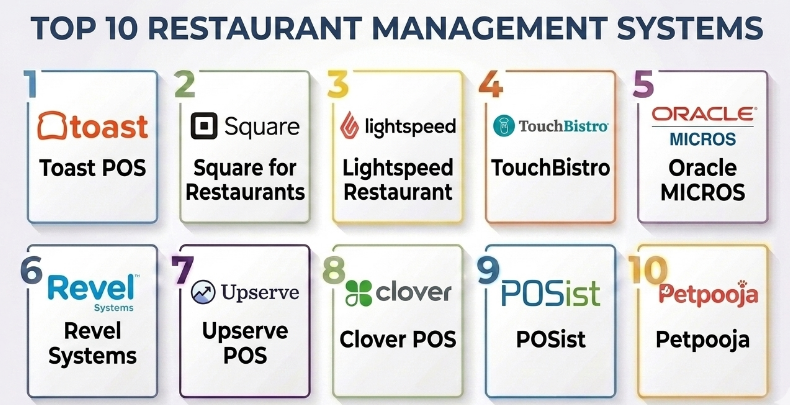
Top 10 Restaurant Management Systems
#1 — Toast POS
Short description (5-6 lines):
Toast POS is a cloud-based restaurant management platform designed specifically for food service businesses. It offers an all-in-one solution covering POS, online ordering, inventory, and payroll. Popular among restaurants in North America, it focuses on ease of use and operational efficiency. It supports both small restaurants and large chains. Toast is particularly strong in front-of-house and back-of-house integration.
Key Features
- Integrated POS and payment processing
- Online ordering and delivery management
- Inventory tracking and menu management
- Employee scheduling and payroll
- Customer loyalty programs
- Reporting and analytics
Pros
- Strong restaurant-specific features
- Seamless integration of front and back operations
Cons
- Limited global availability
- Hardware dependency
Platforms / Deployment
- Web / iOS / Android
- Cloud
Security & Compliance
- Encryption, RBAC, audit logs
- Not publicly stated for certifications
Integrations & Ecosystem
Toast integrates with delivery platforms, accounting tools, and CRM systems.
- Payment gateways
- Delivery services
- Accounting software
- Marketing tools
Support & Community
Strong onboarding support and documentation; enterprise support tiers available.
#2 — Square for Restaurants
Short description (5-6 lines):
Square for Restaurants is a flexible and widely adopted POS and management system tailored for restaurants of all sizes. It is known for its ease of setup and affordability. Ideal for small to mid-sized restaurants, it supports both dine-in and takeaway operations efficiently.
Key Features
- POS and payment processing
- Table management
- Menu customization
- Staff management
- Reporting tools
Pros
- Easy to set up
- Affordable pricing
Cons
- Limited advanced features for large enterprises
- Customization constraints
Platforms / Deployment
- Web / iOS / Android
- Cloud
Security & Compliance
- Encryption, MFA
- Not publicly stated for certifications
Integrations & Ecosystem
Square integrates with e-commerce, accounting, and CRM tools.
- Payment integrations
- CRM tools
- Delivery apps
Support & Community
Good support resources; strong user community.
#3 — Lightspeed Restaurant
Short description (5-6 lines):
Lightspeed Restaurant offers a powerful POS and restaurant management system designed for high-volume restaurants and chains. It provides deep analytics, inventory control, and multi-location management capabilities.
Key Features
- Advanced POS system
- Inventory and supplier management
- Multi-location support
- Analytics dashboard
- Customer management
Pros
- Strong reporting capabilities
- Scalable for growth
Cons
- Higher cost
- Learning curve for new users
Platforms / Deployment
- Web / iOS
- Cloud
Security & Compliance
- Not publicly stated
Integrations & Ecosystem
Integrates with accounting, delivery, and CRM systems.
- Third-party integrations
- API support
Support & Community
Professional support; onboarding assistance available.
#4 — TouchBistro
Short description (5-6 lines):
TouchBistro is an iPad-based restaurant POS system designed for ease of use and quick deployment. It is popular among small to mid-sized restaurants and cafes.
Key Features
- iPad-based POS
- Table and order management
- Inventory tracking
- Staff scheduling
- Reporting
Pros
- User-friendly interface
- Quick deployment
Cons
- Limited scalability
- Hardware dependency
Platforms / Deployment
- iOS
- Cloud
Security & Compliance
- Not publicly stated
Integrations & Ecosystem
Supports integrations with payment systems and delivery apps.
- Payment processors
- Delivery integrations
Support & Community
Responsive support; moderate community presence.
#5 — Oracle MICROS
Short description (5-6 lines):
Oracle MICROS is an enterprise-grade restaurant management system used by global chains. It offers comprehensive functionality, scalability, and integration with enterprise systems.
Key Features
- Enterprise POS
- Inventory and supply chain
- Workforce management
- Advanced analytics
- Multi-location support
Pros
- Highly scalable
- Enterprise-level features
Cons
- Complex implementation
- Expensive
Platforms / Deployment
- Web / Windows
- Cloud / On-premise
Security & Compliance
- RBAC, audit logs
- Not publicly stated for certifications
Integrations & Ecosystem
Deep integration with enterprise systems.
- ERP systems
- CRM platforms
Support & Community
Enterprise-grade support; dedicated account management.
#6 — Revel Systems
Short description (5-6 lines):
Revel Systems is a cloud-based POS and management solution tailored for restaurants and retail businesses. It supports multi-location operations and provides robust reporting tools.
Key Features
- POS system
- Inventory tracking
- Customer management
- Reporting tools
- Employee management
Pros
- Scalable
- Good reporting
Cons
- Higher cost
- Setup complexity
Platforms / Deployment
- iOS
- Cloud
Security & Compliance
- Not publicly stated
Integrations & Ecosystem
Integrates with payment systems and third-party tools.
- Payment integrations
- API access
Support & Community
Reliable support; onboarding services available.
#7 — Upserve POS
Short description (5-6 lines):
Upserve POS focuses on improving restaurant performance through analytics and insights. It is suitable for mid-sized restaurants aiming to enhance customer experience.
Key Features
- POS system
- Analytics and reporting
- Inventory management
- Customer insights
- Staff management
Pros
- Strong analytics
- Customer insights
Cons
- Limited scalability
- Pricing
Platforms / Deployment
- iOS
- Cloud
Security & Compliance
- Not publicly stated
Integrations & Ecosystem
Supports integrations with CRM and delivery platforms.
- CRM integrations
- Delivery apps
Support & Community
Good support; documentation available.
#8 — Clover POS
Short description (5-6 lines):
Clover POS is a versatile restaurant management system offering customizable hardware and software solutions. It is widely used by small and mid-sized businesses.
Key Features
- POS and payments
- Inventory management
- Employee tracking
- Reporting tools
- App marketplace
Pros
- Flexible hardware options
- App ecosystem
Cons
- Add-on costs
- Limited customization
Platforms / Deployment
- Web / Android
- Cloud
Security & Compliance
- Encryption, MFA
- Not publicly stated
Integrations & Ecosystem
Extensive app marketplace for integrations.
- Payment integrations
- Third-party apps
Support & Community
Good support; active ecosystem.
#9 — POSist
Short description (5-6 lines):
POSist is a cloud-based restaurant management platform focused on automation and analytics. It is popular among growing restaurant chains.
Key Features
- POS system
- Inventory automation
- Analytics dashboard
- Multi-location support
- CRM features
Pros
- Strong automation
- Scalable
Cons
- Learning curve
- Pricing transparency
Platforms / Deployment
- Web / Android / iOS
- Cloud
Security & Compliance
- Not publicly stated
Integrations & Ecosystem
Supports integrations with delivery platforms and ERP systems.
- Delivery apps
- ERP systems
Support & Community
Professional support; onboarding available.
#10 — Petpooja
Short description (5-6 lines):
Petpooja is a widely used restaurant management system in India, offering affordable and scalable solutions for restaurants and cloud kitchens.
Key Features
- POS system
- Inventory management
- Online ordering
- CRM tools
- Reporting
Pros
- Affordable
- Local market focus
Cons
- Limited global presence
- Feature depth varies
Platforms / Deployment
- Web / Android / iOS
- Cloud
Security & Compliance
- Not publicly stated
Integrations & Ecosystem
Integrates with local delivery platforms and payment systems.
- Payment integrations
- Delivery apps
Support & Community
Strong regional support; good onboarding.
Comparison Table (Top 10)
| Tool Name | Best For | Platform(s) Supported | Deployment | Standout Feature | Public Rating |
|---|---|---|---|---|---|
| Toast POS | Full-service restaurants | Web, iOS, Android | Cloud | All-in-one restaurant solution | N/A |
| Square for Restaurants | Small businesses | Web, iOS, Android | Cloud | Easy setup | N/A |
| Lightspeed Restaurant | Multi-location chains | Web, iOS | Cloud | Advanced analytics | N/A |
| TouchBistro | Small cafes | iOS | Cloud | iPad-based POS | N/A |
| Oracle MICROS | Enterprises | Web, Windows | Hybrid | Enterprise scalability | N/A |
| Revel Systems | Growing businesses | iOS | Cloud | Multi-location support | N/A |
| Upserve POS | Mid-sized restaurants | iOS | Cloud | Customer insights | N/A |
| Clover POS | SMBs | Web, Android | Cloud | App marketplace | N/A |
| POSist | Chain restaurants | Web, Android, iOS | Cloud | Automation | N/A |
| Petpooja | Indian market | Web, Android, iOS | Cloud | Affordability | N/A |
Evaluation & Scoring of Restaurant Management Systems
| Tool Name | Core (25%) | Ease (15%) | Integrations (15%) | Security (10%) | Performance (10%) | Support (10%) | Value (15%) | Weighted Total |
|---|---|---|---|---|---|---|---|---|
| Toast POS | 9 | 8 | 8 | 7 | 8 | 8 | 7 | 8.05 |
| Square | 8 | 9 | 7 | 7 | 8 | 8 | 9 | 8.15 |
| Lightspeed | 9 | 7 | 8 | 7 | 8 | 7 | 6 | 7.75 |
| TouchBistro | 7 | 9 | 6 | 6 | 7 | 7 | 8 | 7.55 |
| Oracle MICROS | 10 | 6 | 9 | 8 | 9 | 9 | 5 | 8.10 |
| Revel | 8 | 7 | 7 | 7 | 8 | 7 | 6 | 7.45 |
| Upserve | 7 | 8 | 7 | 6 | 7 | 7 | 7 | 7.20 |
| Clover | 7 | 8 | 8 | 7 | 7 | 7 | 8 | 7.60 |
| POSist | 8 | 7 | 8 | 6 | 7 | 7 | 7 | 7.45 |
| Petpooja | 7 | 8 | 7 | 6 | 7 | 8 | 9 | 7.70 |
How to interpret scores:
These scores are comparative and based on typical capabilities across tools. A higher score indicates stronger overall performance in that category. However, businesses should prioritize criteria based on their specific needs (e.g., cost vs scalability). The weighted total provides a balanced overview rather than an absolute ranking.
Which Restaurant Management Systems
Solo / Freelancer
Square or Petpooja due to affordability and simplicity.
SMB
Clover, TouchBistro, or Square offer balanced features and cost.
Mid-Market
Lightspeed, POSist, and Revel provide scalability and analytics.
Enterprise
Oracle MICROS and Toast POS are best for large operations.
Budget vs Premium
- Budget: Petpooja, Square
- Premium: Oracle MICROS, Lightspeed
Feature Depth vs Ease of Use
- Feature-rich: Oracle MICROS
- Easy-to-use: Square, TouchBistro
Integrations & Scalability
- Best integrations: Toast, Lightspeed
- Scalable: Oracle MICROS
Security & Compliance Needs
- Enterprise-grade: Oracle MICROS
- Basic: SMB tools
Frequently Asked Questions (FAQs)
1. What is the cost of restaurant management systems?
Pricing varies widely from subscription-based monthly fees to enterprise-level contracts. Small businesses can expect affordable plans, while enterprise solutions are significantly higher.
2. How long does implementation take?
Implementation can take from a few hours (for simple systems) to several weeks for enterprise deployments.
3. Can these systems integrate with delivery apps?
Yes, most modern systems support integration with food delivery platforms for seamless order management.
4. Are these systems suitable for cloud kitchens?
Yes, many tools are optimized for cloud kitchens with online ordering and inventory management features.
5. What are common mistakes when choosing an RMS?
Choosing based only on price, ignoring integrations, and not considering scalability are common mistakes.
6. Do RMS tools support multiple locations?
Yes, most mid-market and enterprise tools support multi-location management.
7. How secure are these systems?
Security varies by provider; common features include encryption, RBAC, and audit logs.
8. Can I switch systems later?
Yes, but migration requires careful planning to avoid data loss and operational disruption.
9. Do these tools work offline?
Some systems offer offline modes, but cloud-based tools may have limitations.
10. Are there alternatives to RMS?
Basic POS systems or manual processes can be alternatives for very small businesses.
Conclusion
Restaurant Management Systems have evolved into comprehensive platforms that unify operations, improve efficiency, and enhance customer experience. From small cafes to global restaurant chains, the right system can significantly impact profitability and scalability. However, there is no one-size-fits-all solution. Businesses must carefully evaluate their size, budget, operational complexity, and integration needs before making a decision. The best approach is to shortlist two or three systems, test them in real-world scenarios, and validate how well they integrate with your existing workflows. A thoughtful selection today can set the foundation for long-term operational success.
