Introduction
Software delivery currently moves at a pace that traditional security models simply cannot match. For this reason, many organizations find themselves choosing between velocity and vulnerability. Fortunately, the DevSecOps Certified Professional (DSOCP) offers a middle ground where security becomes an accelerator rather than a roadblock. This guide specifically targets engineers who want to lead the charge in cloud-native and platform engineering circles. By reading further, you will gain a clear perspective on how to navigate your professional growth. Moreover, this resource helps you evaluate whether this certification aligns with your long-term goals. Consequently, you will move beyond the hype to understand the actual mechanics of a secure pipeline.
What is the DevSecOps Certified Professional (DSOCP)?
The DevSecOps Certified Professional (DSOCP) represents a specialized training and validation program designed to embed security practices directly into the automated CI/CD pipeline. Specifically, it exists to transform the traditional “security as a gatekeeper” model into a collaborative “security as code” approach. Instead of focusing solely on theoretical concepts, the program emphasizes real-world, production-focused learning. This ensures that participants can handle the complexities of modern engineering workflows and enterprise practices. Moreover, it aligns perfectly with the needs of large-scale organizations that require high-velocity releases without compromising on data integrity or compliance standards.
Who Should Pursue DevSecOps Certified Professional (DSOCP)?
A diverse range of professionals can benefit significantly from obtaining this credential. For instance, DevOps engineers and Site Reliability Engineers (SREs) will find the curriculum essential for automating security checks across distributed systems. Similarly, cloud professionals and security analysts should pursue this certification to understand how to protect containerized environments and serverless architectures. Even beginners who possess a fundamental understanding of Linux and automation can use this as a stepping stone into high-growth roles. Additionally, engineering managers and technical leaders in India and across the globe often seek this certification to lead their teams through successful digital transformations while maintaining a secure posture.
Why DevSecOps Certified Professional (DSOCP) is Valuable for the Future
The enterprise adoption of cloud-native technologies has led to an unprecedented demand for security-conscious automation experts. Therefore, the DevSecOps Certified Professional (DSOCP) remains highly valuable because it addresses the growing longevity of secure infrastructure needs. As toolchains continue to evolve, the core principles of this certification help professionals stay relevant by focusing on architectural patterns rather than just specific software versions. Furthermore, organizations are increasingly prioritizing security due to rising cyber threats, which translates to a high return on time and career investment for certified individuals. Consequently, mastering these skills ensures that you remain an indispensable asset to any modern engineering team.
DevSecOps Certified Professional (DSOCP) Certification Overview
The program is delivered via the official DevSecOps Certified Professional (DSOCP) portal and hosted on the main DevOpsSchool website. This certification provides a structured assessment approach that focuses on the practical application of security tools within the DevOps lifecycle. It is owned and managed by industry veterans who understand the nuances of enterprise-grade security. In practical terms, the structure includes hands-on labs, comprehensive lectures, and a final assessment that validates your ability to secure code, builds, and deployments. Thus, it offers a clear roadmap for anyone looking to transition from traditional IT roles into specialized security positions.
DevSecOps Certified Professional (DSOCP) Certification Tracks & Levels
The certification framework is organized into foundation, professional, and advanced levels to cater to different career stages. Initially, the foundation level introduces the core concepts of shift-left security and basic automation. Subsequently, the professional level dives deep into the integration of static and dynamic analysis tools within the pipeline. Finally, the advanced level focuses on architectural security, compliance as code, and governance at scale. Moreover, there are specialization tracks that allow you to align your learning with specific domains such as FinOps or AIOps. This tiered approach ensures that your certification level directly matches your real-world experience and your desired career progression.
Complete DevSecOps Certified Professional (DSOCP) Certification Table
| Track | Level | Who it’s for | Prerequisites | Skills Covered | Recommended Order |
| Security | Foundation | Junior Engineers | Basic Linux | CI/CD Basics, Security Culture | 1st |
| Automation | Professional | DevOps Engineers | Docker, Jenkins | SAST, DAST, Container Security | 2nd |
| Infrastructure | Professional | SREs | Terraform, K8s | Infrastructure as Code Security | 3rd |
| Compliance | Advanced | Security Architects | 3+ years Exp | Governance, Auditing, Policy as Code | 4th |
| Strategy | Advanced | Tech Leads/Managers | Lead Experience | Risk Management, DevSecOps ROI | 5th |
Detailed Guide for Each DevSecOps Certified Professional (DSOCP) Certification
DevSecOps Certified Professional (DSOCP) – Foundation Level
What it is This certification validates a candidate’s understanding of the fundamental principles of security within a DevOps environment. It ensures that the professional can articulate the value of the DevSecOps culture and identify common security bottlenecks in a standard delivery pipeline.
Who should take it This is suitable for junior developers, system administrators, and recent graduates who want to build a career in cloud security. It also serves as an excellent starting point for project managers who need to understand the technical requirements of secure delivery.
Skills you’ll gain
- Mastery of the “Shift-Left” philosophy in software development.
- Ability to identify different types of security vulnerabilities early.
- Basic understanding of automated security scanning tools.
- Proficiency in collaborating across development and security teams.
Real-world projects you should be able to do
- Setting up a basic Jenkins pipeline with integrated linting.
- Identifying hardcoded secrets in source code repositories.
- Creating a simple documentation set for security compliance.
Preparation plan
- 7-14 Days: Focus on the core definitions, culture, and the “Three Ways” of DevOps.
- 30 Days: Practice with basic open-source security tools like SonarQube.
- 60 Days: Complete the official training modules and review the foundation exam guide.
Common mistakes
- Focusing too much on tools instead of understanding the underlying culture.
- Ignoring the importance of communication between development and operations.
Best next certification after this
- Same-track option: DSOCP Professional Level.
- Cross-track option: Certified Kubernetes Administrator (CKA).
- Leadership option: DevOps Leader (DOL).
DevSecOps Certified Professional (DSOCP) – Professional Level
What it is This certification confirms your ability to design and implement automated security checkpoints throughout the entire CI/CD lifecycle. It demonstrates that you can use professional-grade tools to protect applications in a production environment.
Who should take it This is designed for experienced DevOps engineers and SREs who are responsible for maintaining and securing the deployment infrastructure. It also caters to security professionals who wish to transition into automation-heavy roles.
Skills you’ll gain
- Implementation of Static Application Security Testing (SAST).
- Configuration of Dynamic Application Security Testing (DAST).
- Securing containerized workloads in Kubernetes environments.
- Managing secrets and sensitive data using HashiCorp Vault.
Real-world projects you should be able to do
- Building a full-stack CI/CD pipeline with automated vulnerability scanning.
- Implementing “Policy as Code” using Open Policy Agent (OPA).
- Configuring real-time monitoring and alerting for security incidents.
Preparation plan
- 7-14 Days: Review advanced Git workflows and container security basics.
- 30 Days: Set up a lab environment to integrate Snyk, Aqua, and SonarQube.
- 60 Days: Work on complex automation scripts and finalize the professional curriculum.
Common mistakes
- Neglecting the performance impact of security scans on build times.
- Failing to automate the remediation process for common vulnerabilities.
Best next certification after this
- Same-track option: DSOCP Advanced Level.
- Cross-track option: Cloud Security Professional (CCSP).
- Leadership option: DevSecOps Manager Certification.
Choose Your Learning Path
DevOps Path
Individuals following the DevOps path should focus on integrating security into their automation scripts immediately. Consequently, they learn how to ensure that every code commit is automatically verified for security flaws. This path emphasizes the speed of delivery while maintaining high security standards. Therefore, it is ideal for those who love scripting and system architecture.
DevSecOps Path
The DevSecOps path is a specialized journey that prioritizes security at every single layer of the stack. Specifically, you will learn how to build security into the infrastructure, the application code, and the deployment environment. Moreover, this path focuses heavily on tools like Vault and OPA. It is the perfect choice for professionals who want to become dedicated security engineers within a DevOps team.
SRE Path
Site Reliability Engineers should pursue a path that combines security with system resilience and observability. In this context, you will learn how to monitor for security anomalies in real-time and automate the response to potential threats. Furthermore, this path explores the security of distributed systems and high-availability clusters. As a result, it produces professionals who can protect complex production environments.
AIOps / MLOps Path
This path involves applying artificial intelligence and machine learning to the security operations landscape. Specifically, you will learn how to use AI to predict potential security breaches and automate complex decision-making processes. Additionally, you will study how to secure the ML models themselves against adversarial attacks. Consequently, this is the most innovative path for forward-thinking engineers.
DataOps Path
The DataOps path focuses on the security of data pipelines and large-scale data storage solutions. For instance, you will learn how to implement encryption at rest and in transit for massive datasets. Moreover, you will explore how to manage access controls and compliance for sensitive data in the cloud. Therefore, this path is essential for data engineers and privacy officers.
FinOps Path
FinOps professionals must learn to balance the cost of security tools with the overall budget of the cloud infrastructure. Specifically, this path teaches you how to optimize the financial impact of security operations. Furthermore, you will understand how to justify security investments based on risk mitigation and compliance needs. Consequently, this path is vital for those who manage cloud finances and operational efficiency.
Role → Recommended DevSecOps Certified Professional (DSOCP) Certifications
| Role | Recommended Certifications |
| DevOps Engineer | DSOCP Professional, Foundation |
| SRE | DSOCP Professional, SRE Specialist |
| Platform Engineer | DSOCP Advanced, Infrastructure Security |
| Cloud Engineer | DSOCP Professional, Cloud Security |
| Security Engineer | DSOCP Advanced, Professional |
| Data Engineer | DSOCP Foundation, Data Security |
| FinOps Practitioner | DSOCP Foundation, Cost Security |
| Engineering Manager | DSOCP Advanced, Leadership |
Next Certifications to Take After DevSecOps Certified Professional (DSOCP)
Same Track Progression
Once you complete the professional level, you should strive for the advanced DevSecOps Certified Professional (DSOCP) designation. This allows you to dive deeper into governance, risk management, and large-scale compliance. Moreover, deep specialization helps you become a subject matter expert in niche areas such as “Security as Code.” Consequently, this path ensures you remain at the top of your technical field.
Cross-Track Expansion
If you want to broaden your skill set, consider moving into related fields like SRE or FinOps. For instance, learning about reliability will help you understand how security affects system uptime. Furthermore, expanding your knowledge into different “Ops” domains makes you a more versatile professional. Consequently, this approach opens up a wider variety of career opportunities across the industry.
Leadership & Management Track
For those interested in the human side of technology, moving into a leadership track is a logical next step. Specifically, you can look for certifications focused on DevOps leadership or IT management. This transition allows you to move from individual technical tasks to strategic decision-making. Therefore, you will be able to lead entire departments through the cultural shift required for successful DevSecOps adoption.
Training & Certification Support Providers for DevSecOps Certified Professional (DSOCP)
DevOpsSchool
This provider offers extensive resources and instructor-led training specifically tailored for the DSOCP curriculum. Furthermore, they provide high-quality labs and real-world scenarios that help students master the material quickly. Consequently, many professionals choose this site for its comprehensive support and industry-aligned content.
Cotocus
Cotocus focuses on providing hands-on experience and practical workshops for aspiring security professionals. Specifically, their training modules are designed to be interactive and engaging for working engineers. In addition, they offer flexible learning schedules that accommodate the needs of busy professionals globally.
Scmgalaxy
This platform serves as a massive community hub for DevOps and security enthusiasts alike. Specifically, it provides a wealth of articles, tutorials, and certification guides that support the DSOCP journey. Moreover, their focus on configuration management makes them a unique choice for those specializing in infrastructure security.
BestDevOps
BestDevOps offers a streamlined approach to certification preparation with a focus on core technical competencies. Furthermore, their study materials are regularly updated to reflect the latest trends in the security industry. Consequently, it is a reliable resource for anyone looking to pass their exams on the first attempt.
devsecopsschool.com
This dedicated portal focuses exclusively on the DevSecOps domain and offers specialized training for the DSOCP track. Specifically, the curriculum covers everything from basic container security to advanced cloud governance. Furthermore, the platform provides access to a network of security experts and mentors.
sreschool.com
While primarily focused on site reliability, this provider includes significant security components in its training programs. Specifically, they teach how to build resilient systems that are fundamentally secure by design. Consequently, it is an excellent resource for engineers who want to blend SRE and DevSecOps skills.
aiopsschool.com
This provider specializes in the intersection of artificial intelligence and operations. Specifically, they offer insights into how AI can be used to automate security responses and monitor complex systems. Therefore, it is a great choice for those looking to advance into the AIOps specialization.
dataopsschool.com
DataOpsSchool provides targeted training for securing data pipelines and ensuring data privacy in the cloud. Furthermore, their courses cover the essential tools and techniques needed to protect sensitive information. Consequently, it is the primary destination for data engineers seeking security certifications.
finopsschool.com
This site helps professionals understand the financial aspects of cloud security and infrastructure management. Specifically, they offer courses that bridge the gap between technical security and financial accountability. Moreover, it is a vital resource for those looking to optimize their security spending.
Frequently Asked Questions
- How difficult is the DevSecOps Certified Professional (DSOCP) exam? The difficulty level is moderate to high because it requires both theoretical knowledge and practical skills. Specifically, you must demonstrate a deep understanding of how security tools integrate with CI/CD pipelines. However, if you have experience with Jenkins, Docker, and basic security principles, you will find the material manageable. Consistent practice in lab environments is the key to success.
- What is the typical time required to complete this certification? Most professionals complete the entire program within two to three months of dedicated study. Specifically, this includes attending training sessions, completing hands-on labs, and reviewing the official documentation. Furthermore, your existing experience in DevOps will significantly influence the total time required. Consequently, engineers with some background in automation can often finish the curriculum faster than absolute beginners.
- Are there any specific prerequisites for the DSOCP Professional level? Yes, candidates should ideally have a basic understanding of Linux administration and shell scripting. Furthermore, familiarity with containerization technologies like Docker and orchestration tools like Kubernetes is highly recommended. While the foundation level is not strictly mandatory, it provides a solid base that makes the professional level much easier to comprehend and complete successfully.
- What is the expected ROI for this certification in India? In India, the demand for security-aware DevOps engineers is growing rapidly, leading to significant salary increases. Specifically, professionals with this certification often see a 20% to 40% jump in their compensation packages. Furthermore, it opens doors to senior roles in multinational corporations and high-growth startups. Consequently, the investment in this certification pays off very quickly for most engineers.
- In what order should I take the DevSecOps certifications? The most logical sequence is to start with the Foundation level to grasp the core culture. Subsequently, you should move to the Professional level to master the technical tools and automation. Finally, you should aim for the Advanced level once you have at least three years of industry experience. This gradual progression ensures that you build a solid foundation before tackling complex topics.
- How does this certification help with career longevity? Security is a foundational requirement that will never go out of style, regardless of which tools become popular. Specifically, the DSOCP focuses on architectural principles and security mindsets that are applicable across various technologies. Furthermore, as more companies migrate to the cloud, the need for security experts will only increase. Consequently, this certification protects your career against future technological shifts.
- Is the DSOCP certification recognized globally? Yes, the certification is recognized by major enterprises and technology firms around the world. Specifically, it follows industry-standard practices that are relevant in the United States, Europe, and Asia. Moreover, the curriculum is based on the same principles used by global leaders in cloud-native security. Therefore, you can use this credential to pursue career opportunities in any international market.
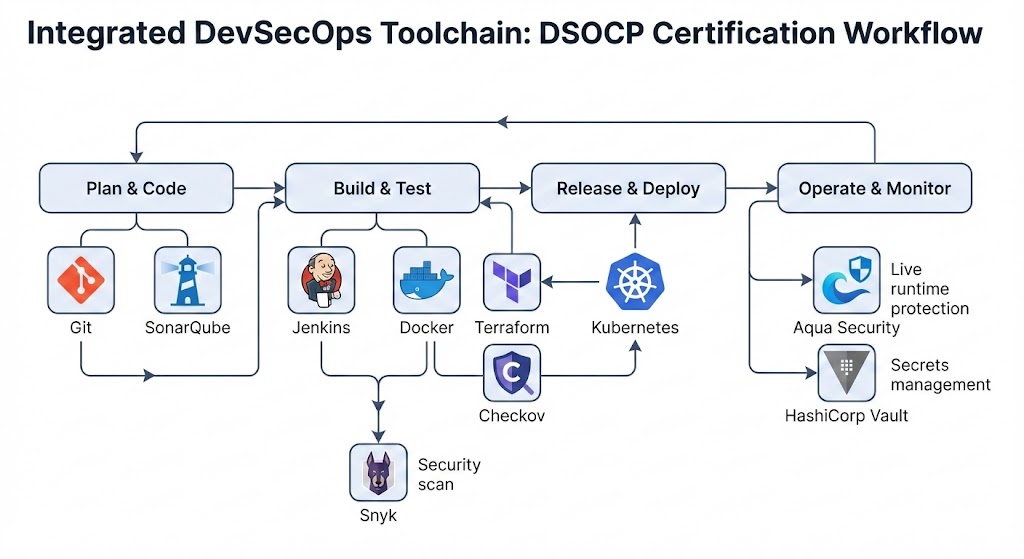
- What tools are covered in the DSOCP curriculum? The curriculum covers a wide range of industry-standard tools including SonarQube for static analysis and OWASP ZAP for dynamic testing. Furthermore, you will learn about HashiCorp Vault for secrets management and Aqua Security for container protection. Additionally, the program includes training on Jenkins, Git, and various cloud-native security features. Consequently, you will gain hands-on experience with the most relevant technologies.
- Can I skip the training and just take the exam? While some experienced professionals might attempt this, it is not recommended due to the practical nature of the assessment. Specifically, the training provides access to specialized labs and scenarios that are difficult to replicate on your own. Furthermore, the instructors provide valuable insights into the specific format and expectations of the final exam. Therefore, completing the training significantly increases your chances of passing.
- Does the certification expire? Most professional certifications require renewal every few years to ensure your skills remain current. Specifically, you may need to earn continuing education credits or pass a brief update exam. Furthermore, staying active in the security community and attending workshops can help you maintain your certified status. Consequently, you should plan to refresh your knowledge periodically to keep your credential valid and relevant.
- What kind of support is available during the learning process? Most providers offer extensive support including dedicated mentors, community forums, and 24/7 access to lab environments. Specifically, you can reach out to instructors if you encounter difficulties with complex technical topics. Furthermore, many students find that joining study groups and online communities provides additional motivation and clarity. Consequently, you will have plenty of resources to help you succeed in your journey.
- Is it worth getting DSOCP if I am already a Security Engineer? Absolutely, because many traditional security engineers lack the automation and CI/CD skills required in a modern DevOps environment. Specifically, the DSOCP helps you understand how to translate security requirements into automated code. Furthermore, it allows you to collaborate more effectively with development and operations teams. Consequently, this certification makes you a much more effective and valuable member of a modern engineering organization.
FAQs on DevSecOps Certified Professional (DSOCP)
- How does DSOCP differ from other security certifications like CISSP? While CISSP focuses on high-level security management and governance, DSOCP is specifically designed for the technical implementation of security within a DevOps pipeline. It emphasizes hands-on automation and tool integration over administrative policy.
- Can a project manager benefit from the DSOCP certification? Yes, project managers gain a better understanding of the technical constraints and timelines associated with secure software delivery. It helps them communicate more effectively with engineering teams and manage risks more accurately during the development lifecycle.
- What is the significance of the “Shift-Left” concept in this certification? “Shift-Left” is the core philosophy of DSOCP, focusing on moving security testing to the earliest possible stage of development. This approach reduces the cost of fixing vulnerabilities and prevents security bottlenecks at the end of the release cycle.
- Is the exam based on multiple-choice questions or practical labs? The exam typically includes a combination of both theoretical questions and hands-on lab exercises. This ensures that the candidate not only knows the concepts but can also apply them in a simulated production environment.
- How does DSOCP address container and Kubernetes security? The certification includes specific modules on securing Docker images, managing container registries, and protecting Kubernetes clusters. You will learn how to implement network policies and use admission controllers to maintain a secure cloud-native environment.
- What role does “Compliance as Code” play in the DSOCP curriculum? Compliance as Code is a key topic that teaches you how to automate the auditing and enforcement of regulatory standards. You will learn how to write policies that automatically check your infrastructure for compliance with frameworks like PCI-DSS or HIPAA.
- How does the certification prepare you for real-world security incidents? The program covers incident response and real-time monitoring, teaching you how to detect and mitigate threats as they occur. You will learn how to set up automated alerts and playbooks to handle common security events efficiently.
- Does the program cover the security of open-source components? Yes, a significant portion of the curriculum is dedicated to Software Composition Analysis (SCA). You will learn how to scan third-party libraries for known vulnerabilities and manage the risks associated with using open-source software in your applications.
Final Thoughts: Is DevSecOps Certified Professional (DSOCP) Worth It?
As a mentor who has watched the industry shift from manual deployments to fully automated cloud environments, I can confidently state that the DevSecOps Certified Professional (DSOCP) is a high-value investment. In today’s landscape, security is no longer an optional feature; it is a fundamental requirement for every piece of software. Therefore, engineers who possess the skills to automate security are the ones who will lead the most successful projects. This certification provides a structured and practical way to gain those skills without the fluff found in many other programs. If you are willing to put in the effort to master the labs and understand the underlying culture, this credential will serve as a powerful catalyst for your career. Consequently, I highly recommend it to anyone who is serious about becoming a top-tier professional in the DevOps and security domains.