Introduction
Workflow automation platforms help organizations streamline repetitive tasks, standardize processes, and improve operational efficiency by automating workflows across applications, teams, and systems. These platforms reduce manual intervention, minimize errors, and enable faster execution of business processes.
From simple task automation to complex multi-step workflows involving approvals, integrations, and conditional logic, workflow automation tools are now essential for modern businesses aiming to scale efficiently.
Common use cases include:
- Automating approvals and task assignments
- Streamlining marketing and sales workflows
- Managing IT operations and ticketing systems
- Automating HR onboarding processes
- Synchronizing data between apps
What buyers should evaluate:
- Ease of use (no-code vs low-code vs developer tools)
- Workflow complexity support
- Integration capabilities
- Automation triggers and conditions
- Scalability and performance
- Monitoring and reporting
- Security and compliance
- Pricing structure
Best for:
Startups, SMBs, enterprises, operations teams, marketing teams, IT departments, and SaaS companies.
Not ideal for:
Teams with minimal automation needs or very simple workflows that can be handled manually.
Key Trends in Workflow Automation Platforms
- No-code/low-code adoption: Business users can build workflows without coding
- AI-powered automation: Smart recommendations and predictive automation
- Cross-platform integrations: Connecting multiple SaaS tools seamlessly
- Event-driven automation: Real-time triggers and responses
- Hyperautomation: Combining RPA, AI, and workflows
- Mobile-friendly automation: Managing workflows on mobile devices
- Process mining: Identifying inefficiencies in workflows
- Security-first automation: Data protection and governance
How We Selected These Tools (Methodology)
We evaluated workflow automation platforms based on:
- Market adoption and popularity
- Ease of use and onboarding
- Workflow flexibility and depth
- Integration ecosystem
- Performance and scalability
- Security and compliance features
- Support and community
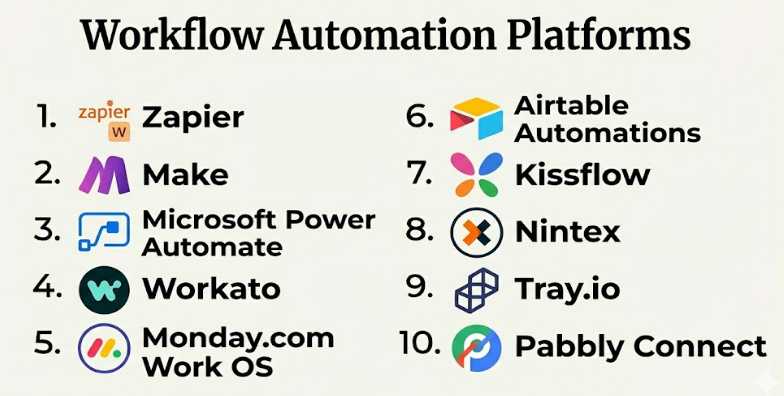
Top 10 Workflow Automation Platforms
#1 — Zapier
Short description: A widely used no-code automation platform connecting thousands of apps.
Key Features
- Trigger-based workflows
- Multi-step automations
- Thousands of integrations
- No-code interface
- Scheduling and filters
Pros
- Extremely easy to use
- Large app ecosystem
Cons
- Limited advanced logic
- Costs increase with usage
Platforms / Deployment
Cloud
Security & Compliance
Not publicly stated
Integrations & Ecosystem
- SaaS tools
- APIs
- CRM systems
Support & Community
Large user base and strong community.
#2 — Make (formerly Integromat)
Short description: Visual automation platform for building complex workflows.
Key Features
- Visual workflow builder
- Advanced logic and branching
- Data transformation
- Scheduling
- Error handling
Pros
- Highly flexible
- Visual interface
Cons
- Learning curve
- Not beginner-friendly
Platforms / Deployment
Cloud
Security & Compliance
Not publicly stated
Integrations & Ecosystem
- APIs
- SaaS tools
- Data platforms
Support & Community
Active community.
#3 — Microsoft Power Automate
Short description: Workflow automation tool integrated with Microsoft ecosystem.
Key Features
- Workflow automation
- RPA capabilities
- AI-based automation
- Integration with Microsoft tools
- Pre-built templates
Pros
- Strong Microsoft integration
- Easy to adopt for business users
Cons
- Limited outside ecosystem
- Performance issues at scale
Platforms / Deployment
Cloud
Security & Compliance
SSO, RBAC. Compliance: Not publicly stated
Integrations & Ecosystem
- Office 365
- Dynamics
- Azure
Support & Community
Strong enterprise support.
#4 — Workato
Short description: Enterprise-grade automation platform combining integration and workflows.
Key Features
- Low-code automation
- Pre-built recipes
- Real-time triggers
- Data mapping
- API integrations
Pros
- Scalable
- Strong automation capabilities
Cons
- Expensive
- Limited customization depth
Platforms / Deployment
Cloud
Security & Compliance
SSO, RBAC. Compliance: Not publicly stated
Integrations & Ecosystem
- CRM
- Marketing tools
- SaaS apps
Support & Community
Strong support.
#5 — Monday.com Work OS
Short description: Work management platform with built-in automation capabilities.
Key Features
- Workflow automation
- Task management
- Custom workflows
- Notifications
- Integrations
Pros
- User-friendly UI
- Flexible workflows
Cons
- Limited deep automation
- Pricing tiers can be restrictive
Platforms / Deployment
Cloud
Security & Compliance
Not publicly stated
Integrations & Ecosystem
- Productivity tools
- CRM
- Collaboration apps
Support & Community
Large user base.
#6 — Airtable Automations
Short description: Automation features within Airtable for managing workflows and data.
Key Features
- Trigger-based automation
- Database-driven workflows
- Integrations
- Custom scripts
- Notifications
Pros
- Easy to use
- Great for data workflows
Cons
- Limited advanced automation
- Dependent on Airtable ecosystem
Platforms / Deployment
Cloud
Security & Compliance
Not publicly stated
Integrations & Ecosystem
- APIs
- SaaS tools
- Data apps
Support & Community
Active community.
#7 — Kissflow
Short description: Business process automation platform focused on workflow management.
Key Features
- Process automation
- Visual workflow builder
- Form builder
- Role-based access
- Reporting
Pros
- Business-user friendly
- Good for approvals
Cons
- Limited integrations
- Less developer flexibility
Platforms / Deployment
Cloud
Security & Compliance
RBAC, encryption. Compliance: Not publicly stated
Integrations & Ecosystem
- Business apps
- SaaS tools
Support & Community
Moderate support.
#8 — Nintex
Short description: Workflow automation platform with strong document and process automation features.
Key Features
- Workflow automation
- Document automation
- Process mapping
- RPA
- Analytics
Pros
- Strong enterprise features
- Good for document workflows
Cons
- Expensive
- Complex setup
Platforms / Deployment
Cloud / On-prem
Security & Compliance
Enterprise-grade controls. Compliance: Not publicly stated
Integrations & Ecosystem
- SharePoint
- CRM systems
- Enterprise apps
Support & Community
Strong enterprise support.
#9 — Tray.io
Short description: Low-code automation platform designed for developers and IT teams.
Key Features
- API-based automation
- Custom workflows
- Data processing
- Integration builder
- Scalable pipelines
Pros
- Highly customizable
- Scalable
Cons
- Learning curve
- Pricing complexity
Platforms / Deployment
Cloud
Security & Compliance
RBAC, encryption. Compliance: Not publicly stated
Integrations & Ecosystem
- APIs
- SaaS apps
- Data tools
Support & Community
Good support.
#10 — Pabbly Connect
Short description: Affordable automation tool for connecting apps and workflows.
Key Features
- Workflow automation
- Trigger-based actions
- App integrations
- Scheduling
- Filters
Pros
- Cost-effective
- Easy to use
Cons
- Smaller ecosystem
- Limited advanced features
Platforms / Deployment
Cloud
Security & Compliance
Not publicly stated
Integrations & Ecosystem
- SaaS tools
- APIs
Support & Community
Growing community.
Comparison Table (Top 10)
| Tool Name | Best For | Platform(s) Supported | Deployment | Standout Feature | Public Rating |
|---|---|---|---|---|---|
| Zapier | Beginners | Web | Cloud | Easy automation | N/A |
| Make | Advanced users | Web | Cloud | Visual workflows | N/A |
| Power Automate | Microsoft users | Web | Cloud | RPA features | N/A |
| Workato | Enterprise | Web | Cloud | Recipes | N/A |
| Monday.com | Teams | Web | Cloud | Work OS | N/A |
| Airtable | Data workflows | Web | Cloud | Database automation | N/A |
| Kissflow | Business users | Web | Cloud | Process builder | N/A |
| Nintex | Enterprises | Web | Hybrid | Document automation | N/A |
| Tray.io | Developers | Web | Cloud | API workflows | N/A |
| Pabbly | Budget users | Web | Cloud | Cost-effective | N/A |
Evaluation & Scoring of Workflow Automation Platforms
| Tool Name | Core (25%) | Ease (15%) | Integrations (15%) | Security (10%) | Performance (10%) | Support (10%) | Value (15%) | Weighted Total |
|---|---|---|---|---|---|---|---|---|
| Zapier | 8 | 10 | 10 | 6 | 7 | 9 | 7 | 8.2 |
| Make | 9 | 8 | 9 | 6 | 8 | 8 | 8 | 8.3 |
| Power Automate | 8 | 9 | 8 | 7 | 7 | 8 | 8 | 8.0 |
| Workato | 9 | 8 | 9 | 7 | 9 | 8 | 7 | 8.4 |
| Monday | 7 | 9 | 7 | 6 | 7 | 8 | 7 | 7.6 |
| Airtable | 7 | 9 | 7 | 6 | 7 | 7 | 8 | 7.5 |
| Kissflow | 7 | 8 | 6 | 7 | 7 | 7 | 8 | 7.3 |
| Nintex | 9 | 6 | 8 | 8 | 9 | 8 | 6 | 8.0 |
| Tray.io | 8 | 7 | 8 | 7 | 8 | 7 | 7 | 7.7 |
| Pabbly | 7 | 8 | 6 | 5 | 6 | 6 | 9 | 7.0 |
Which Workflow Automation Platform Is Right for You?
Solo / Freelancers
- Best: Zapier, Pabbly
- Focus on simplicity and cost
SMB
- Best: Make, Airtable, Monday.com
- Balance usability and flexibility
Mid-Market
- Best: Workato, Tray.io
- Need scalability and integrations
Enterprise
- Best: Workato, Nintex, Power Automate
- Focus on governance and performance
Budget vs Premium
- Budget: Pabbly, Zapier
- Premium: Workato, Nintex
Feature Depth vs Ease of Use
- Deep features: Make, Tray.io
- Easy to use: Zapier
Integrations & Scalability
- Strong integrations: Zapier, Workato
- Scalable: Tray.io
Security & Compliance Needs
- High security: Nintex
- Moderate: Zapier
Frequently Asked Questions (FAQs)
What is a workflow automation platform?
A tool that automates repetitive tasks and business processes across systems.
Do I need coding skills?
No, many platforms offer no-code or low-code interfaces.
Are these tools secure?
Most offer basic to advanced security features depending on the plan.
Can I integrate multiple apps?
Yes, integrations are a core feature.
Are they expensive?
Pricing varies from affordable to enterprise-level.
Can they scale?
Yes, most platforms support scaling workflows.
What industries use them?
Almost all industries including SaaS, healthcare, finance, and e-commerce.
What are common limitations?
Complex workflows, pricing, and integration limits.
Can I automate approvals?
Yes, approval workflows are a common use case.
How do I choose the right tool?
Evaluate based on your workflow complexity, budget, and integrations.
Conclusion
Workflow automation platforms have become essential tools for improving efficiency, reducing manual work, and scaling business operations. From simple task automation to complex enterprise workflows, these tools provide the flexibility and power needed in modern organizations.