Introduction
Webhook management tools are platforms that help developers and teams send, receive, monitor, debug, and secure webhook events between systems. Webhooks are automated messages sent from one application to another when a specific event occurs—making them a core building block for real-time integrations.
As businesses rely more on event-driven architectures, SaaS integrations, and automation workflows, managing webhooks at scale becomes complex. Issues like failed deliveries, retries, debugging payloads, and securing endpoints require specialized tooling beyond basic webhook implementations.
Common use cases include:
- Real-time data synchronization between applications
- Payment event handling (e.g., order confirmations, refunds)
- CI/CD pipeline triggers
- CRM and marketing automation integrations
- Monitoring and debugging webhook deliveries
What buyers should evaluate:
- Webhook delivery reliability and retry logic
- Debugging and logging capabilities
- Security features (signatures, authentication, encryption)
- Scalability for high event volumes
- Ease of setup and developer experience
- Integration with APIs and SaaS platforms
- Observability and alerting
- Deployment flexibility (cloud, self-hosted)
Best for:
Developers, SaaS companies, integration engineers, and DevOps teams building event-driven systems or managing multiple third-party integrations.
Not ideal for:
Simple applications with minimal integration needs or systems that rely on polling instead of event-driven communication.
Key Trends in Webhook Management Tools
- Event-driven architecture adoption: Webhooks are central to modern integration strategies
- Reliability and retry automation: Built-in retry logic and dead-letter queues are becoming standard
- Webhook observability: Advanced logging, replay, and debugging tools
- Security-first design: Signature verification, IP whitelisting, and encryption
- Serverless webhook handling: Reduced infrastructure overhead
- Unified event platforms: Combining webhooks with messaging queues and event buses
- Low-code integrations: Simplifying webhook workflows for non-developers
- Edge processing: Faster event delivery closer to users
How We Selected These Tools (Methodology)
We evaluated webhook management tools based on:
- Market adoption and developer popularity
- Reliability and delivery guarantees
- Debugging and observability features
- Security and compliance capabilities
- Ease of integration and developer experience
- Scalability and performance
- Flexibility in deployment models
- Community and support availability
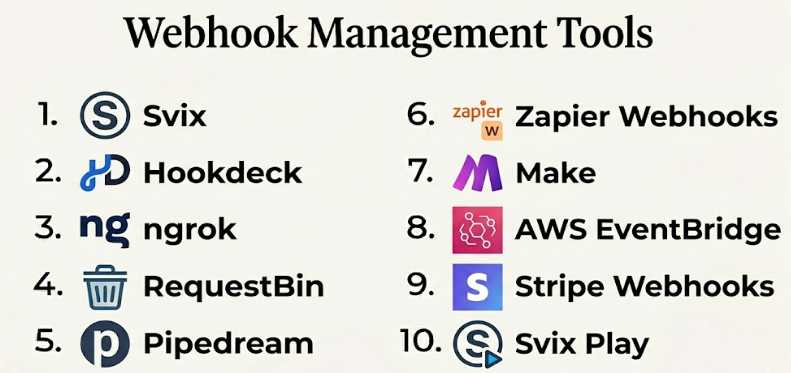
Top 10 Webhook Management Tools
#1 — Svix
Short description: A modern webhook service designed for reliability, security, and scalability in production environments.
Key Features
- Guaranteed delivery with retries
- Webhook signatures for security
- Event replay functionality
- SDKs and APIs
- Monitoring and analytics
Pros
- Built specifically for webhooks
- Strong reliability features
Cons
- Paid plans for advanced features
- Smaller ecosystem
Platforms / Deployment
Cloud
Security & Compliance
Signature verification, encryption. Compliance: Not publicly stated
Integrations & Ecosystem
- REST APIs
- SDKs for multiple languages
- Event-driven systems
Support & Community
Growing developer-focused community with solid documentation.
#2 — Hookdeck
Short description: Webhook infrastructure platform for monitoring, debugging, and scaling webhook traffic.
Key Features
- Event buffering and routing
- Replay and retry logic
- Filtering and transformation
- Observability dashboard
- Error handling
Pros
- Excellent debugging tools
- Scales well
Cons
- Learning curve
- Pricing complexity
Platforms / Deployment
Cloud
Security & Compliance
Encryption, access control. Compliance: Not publicly stated
Integrations & Ecosystem
- APIs
- Dev tools
- Monitoring systems
Support & Community
Strong documentation and support.
#3 — ngrok
Short description: Popular tool for exposing local servers to the internet, widely used for webhook testing and development.
Key Features
- Secure tunnels
- Request inspection
- Replay requests
- Easy setup
- CLI and UI tools
Pros
- Very easy to use
- Ideal for development
Cons
- Not a full production webhook system
- Limited scalability
Platforms / Deployment
Web / Windows / macOS / Linux
Security & Compliance
TLS encryption. Compliance: Not publicly stated
Integrations & Ecosystem
- Local dev environments
- APIs
- Testing tools
Support & Community
Large developer community.
#4 — RequestBin (Pipedream)
Short description: Tool for capturing and inspecting webhook requests in real time.
Key Features
- Request capture
- Payload inspection
- Temporary endpoints
- Debugging tools
- Event history
Pros
- Simple and effective
- Great for debugging
Cons
- Not for production use
- Limited features
Platforms / Deployment
Cloud
Security & Compliance
Not publicly stated
Integrations & Ecosystem
- APIs
- Dev tools
Support & Community
Moderate community support.
#5 — Pipedream
Short description: Integration platform that supports webhook triggers and automation workflows.
Key Features
- Webhook triggers
- Workflow automation
- Serverless execution
- API integrations
- Logging and debugging
Pros
- Combines webhooks with automation
- Easy to build workflows
Cons
- Not webhook-specific
- Complexity for advanced use
Platforms / Deployment
Cloud
Security & Compliance
Authentication, encryption. Compliance: Not publicly stated
Integrations & Ecosystem
- SaaS apps
- APIs
- Automation tools
Support & Community
Active developer community.
#6 — Zapier Webhooks
Short description: Webhook feature within Zapier for connecting apps and automating workflows.
Key Features
- Webhook triggers and actions
- Automation workflows
- App integrations
- No-code interface
- Logging
Pros
- Very easy to use
- Huge integration library
Cons
- Limited control
- Expensive at scale
Platforms / Deployment
Cloud
Security & Compliance
Not publicly stated
Integrations & Ecosystem
- Thousands of SaaS apps
- APIs
- Automation tools
Support & Community
Strong support and large user base.
#7 — Make (formerly Integromat)
Short description: Visual automation platform with webhook support for building integrations.
Key Features
- Webhook triggers
- Visual workflow builder
- Data transformation
- Scheduling
- App integrations
Pros
- Visual interface
- Flexible workflows
Cons
- Learning curve
- Not developer-first
Platforms / Deployment
Cloud
Security & Compliance
Not publicly stated
Integrations & Ecosystem
- SaaS apps
- APIs
- Automation tools
Support & Community
Active community.
#8 — AWS EventBridge (Webhook alternative)
Short description: Event bus service for routing events between AWS services and external systems.
Key Features
- Event routing
- Filtering
- Integration with AWS services
- Scalability
- Monitoring
Pros
- Highly scalable
- Reliable
Cons
- AWS dependency
- Not webhook-native
Platforms / Deployment
Cloud
Security & Compliance
IAM, encryption. Compliance: Not publicly stated
Integrations & Ecosystem
- AWS services
- APIs
- Event-driven systems
Support & Community
Strong AWS ecosystem support.
#9 — Stripe Webhooks (Developer tooling)
Short description: Webhook system used within Stripe for handling payment-related events.
Key Features
- Event notifications
- Retry logic
- Security signatures
- Logging
- API integration
Pros
- Reliable
- Well-documented
Cons
- Limited to Stripe ecosystem
- Not general-purpose
Platforms / Deployment
Cloud
Security & Compliance
Signature verification. Compliance: Not publicly stated
Integrations & Ecosystem
- Payment systems
- APIs
Support & Community
Strong documentation.
#10 — Svix Play (Developer tool)
Short description: Tool for testing and simulating webhook events during development.
Key Features
- Event simulation
- Testing tools
- Debugging
- Developer-friendly UI
- Logging
Pros
- Useful for testing
- Easy to use
Cons
- Limited production features
- Niche use case
Platforms / Deployment
Cloud
Security & Compliance
Not publicly stated
Integrations & Ecosystem
- Dev tools
- APIs
Support & Community
Moderate support.
Comparison Table (Top 10)
| Tool Name | Best For | Platform(s) Supported | Deployment | Standout Feature | Public Rating |
|---|---|---|---|---|---|
| Svix | Production webhooks | Web | Cloud | Reliable delivery | N/A |
| Hookdeck | Monitoring | Web | Cloud | Debugging tools | N/A |
| ngrok | Local testing | Multi-platform | Local | Tunneling | N/A |
| RequestBin | Debugging | Web | Cloud | Payload capture | N/A |
| Pipedream | Automation | Web | Cloud | Workflows | N/A |
| Zapier | No-code users | Web | Cloud | Integrations | N/A |
| Make | Visual workflows | Web | Cloud | Visual builder | N/A |
| EventBridge | Event systems | Web | Cloud | Event routing | N/A |
| Stripe Webhooks | Payments | Web | Cloud | Reliability | N/A |
| Svix Play | Testing | Web | Cloud | Simulation | N/A |
Evaluation & Scoring of Webhook Management Tools
| Tool Name | Core (25%) | Ease (15%) | Integrations (15%) | Security (10%) | Performance (10%) | Support (10%) | Value (15%) | Weighted Total |
|---|---|---|---|---|---|---|---|---|
| Svix | 9 | 8 | 7 | 8 | 9 | 8 | 7 | 8.2 |
| Hookdeck | 9 | 7 | 8 | 8 | 9 | 8 | 7 | 8.1 |
| ngrok | 6 | 9 | 7 | 7 | 7 | 8 | 9 | 7.6 |
| RequestBin | 5 | 9 | 6 | 5 | 6 | 7 | 9 | 6.8 |
| Pipedream | 7 | 8 | 9 | 7 | 8 | 8 | 8 | 7.9 |
| Zapier | 6 | 9 | 10 | 6 | 7 | 9 | 7 | 7.8 |
| Make | 7 | 8 | 9 | 6 | 7 | 8 | 8 | 7.7 |
| EventBridge | 8 | 6 | 8 | 8 | 9 | 8 | 7 | 7.9 |
| Stripe | 7 | 8 | 6 | 8 | 9 | 8 | 7 | 7.8 |
| Svix Play | 5 | 9 | 6 | 5 | 6 | 7 | 9 | 6.9 |
How to interpret the scores:
- Scores are comparative across tools
- Higher scores indicate balanced capabilities
- Developer tools score high in ease but lower in core features
- Enterprise tools focus on reliability and performance
- Choose based on your use case
Which Webhook Management Tools Tool Is Right for You?
Solo / Freelancer
- Best: ngrok, RequestBin
- Focus on testing and simplicity
SMB
- Best: Pipedream, Make
- Balance automation and cost
Mid-Market
- Best: Hookdeck, Svix
- Need reliability and monitoring
Enterprise
- Best: Svix, AWS EventBridge
- Focus on scalability and security
Budget vs Premium
- Budget: RequestBin, ngrok
- Premium: Svix, Hookdeck
Feature Depth vs Ease of Use
- Deep features: Hookdeck
- Easy to use: Zapier
Integrations & Scalability
- Strong integrations: Zapier, Pipedream
- Scalable: EventBridge
Security & Compliance Needs
- High security: Svix
- Moderate: Make
Frequently Asked Questions (FAQs)
What is a webhook?
A webhook is an automated message sent when an event occurs in an application.
How are webhooks different from APIs?
Webhooks push data automatically, while APIs require polling.
Are webhook tools necessary?
Yes, for managing reliability, debugging, and scaling.
Can I use webhooks without tools?
Yes, but tools simplify management.
Are webhooks secure?
They can be secured with signatures and authentication.
What happens if a webhook fails?
Most tools retry delivery automatically.
Can webhooks scale?
Yes, with proper infrastructure and tools.
Do these tools support automation?
Many include automation workflows.
Are there free options?
Yes, some tools offer free tiers.
What are common mistakes?
Ignoring retries, poor security, and lack of monitoring.
Conclusion
Webhook management tools are essential for building reliable, event-driven systems. From simple debugging tools to enterprise-grade platforms, the ecosystem offers solutions for every level of complexity.