Introduction
VFX Compositing Software is used to combine visual elements from multiple sources—such as live-action footage, CGI, matte paintings, and simulations—into a single, seamless final image. It plays a critical role in film production, television, advertising, gaming cinematics, and digital content creation.
With the rise of real-time rendering, AI-assisted workflows, and virtual production, compositing tools have become more powerful and accessible. Modern solutions now support node-based workflows, GPU acceleration, deep compositing, and seamless integration with 3D pipelines.
Common Use Cases
- Film & TV production: Combining CGI with live-action footage
- Advertising & marketing: Creating high-impact visual effects
- Game cinematics: Producing pre-rendered scenes and trailers
- Virtual production: Real-time compositing with LED walls
- YouTube & content creation: Enhancing videos with visual effects
What Buyers Should Evaluate
- Node-based vs layer-based workflows
- Real-time preview and GPU acceleration
- Color grading and keying capabilities
- Integration with 3D tools (Maya, Blender, Unreal Engine)
- Support for high-resolution and HDR workflows
- Scripting and automation support
- Collaboration and pipeline integration
- Learning curve and usability
- Pricing model and licensing flexibility
- Plugin ecosystem and extensibility
Best for: VFX artists, film studios, motion designers, video editors, and production teams needing advanced compositing workflows.
Not ideal for: Users who only need basic video editing or simple effects. In such cases, standard video editing software may be more suitable.
Key Trends in VFX Compositing Software
- AI-assisted compositing: Automated rotoscoping, object removal, and scene reconstruction
- Real-time compositing pipelines: Integration with game engines for virtual production
- GPU acceleration: Faster rendering and preview workflows
- Node-based workflows dominance: Greater flexibility and scalability
- Cloud collaboration: Remote compositing pipelines and shared assets
- Deep compositing adoption: Handling complex 3D scene data more efficiently
- HDR and high-resolution workflows: Support for cinematic-quality outputs
- Automation via scripting: Python-based pipeline customization
- Cross-tool interoperability: Seamless integration with 3D and editing tools
- Subscription licensing models: Flexible pricing structures
How We Selected These Tools (Methodology)
The tools listed here were selected based on:
- Industry adoption in film, TV, and digital production
- Feature completeness for compositing workflows
- Performance in handling complex visual effects
- Availability of GPU acceleration and real-time capabilities
- Integration with 3D, editing, and rendering pipelines
- Flexibility for different team sizes (indie to enterprise)
- Strength of plugin ecosystem and extensibility
- Community support and learning resources
- Stability and reliability in production environments
- Suitability across various use cases
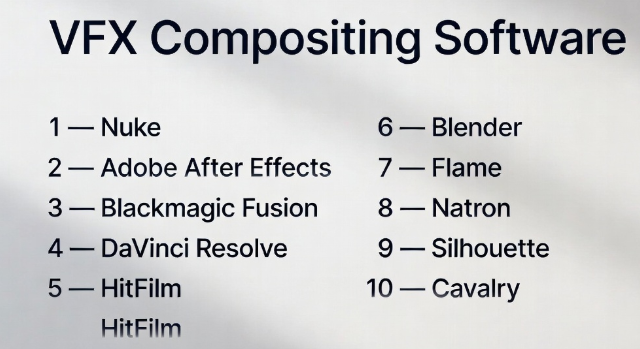
Top 10 VFX Compositing Software Tools
#1 — Nuke
Short description: A high-end node-based compositing software widely used in film and VFX studios for complex visual effects work.
Key Features
- Node-based compositing workflow
- Deep compositing support
- Advanced keying and rotoscoping tools
- 3D compositing environment
- GPU acceleration
- Python scripting support
- High-end color management
Pros
- Industry-standard for film production
- Highly scalable for complex projects
- Strong pipeline integration
Cons
- Expensive
- Steep learning curve
- Requires powerful hardware
Platforms / Deployment
Windows / macOS / Linux
Security & Compliance
Not publicly stated
Integrations & Ecosystem
Nuke integrates deeply into professional VFX pipelines and supports extensive customization.
- Maya
- Houdini
- Unreal Engine
- Python API
- Custom plugins
Support & Community
Strong professional community with extensive training resources.
#2 — Adobe After Effects
Short description: A widely used compositing and motion graphics tool suitable for both beginners and professionals.
Key Features
- Layer-based compositing
- Motion graphics tools
- Built-in effects and presets
- Integration with Adobe Creative Cloud
- Keying and tracking tools
- Plugin ecosystem
- Real-time previews
Pros
- Easy to learn
- Versatile for multiple use cases
- Large plugin ecosystem
Cons
- Less powerful for complex VFX
- Performance limitations on heavy projects
- Subscription-based pricing
Platforms / Deployment
Windows / macOS
Security & Compliance
Not publicly stated
Integrations & Ecosystem
Strong integration within the Adobe ecosystem.
- Premiere Pro
- Photoshop
- Illustrator
- Third-party plugins
- Scripts
Support & Community
Massive community, tutorials, and resources.
#3 — Blackmagic Fusion
Short description: A node-based compositing software integrated into DaVinci Resolve, offering professional-grade VFX tools.
Key Features
- Node-based workflow
- 3D compositing environment
- VR and 360 support
- GPU acceleration
- Keying and tracking tools
- Scripting support
- Deep compositing
Pros
- Free version available
- Integrated with editing and color grading
- Powerful features
Cons
- Complex interface
- Smaller ecosystem compared to Nuke
- Learning curve
Platforms / Deployment
Windows / macOS / Linux
Security & Compliance
Not publicly stated
Integrations & Ecosystem
Fusion works seamlessly within the DaVinci Resolve ecosystem.
- DaVinci Resolve
- Unreal Engine
- Python scripting
- Plugins
Support & Community
Growing community with official training resources.
#4 — DaVinci Resolve (Fusion Page)
Short description: An all-in-one post-production suite combining editing, color grading, and compositing.
Key Features
- Integrated compositing tools
- Node-based Fusion page
- Color grading capabilities
- Real-time playback
- Collaboration features
- GPU acceleration
- Audio post-production
Pros
- All-in-one solution
- Free version available
- Strong performance
Cons
- Complex for beginners
- Heavy system requirements
- Compositing less advanced than Nuke
Platforms / Deployment
Windows / macOS / Linux
Security & Compliance
Not publicly stated
Integrations & Ecosystem
- Editing and grading tools
- Plugins
- External pipelines
Support & Community
Large and active community.
#5 — HitFilm
Short description: A combined video editing and VFX compositing tool aimed at content creators and indie filmmakers.
Key Features
- Layer-based compositing
- Built-in VFX presets
- 3D compositing tools
- Particle simulation
- Keying tools
- Motion tracking
- Editing integration
Pros
- Beginner-friendly
- Affordable
- All-in-one workflow
Cons
- Limited advanced features
- Smaller ecosystem
- Performance constraints
Platforms / Deployment
Windows / macOS
Security & Compliance
Not publicly stated
Integrations & Ecosystem
- Plugins
- Export formats
- Basic integrations
Support & Community
Moderate community with tutorials.
#6 — Blender (Compositor)
Short description: An open-source 3D suite with a powerful built-in node-based compositor.
Key Features
- Node-based compositing
- Integrated with 3D pipeline
- Real-time preview
- Open-source flexibility
- Scripting support
- Multi-pass rendering
- GPU acceleration
Pros
- Free and open-source
- Strong integration with 3D workflows
- Highly customizable
Cons
- Interface complexity
- Less specialized for VFX-only tasks
- Limited enterprise support
Platforms / Deployment
Windows / macOS / Linux
Security & Compliance
Not publicly stated
Integrations & Ecosystem
- Add-ons
- Python scripting
- Game engines
- Rendering pipelines
Support & Community
Large open-source community.
#7 — Flame
Short description: A high-end compositing and finishing tool used in professional post-production environments.
Key Features
- Advanced compositing tools
- Real-time playback
- 3D compositing
- AI-assisted tools
- Color grading
- Timeline-based workflow
- High-end finishing tools
Pros
- Powerful finishing tool
- Real-time performance
- Industry-proven
Cons
- Expensive
- Requires training
- Limited accessibility
Platforms / Deployment
Linux
Security & Compliance
Not publicly stated
Integrations & Ecosystem
- Post-production pipelines
- Media management tools
- Plugins
Support & Community
Enterprise-level support.
#8 — Natron
Short description: An open-source node-based compositing software inspired by professional tools.
Key Features
- Node-based compositing
- OpenFX plugin support
- Multi-platform support
- GPU acceleration
- Rotoscoping tools
- Keying tools
- Python scripting
Pros
- Free to use
- Familiar workflow for Nuke users
- Extensible via plugins
Cons
- Slower development
- Limited support
- Stability concerns
Platforms / Deployment
Windows / macOS / Linux
Security & Compliance
Not publicly stated
Integrations & Ecosystem
- OpenFX plugins
- Python scripting
- External tools
Support & Community
Community-driven support.
#9 — Silhouette
Short description: A specialized compositing tool focused on rotoscoping, paint, and visual effects.
Key Features
- Advanced rotoscoping tools
- Paint and cleanup tools
- Node-based workflow
- Tracking capabilities
- GPU acceleration
- Plugin support
- High-resolution support
Pros
- Best-in-class rotoscoping
- Efficient cleanup workflows
- Production-ready tools
Cons
- Limited full compositing features
- Niche use case
- Learning curve
Platforms / Deployment
Windows / macOS / Linux
Security & Compliance
Not publicly stated
Integrations & Ecosystem
- Nuke
- After Effects
- Plugins
- Pipeline tools
Support & Community
Professional user base with focused documentation.
#10 — Cavalry
Short description: A procedural animation and compositing tool designed for motion designers.
Key Features
- Procedural animation
- Real-time rendering
- Vector-based workflows
- Automation tools
- Plugin support
- Motion design focus
- Lightweight performance
Pros
- Fast and responsive
- Great for motion graphics
- Modern interface
Cons
- Limited VFX capabilities
- Smaller ecosystem
- Not for complex compositing
Platforms / Deployment
Windows / macOS
Security & Compliance
Not publicly stated
Integrations & Ecosystem
- Plugins
- Export pipelines
- Motion design tools
Support & Community
Growing community with modern documentation.
Comparison Table (Top 10)
| Tool Name | Best For | Platform(s) Supported | Deployment | Standout Feature | Public Rating |
|---|---|---|---|---|---|
| Nuke | Film VFX | Windows, macOS, Linux | Local | Node-based deep compositing | N/A |
| After Effects | Motion graphics | Windows, macOS | Local/Cloud | Plugin ecosystem | N/A |
| Fusion | VFX workflows | Windows, macOS, Linux | Local | Node-based compositing | N/A |
| DaVinci Resolve | All-in-one | Windows, macOS, Linux | Local | Integrated pipeline | N/A |
| HitFilm | Indie creators | Windows, macOS | Local | All-in-one editing + VFX | N/A |
| Blender | Open-source users | Windows, macOS, Linux | Local | Integrated 3D + compositing | N/A |
| Flame | Enterprise studios | Linux | Local | Real-time finishing | N/A |
| Natron | Open-source VFX | Windows, macOS, Linux | Local | OpenFX support | N/A |
| Silhouette | Rotoscoping | Windows, macOS, Linux | Local | Advanced rotoscoping | N/A |
| Cavalry | Motion design | Windows, macOS | Local | Procedural animation | N/A |
Evaluation & Scoring of VFX Compositing Software
| Tool Name | Core | Ease | Integrations | Security | Performance | Support | Value | Weighted Total |
|---|---|---|---|---|---|---|---|---|
| Nuke | 10 | 6 | 9 | 6 | 10 | 9 | 5 | 8.1 |
| After Effects | 8 | 9 | 9 | 6 | 7 | 9 | 7 | 8.0 |
| Fusion | 9 | 7 | 8 | 6 | 9 | 8 | 8 | 8.2 |
| DaVinci Resolve | 9 | 7 | 8 | 6 | 9 | 8 | 9 | 8.4 |
| HitFilm | 7 | 8 | 7 | 5 | 7 | 7 | 8 | 7.4 |
| Blender | 8 | 6 | 8 | 5 | 8 | 8 | 10 | 8.1 |
| Flame | 10 | 5 | 8 | 6 | 10 | 9 | 5 | 7.9 |
| Natron | 7 | 6 | 7 | 5 | 7 | 6 | 10 | 7.2 |
| Silhouette | 8 | 6 | 7 | 5 | 8 | 7 | 7 | 7.3 |
| Cavalry | 7 | 9 | 6 | 5 | 7 | 7 | 8 | 7.5 |
Interpretation:
- Scores reflect relative comparison, not absolute performance
- Enterprise tools excel in performance but may lack ease
- Free/open tools offer high value but may lack support
- Choose based on workflow needs and team size
Which VFX Compositing Software Is Right for You?
Solo / Freelancer
- Best: Blender, HitFilm, Cavalry
- Focus on affordability and ease of use
SMB
- Best: After Effects, DaVinci Resolve
- Balance power and usability
Mid-Market
- Best: Fusion, After Effects
- Need better scalability and integration
Enterprise
- Best: Nuke, Flame
- Prioritize performance and pipeline integration
Budget vs Premium
- Budget: Blender, Natron
- Premium: Nuke, Flame
Feature Depth vs Ease of Use
- Deep features: Nuke, Fusion
- Easy tools: After Effects, Cavalry
Integrations & Scalability
- Strong: Nuke, After Effects
- Lightweight: Blender
Security & Compliance Needs
- Most tools: Not publicly stated
- Enterprises should validate internally
Frequently Asked Questions (FAQs)
What is VFX compositing software?
It combines multiple visual elements into a final image or scene.
Is compositing different from video editing?
Yes, compositing focuses on visual effects, while editing focuses on sequencing.
Which tool is best for beginners?
After Effects and Blender are good starting points.
Is node-based compositing better?
It offers more flexibility but has a steeper learning curve.
Do I need a powerful PC?
Yes, especially for high-resolution or complex projects.
Can I use free tools professionally?
Yes, tools like Blender are used in professional workflows.
What is deep compositing?
A technique that handles 3D depth data for advanced effects.
Are plugins necessary?
Not always, but they enhance capabilities.
Can these tools integrate with game engines?
Yes, most support Unity and Unreal Engine.
Is cloud compositing common?
It is growing but still evolving.
Conclusion
VFX compositing software ranges from beginner-friendly tools to high-end enterprise solutions. The best choice depends on your workflow complexity, budget, and integration needs.
- Choose node-based tools for complex VFX pipelines
- Choose layer-based tools for motion graphics and simplicity
- Consider open-source tools for flexibility and cost savings
There is no single best tool—only the one that fits your specific use case