Introduction
Robotic Process Automation (RPA) tools are software platforms that automate repetitive, rule-based tasks by mimicking human interactions with digital systems. These tools can log into applications, extract data, process transactions, and perform routine operations—without manual intervention.
RPA has become a key component of digital transformation strategies, enabling organizations to improve efficiency, reduce operational costs, and minimize errors. From back-office processes to customer-facing workflows, RPA helps businesses scale operations without increasing headcount.
Common use cases include:
- Automating data entry and data migration
- Processing invoices and financial transactions
- Managing HR onboarding workflows
- Extracting and processing documents
- Automating customer support tasks
What buyers should evaluate:
- Ease of bot development (no-code vs low-code)
- Scalability and orchestration capabilities
- Integration with enterprise systems
- AI/ML capabilities (for intelligent automation)
- Security and compliance features
- Monitoring and analytics
- Deployment flexibility (cloud, on-premise)
- Pricing model
Best for:
Enterprises, operations teams, finance departments, HR teams, and organizations with high-volume repetitive processes.
Not ideal for:
Tasks requiring complex decision-making, creativity, or highly dynamic inputs without structured rules.
Key Trends in Robotic Process Automation (RPA)
- Hyperautomation: Combining RPA with AI, ML, and process mining
- AI-powered bots: Handling unstructured data and decision-making
- Cloud-based RPA: Reduced infrastructure and easier scaling
- Citizen developers: Non-technical users building bots
- Process mining integration: Identifying automation opportunities
- End-to-end automation platforms: Beyond simple task automation
- Security and governance focus: Role-based access and auditing
- Low-code/no-code interfaces: Simplifying bot creation
How We Selected These Tools (Methodology)
We evaluated RPA tools based on:
- Market leadership and adoption
- Automation capabilities and flexibility
- Ease of use and development experience
- Integration ecosystem
- AI and intelligent automation features
- Scalability and performance
- Security and compliance readiness
- Support and community
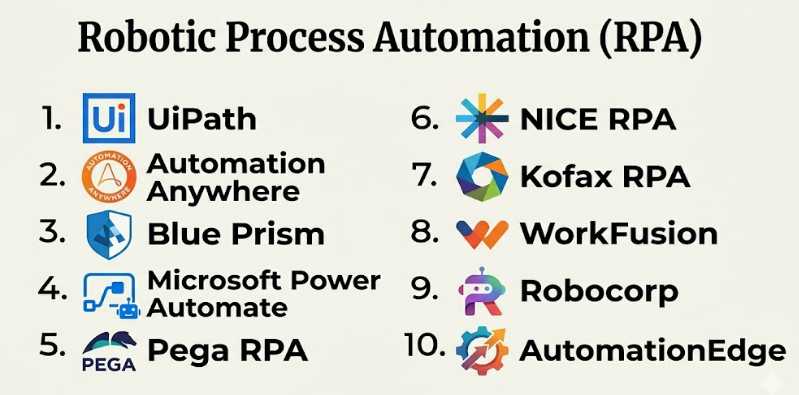
Top 10 Robotic Process Automation (RPA) Tools
#1 — UiPath
Short description: A leading RPA platform offering end-to-end automation with strong AI capabilities.
Key Features
- Drag-and-drop bot builder
- AI and machine learning integration
- Process mining
- Orchestration and monitoring
- Document understanding
Pros
- Comprehensive platform
- Strong community and ecosystem
Cons
- Pricing complexity
- Learning curve for advanced features
Platforms / Deployment
Cloud / On-premise / Hybrid
Security & Compliance
SSO, RBAC, encryption, audit logs. Compliance: Not publicly stated
Integrations & Ecosystem
- Enterprise apps
- APIs
- AI tools
- Databases
Support & Community
Large global community and strong enterprise support.
#2 — Automation Anywhere
Short description: Enterprise RPA platform focused on scalable and intelligent automation.
Key Features
- Cloud-native RPA
- Bot lifecycle management
- AI-powered automation
- Analytics dashboard
- Pre-built bots
Pros
- Scalable
- Strong cloud capabilities
Cons
- Expensive
- Setup complexity
Platforms / Deployment
Cloud / Hybrid
Security & Compliance
RBAC, encryption. Compliance: Not publicly stated
Integrations & Ecosystem
- SaaS apps
- Enterprise systems
- APIs
Support & Community
Strong enterprise support.
#3 — Blue Prism
Short description: Enterprise-grade RPA platform known for governance and security.
Key Features
- Digital workforce
- Process automation
- Centralized control
- Scalability
- Security features
Pros
- High security standards
- Reliable
Cons
- Less user-friendly
- Slower innovation
Platforms / Deployment
On-premise / Cloud
Security & Compliance
RBAC, encryption, audit logs. Compliance: Not publicly stated
Integrations & Ecosystem
- Enterprise apps
- APIs
- Databases
Support & Community
Enterprise-focused support.
#4 — Microsoft Power Automate (RPA)
Short description: RPA capabilities integrated within Microsoft’s automation platform.
Key Features
- Desktop and cloud automation
- AI builder
- RPA bots
- Integration with Microsoft tools
- Workflow automation
Pros
- Strong Microsoft ecosystem
- Easy for business users
Cons
- Limited outside ecosystem
- Performance limitations
Platforms / Deployment
Cloud / Desktop
Security & Compliance
SSO, RBAC. Compliance: Not publicly stated
Integrations & Ecosystem
- Office 365
- Dynamics
- Azure
Support & Community
Strong enterprise support.
#5 — Pega RPA
Short description: Intelligent automation platform combining RPA with BPM capabilities.
Key Features
- Workflow automation
- AI decisioning
- Case management
- Bot orchestration
- Analytics
Pros
- Strong AI integration
- Enterprise-ready
Cons
- Complex implementation
- Expensive
Platforms / Deployment
Cloud / On-premise
Security & Compliance
RBAC, encryption. Compliance: Not publicly stated
Integrations & Ecosystem
- CRM
- Enterprise systems
- APIs
Support & Community
Enterprise support.
#6 — NICE RPA (NEVA)
Short description: RPA platform focused on attended automation and employee productivity.
Key Features
- Attended automation
- Desktop automation
- Real-time guidance
- Analytics
- Integration tools
Pros
- Strong attended automation
- User-friendly
Cons
- Limited unattended automation
- Smaller ecosystem
Platforms / Deployment
On-premise / Cloud
Security & Compliance
Not publicly stated
Integrations & Ecosystem
- Desktop apps
- Enterprise tools
Support & Community
Moderate support.
#7 — Kofax RPA
Short description: Automation platform with strong document processing capabilities.
Key Features
- Data extraction
- Document automation
- Workflow automation
- Analytics
- Integration tools
Pros
- Strong document processing
- Enterprise features
Cons
- Complex setup
- Expensive
Platforms / Deployment
Cloud / On-premise
Security & Compliance
Encryption, RBAC. Compliance: Not publicly stated
Integrations & Ecosystem
- Enterprise apps
- Document systems
- APIs
Support & Community
Enterprise support.
#8 — WorkFusion
Short description: AI-driven RPA platform focused on intelligent automation.
Key Features
- AI-powered bots
- Data processing
- Automation workflows
- Analytics
- Pre-built models
Pros
- Strong AI capabilities
- Good for complex tasks
Cons
- Smaller ecosystem
- Learning curve
Platforms / Deployment
Cloud
Security & Compliance
Not publicly stated
Integrations & Ecosystem
- AI tools
- APIs
- Enterprise systems
Support & Community
Moderate support.
#9 — Robocorp
Short description: Developer-focused RPA platform with open-source capabilities.
Key Features
- Python-based automation
- Cloud orchestration
- Open-source tools
- API integrations
- Automation pipelines
Pros
- Developer-friendly
- Flexible
Cons
- Requires coding skills
- Smaller community
Platforms / Deployment
Cloud / Self-hosted
Security & Compliance
Not publicly stated
Integrations & Ecosystem
- Python ecosystem
- APIs
- Dev tools
Support & Community
Growing community.
#10 — AutomationEdge
Short description: RPA and IT automation platform focused on enterprise workflows.
Key Features
- RPA bots
- IT process automation
- AI integration
- Workflow orchestration
- Monitoring
Pros
- Good for IT automation
- Scalable
Cons
- Limited brand recognition
- Smaller ecosystem
Platforms / Deployment
Cloud / On-premise
Security & Compliance
Not publicly stated
Integrations & Ecosystem
- IT systems
- APIs
- Enterprise tools
Support & Community
Moderate support.
Comparison Table (Top 10)
| Tool Name | Best For | Platform(s) Supported | Deployment | Standout Feature | Public Rating |
|---|---|---|---|---|---|
| UiPath | Enterprise | Web/Desktop | Hybrid | AI automation | N/A |
| Automation Anywhere | Cloud RPA | Web | Cloud | Cloud-native | N/A |
| Blue Prism | Security | Web | Hybrid | Governance | N/A |
| Power Automate | Microsoft users | Web/Desktop | Cloud | Integration | N/A |
| Pega | AI automation | Web | Hybrid | BPM + RPA | N/A |
| NICE | Attended bots | Desktop | Hybrid | Employee automation | N/A |
| Kofax | Document processing | Web | Hybrid | OCR | N/A |
| WorkFusion | AI automation | Web | Cloud | ML models | N/A |
| Robocorp | Developers | CLI/Web | Hybrid | Python-based | N/A |
| AutomationEdge | IT automation | Web | Hybrid | IT workflows | N/A |
Evaluation & Scoring of Robotic Process Automation (RPA) Tools
| Tool Name | Core (25%) | Ease (15%) | Integrations (15%) | Security (10%) | Performance (10%) | Support (10%) | Value (15%) | Weighted Total |
|---|---|---|---|---|---|---|---|---|
| UiPath | 9 | 8 | 9 | 8 | 9 | 9 | 7 | 8.5 |
| Automation Anywhere | 9 | 7 | 9 | 8 | 9 | 8 | 7 | 8.3 |
| Blue Prism | 9 | 6 | 8 | 9 | 9 | 8 | 6 | 8.1 |
| Power Automate | 8 | 9 | 8 | 7 | 7 | 8 | 8 | 8.0 |
| Pega | 9 | 6 | 8 | 8 | 8 | 8 | 6 | 7.9 |
| NICE | 7 | 8 | 7 | 7 | 7 | 7 | 7 | 7.3 |
| Kofax | 8 | 6 | 7 | 8 | 8 | 7 | 6 | 7.4 |
| WorkFusion | 8 | 6 | 7 | 7 | 8 | 7 | 7 | 7.4 |
| Robocorp | 7 | 7 | 8 | 6 | 7 | 7 | 9 | 7.5 |
| AutomationEdge | 7 | 6 | 7 | 6 | 7 | 6 | 7 | 6.9 |
Which Robotic Process Automation (RPA) Tool Is Right for You?
Solo / Freelancer
- Best: Robocorp
- Focus on flexibility and low cost
SMB
- Best: Power Automate, NICE
- Balance ease and affordability
Mid-Market
- Best: UiPath, Automation Anywhere
- Need scalability and automation depth
Enterprise
- Best: UiPath, Blue Prism, Pega
- Focus on governance, security, and performance
Budget vs Premium
- Budget: Robocorp
- Premium: UiPath, Automation Anywhere
Feature Depth vs Ease of Use
- Deep features: UiPath, Pega
- Easy to use: Power Automate
Integrations & Scalability
- Strong integrations: Automation Anywhere
- Scalable: UiPath
Security & Compliance Needs
- High security: Blue Prism
- Moderate: NICE
Frequently Asked Questions (FAQs)
What is RPA?
RPA automates repetitive tasks using software bots.
Do I need coding skills?
No, many tools offer no-code interfaces.
Is RPA secure?
Yes, with proper governance and controls.
Can RPA handle complex tasks?
Yes, especially with AI integration.
Is RPA expensive?
Costs vary depending on scale and features.
Can RPA integrate with existing systems?
Yes, most tools support integrations.
What industries use RPA?
Finance, healthcare, IT, and more.
What are common challenges?
Complex setup and maintenance.
Can RPA scale?
Yes, enterprise tools support scaling.
Is RPA the same as AI?
No, but they can be combined.
Conclusion
Robotic Process Automation (RPA) tools are transforming how organizations handle repetitive tasks, enabling greater efficiency and scalability. From simple automations to intelligent workflows, RPA platforms offer powerful capabilities across industries.