Introduction
PCB Design Software (Printed Circuit Board Design Software) is a specialized category of Electronic Design Automation tools used to design, layout, and validate circuit boards that power modern electronic devices. These tools allow engineers to create schematics, route electrical connections, simulate performance, and generate manufacturing-ready files.
In today’s hardware-driven world, PCB design software has become essential due to increasing circuit complexity, high-speed signal requirements, and shorter product development cycles. From IoT devices to automotive systems and industrial electronics, nearly every product relies on well-designed PCBs to function reliably.
Common use cases include:
- Designing multi-layer PCBs for embedded systems
- High-speed digital circuit design (USB, PCIe, Ethernet)
- Power electronics (battery systems, converters)
- Consumer electronics prototyping
- Manufacturing-ready board design and validation
What buyers should evaluate:
- Schematic capture and PCB layout capabilities
- Routing performance (manual + auto-routing)
- Design rule checks (DRC) and validation
- Simulation and signal integrity analysis
- Ease of use and learning curve
- Integration with manufacturing workflows
- Collaboration and version control
- Performance with large designs
- Component libraries and supply chain integration
Best for: Electronics engineers, hardware startups, embedded developers, and manufacturing teams working on PCB-based products.
Not ideal for: Non-technical users or those needing only basic circuit diagrams. Simple schematic tools or educational simulators may be more appropriate.
Key Trends in PCB Design Software
- AI-assisted routing and layout optimization: Tools now automate placement and routing decisions.
- Cloud-based PCB design platforms: Real-time collaboration and browser-based workflows are increasing.
- Integrated simulation: Signal integrity, thermal, and power analysis built into design environments.
- Design-for-manufacturing (DFM) automation: Tools detect production issues early.
- Component supply chain integration: Real-time part availability and lifecycle tracking.
- High-speed design support: Tools optimized for complex, high-frequency circuits.
- Open-source growth: Community-driven tools gaining adoption among startups and engineers.
- Low-code and automation workflows: Reducing manual effort in repetitive design tasks.
- Security and IP protection: Increased focus on protecting proprietary designs.
- Hardware-software co-design: Integration with embedded systems and firmware workflows.
How We Selected These Tools (Methodology)
- Evaluated market adoption and industry relevance
- Assessed feature completeness across schematic, layout, and simulation
- Reviewed performance for high-density and multi-layer boards
- Considered security posture and data protection features
- Analyzed integration with manufacturing and supply chain tools
- Compared ease of use for beginners vs professionals
- Evaluated community support and documentation quality
- Considered deployment flexibility (cloud vs desktop)
- Ensured coverage across enterprise, SMB, and open-source tools
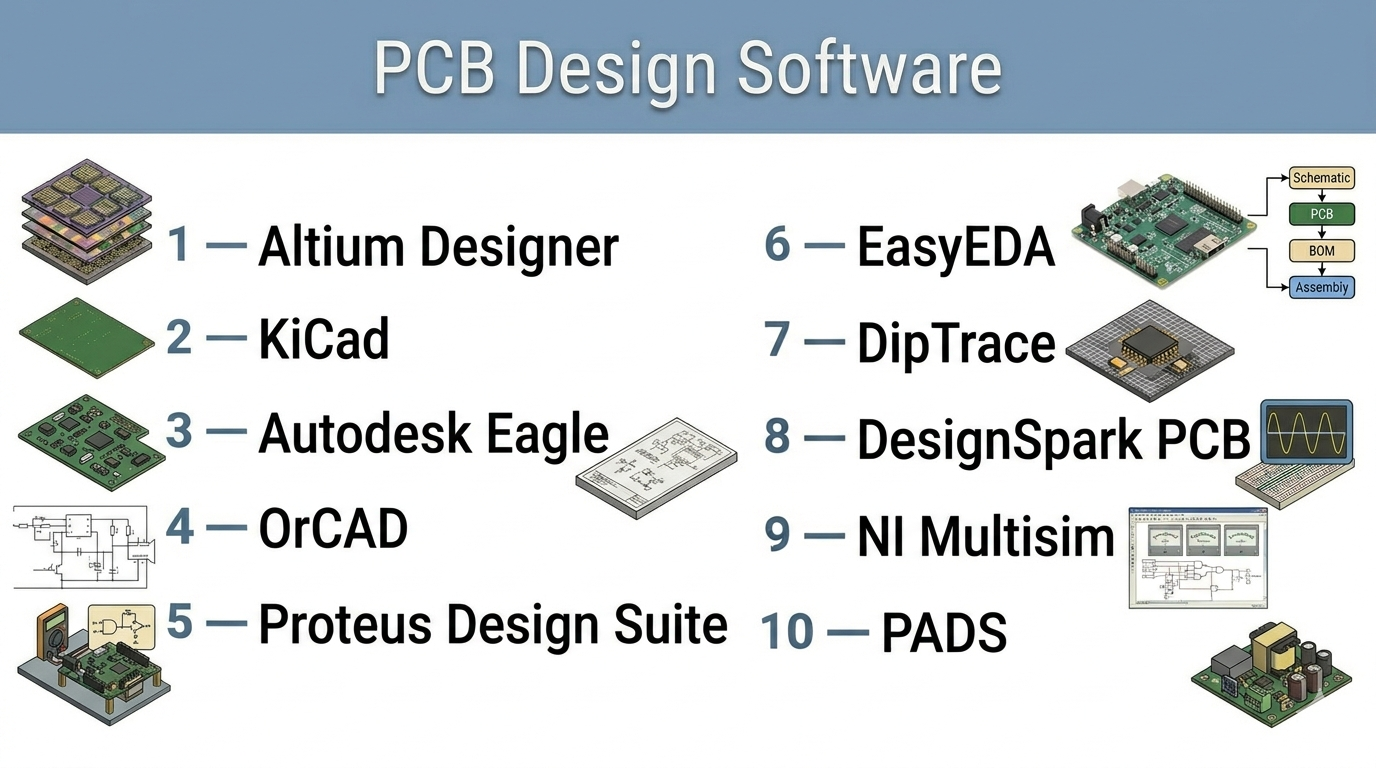
Top 10 PCB Design Software Tools
#1 — Altium Designer
Short description: A premium, all-in-one PCB design platform widely used for complex, high-performance boards in enterprise environments.
Key Features
- Unified schematic and PCB layout
- Advanced routing and high-speed design tools
- 3D PCB visualization
- Design rule checks (DRC)
- Supply chain and component management
- Cloud collaboration
Pros
- Industry-leading capabilities
- Excellent for complex designs
Cons
- Expensive
- Steep learning curve
Platforms / Deployment
Windows / Cloud / Hybrid
Security & Compliance
SSO, RBAC, encryption (varies by deployment)
Integrations & Ecosystem
Altium integrates deeply with design and manufacturing workflows.
- MCAD tools
- Component databases
- Cloud collaboration systems
- Manufacturing outputs
Support & Community
Strong enterprise support, extensive documentation, and global community.
#2 — KiCad
Short description: A popular open-source PCB design suite suitable for hobbyists, startups, and professionals.
Key Features
- Schematic capture and PCB layout
- Multi-layer support
- Interactive routing
- 3D viewer
- Plugin ecosystem
- Open-source customization
Pros
- Free and open-source
- Strong community
Cons
- Limited enterprise features
- Less polished UI
Platforms / Deployment
Windows / macOS / Linux
Security & Compliance
Not publicly stated
Integrations & Ecosystem
- Plugins
- Community libraries
- Custom scripts
Support & Community
Highly active community support.
#3 — Autodesk Eagle
Short description: A user-friendly PCB design tool popular among startups and makers.
Key Features
- Schematic design
- PCB layout
- Autorouting
- Library management
- Cloud integration
Pros
- Easy to learn
- Good for small teams
Cons
- Limited advanced features
- Subscription model
Platforms / Deployment
Windows / macOS / Cloud
Security & Compliance
Not publicly stated
Integrations & Ecosystem
- Autodesk ecosystem
- Fusion integration
- Libraries
Support & Community
Strong community and tutorials.
#4 — OrCAD
Short description: A professional PCB design suite by Cadence for schematic capture and layout.
Key Features
- Schematic capture
- PCB layout
- Simulation tools
- Design rule checks
- Component management
Pros
- Reliable and widely used
- Strong integration
Cons
- Windows-only
- Expensive
Platforms / Deployment
Windows / Self-hosted
Security & Compliance
Not publicly stated
Integrations & Ecosystem
- Cadence tools
- Simulation platforms
- PCB workflows
Support & Community
Well-established support.
#5 — Proteus Design Suite
Short description: A PCB design and simulation tool focused on embedded systems development.
Key Features
- Circuit simulation
- Microcontroller simulation
- PCB layout
- Debugging tools
- Virtual prototyping
Pros
- Excellent simulation capabilities
- Ideal for embedded design
Cons
- Limited advanced PCB features
- Windows-focused
Platforms / Deployment
Windows / Self-hosted
Security & Compliance
Not publicly stated
Integrations & Ecosystem
- Microcontroller libraries
- Simulation tools
Support & Community
Moderate community support.
#6 — EasyEDA
Short description: A cloud-based PCB design tool ideal for beginners and small teams.
Key Features
- Web-based design
- Schematic capture
- PCB layout
- Component libraries
- Cloud storage
Pros
- Easy access
- Affordable
Cons
- Limited advanced features
- Internet dependency
Platforms / Deployment
Web / Cloud
Security & Compliance
Not publicly stated
Integrations & Ecosystem
- Cloud libraries
- Manufacturing integration
Support & Community
Growing community.
#7 — DipTrace
Short description: A user-friendly PCB design tool balancing simplicity and advanced features.
Key Features
- Schematic capture
- PCB layout
- 3D visualization
- Autorouting
- Library management
Pros
- Easy to use
- Affordable
Cons
- Limited enterprise features
- Smaller ecosystem
Platforms / Deployment
Windows / macOS
Security & Compliance
Not publicly stated
Integrations & Ecosystem
- Component libraries
- Export tools
Support & Community
Moderate support.
#8 — DesignSpark PCB
Short description: A free PCB design tool aimed at engineers and hobbyists.
Key Features
- Schematic design
- PCB layout
- Design rule checks
- Libraries
- Free usage
Pros
- Free
- Easy to start
Cons
- Limited advanced features
- Smaller ecosystem
Platforms / Deployment
Windows
Security & Compliance
Not publicly stated
Integrations & Ecosystem
- Component libraries
- Basic integrations
Support & Community
Moderate community.
#9 — NI Multisim
Short description: A simulation-focused tool used for circuit design and testing.
Key Features
- Circuit simulation
- Component libraries
- Analysis tools
- Educational features
- Integration with hardware
Pros
- Strong simulation
- Good for education
Cons
- Limited PCB layout capabilities
- Not a full PCB tool
Platforms / Deployment
Windows
Security & Compliance
Not publicly stated
Integrations & Ecosystem
- Lab tools
- Simulation workflows
Support & Community
Strong in academic environments.
#10 — PADS (Siemens)
Short description: A professional PCB design solution for mid-to-enterprise-level designs.
Key Features
- Advanced PCB layout
- Signal integrity tools
- Design validation
- Routing automation
- Manufacturing output
Pros
- Strong enterprise features
- Reliable performance
Cons
- Expensive
- Complex interface
Platforms / Deployment
Windows / Hybrid
Security & Compliance
Not publicly stated
Integrations & Ecosystem
- Siemens ecosystem
- PLM tools
- Manufacturing systems
Support & Community
Enterprise-level support.
Comparison Table (Top 10)
| Tool Name | Best For | Platform(s) Supported | Deployment | Standout Feature | Public Rating |
|---|---|---|---|---|---|
| Altium Designer | Enterprise PCB design | Windows | Hybrid | Advanced routing | N/A |
| KiCad | Open-source users | Windows, macOS, Linux | Self-hosted | Free and flexible | N/A |
| Eagle | Startups | Windows, macOS | Cloud | Ease of use | N/A |
| OrCAD | Professionals | Windows | Self-hosted | Cadence integration | N/A |
| Proteus | Embedded systems | Windows | Self-hosted | Simulation | N/A |
| EasyEDA | Beginners | Web | Cloud | Browser-based | N/A |
| DipTrace | SMB users | Windows, macOS | Self-hosted | Simplicity | N/A |
| DesignSpark PCB | Hobbyists | Windows | Self-hosted | Free tool | N/A |
| NI Multisim | Education | Windows | Self-hosted | Circuit simulation | N/A |
| PADS | Enterprise | Windows | Hybrid | Signal integrity | N/A |
Evaluation & Scoring of PCB Design Software
| Tool Name | Core (25%) | Ease (15%) | Integrations (15%) | Security (10%) | Performance (10%) | Support (10%) | Value (15%) | Weighted Total |
|---|---|---|---|---|---|---|---|---|
| Altium Designer | 10 | 6 | 9 | 8 | 9 | 9 | 5 | 8.3 |
| KiCad | 8 | 7 | 6 | 6 | 7 | 8 | 10 | 7.6 |
| Eagle | 7 | 8 | 7 | 6 | 7 | 7 | 7 | 7.1 |
| OrCAD | 9 | 6 | 8 | 7 | 8 | 8 | 6 | 7.7 |
| Proteus | 7 | 7 | 6 | 6 | 7 | 7 | 7 | 7.0 |
| EasyEDA | 6 | 9 | 6 | 6 | 6 | 6 | 8 | 7.0 |
| DipTrace | 7 | 8 | 6 | 6 | 7 | 7 | 7 | 7.1 |
| DesignSpark PCB | 6 | 8 | 5 | 6 | 6 | 6 | 9 | 6.9 |
| NI Multisim | 7 | 7 | 6 | 6 | 7 | 7 | 7 | 7.0 |
| PADS | 9 | 6 | 8 | 7 | 8 | 8 | 6 | 7.7 |
How to interpret these scores:
- These are relative comparisons, not absolute rankings.
- Enterprise tools score high in features but lower in value.
- Open-source tools rank high in affordability.
- Cloud tools excel in ease of use.
- Choose based on your specific needs and workflow.
Which PCB Design Software Is Right for You?
Solo / Freelancer
- Best: KiCad, EasyEDA
- Focus on low cost and ease of use
SMB
- Best: DipTrace, Eagle, EasyEDA
- Balance usability and features
Mid-Market
- Best: OrCAD, Altium
- Need scalability and integration
Enterprise
- Best: Altium Designer, PADS
- Focus on performance and complexity
Budget vs Premium
- Budget: KiCad, DesignSpark
- Premium: Altium, PADS
Feature Depth vs Ease of Use
- Deep features: Altium, PADS
- Ease of use: EasyEDA, Eagle
Integrations & Scalability
- Strong: Altium, Siemens ecosystem
- Moderate: Eagle
Security & Compliance Needs
- Enterprise: Altium
- Basic: Open-source tools
Frequently Asked Questions (FAQs)
What is PCB design software?
It is used to design, simulate, and prepare circuit boards for manufacturing.
How much does PCB software cost?
It ranges from free tools to expensive enterprise solutions.
Which tool is best for beginners?
KiCad and EasyEDA are great starting points.
Can PCB tools simulate circuits?
Yes, many tools include simulation capabilities.
Do I need training?
Yes, especially for advanced tools.
Are cloud PCB tools reliable?
They are improving but depend on connectivity.
Can I switch tools later?
Yes, but migration can be complex.
What industries use PCB tools?
Electronics, automotive, telecom, and manufacturing.
Are open-source tools enough?
Yes for many use cases, but limited for enterprise.
What should I prioritize?
Scalability, integration, and long-term usability.
Conclusion
PCB design software is essential for building modern electronic systems. Whether you are a beginner designing simple boards or an enterprise developing complex hardware, the right tool can significantly impact your workflow and product quality.
There is no universal “best” solution—only the one that fits your needs. Enterprise tools provide power and scalability, while open-source and cloud tools offer flexibility and affordability.