Introduction
Mobile app development platforms provide the tools, frameworks, and environments needed to build, test, and deploy applications for smartphones and tablets. These platforms range from fully coded frameworks to low-code and cross-platform solutions, enabling developers and businesses to create apps efficiently across iOS and Android ecosystems.
With the rapid growth of mobile usage, businesses increasingly rely on mobile apps for customer engagement, operations, and revenue generation. Modern platforms now offer cross-platform compatibility, cloud integration, real-time data syncing, and AI-powered features—reducing development time while improving scalability.
Common use cases include:
- Consumer mobile applications
- Enterprise mobile solutions
- E-commerce and on-demand apps
- Internal workforce tools
- Social and content platforms
- Fintech and service apps
What buyers should evaluate:
- Native vs cross-platform capabilities
- Performance and responsiveness
- Development speed and ease of use
- Integration with backend services
- UI/UX flexibility
- Scalability and maintenance
- Security and compliance
- Community support and ecosystem
- Cost of development and ownership
- Deployment and update processes
Best for: Developers, startups, enterprises, and product teams building mobile-first experiences.
Not ideal for: Simple static applications (website builders may suffice) or highly specialized hardware-based apps requiring deep native access.
Key Trends in Mobile App Development Platforms
- Cross-platform frameworks dominance: Build once, deploy everywhere
- AI-assisted development: Code suggestions, testing, and automation
- Cloud-based development: Backend services and hosting integration
- Low-code/no-code mobile tools: Faster app creation for non-developers
- Progressive Web Apps (PWAs): Web apps with mobile-like experiences
- Microservices architecture: Scalable backend systems
- Real-time capabilities: Live data synchronization and notifications
- Enhanced security: Encryption, authentication, and compliance features
- DevOps integration: CI/CD pipelines for faster releases
- 5G optimization: Faster performance and richer app experiences
How We Selected These Tools (Methodology)
We evaluated platforms based on:
- Market adoption and developer popularity
- Performance and reliability
- Cross-platform capabilities
- Ease of development and learning curve
- Integration with backend services and APIs
- UI/UX flexibility and customization
- Security and compliance features
- Deployment and maintenance workflows
- Community support and documentation
- Innovation in mobile development technologies
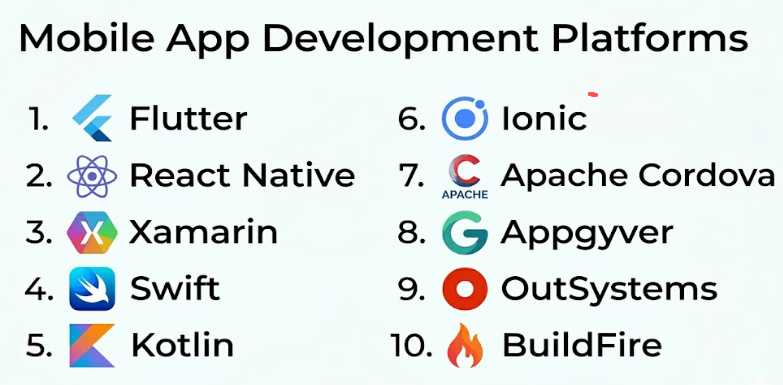
Top 10 Mobile App Development Platforms
#1 — Flutter
Short description: An open-source UI toolkit for building natively compiled applications from a single codebase.
Key Features
- Single codebase for iOS and Android
- Rich UI components
- Fast performance with native compilation
- Hot reload for rapid development
- Strong community support
- Integration with backend services
Pros
- High performance
- Beautiful UI capabilities
- Strong developer ecosystem
Cons
- Larger app sizes
- Dart language learning curve
Platforms / Deployment
iOS / Android / Web / Desktop
Security & Compliance
Depends on implementation
Integrations & Ecosystem
- APIs
- Firebase
- Third-party plugins
Support & Community
Large and active global community.
#2 — React Native
Short description: A popular framework for building mobile apps using JavaScript and React.
Key Features
- Cross-platform development
- Reusable components
- Large ecosystem
- Live reload
- Native modules support
- Strong community
Pros
- Widely adopted
- Faster development
- Large talent pool
Cons
- Performance limitations vs native
- Debugging complexity
Platforms / Deployment
iOS / Android
Security & Compliance
Depends on implementation
Integrations & Ecosystem
- APIs
- Third-party libraries
- Backend services
Support & Community
Very large developer community.
#3 — Xamarin (.NET MAUI)
Short description: A Microsoft framework for building cross-platform apps using C# and .NET.
Key Features
- Single codebase
- Native performance
- Integration with Microsoft tools
- UI frameworks
- Strong enterprise support
Pros
- Great for .NET developers
- Enterprise-friendly
- Strong performance
Cons
- Smaller community than React Native
- UI limitations
Platforms / Deployment
iOS / Android / Windows
Security & Compliance
Enterprise-grade within Microsoft ecosystem
Integrations & Ecosystem
- Microsoft Azure
- APIs
- Enterprise tools
Support & Community
Strong Microsoft-backed support.
#4 — Swift (iOS SDK)
Short description: Apple’s official language and SDK for building native iOS applications.
Key Features
- Native iOS performance
- Full access to device features
- Optimized UI frameworks
- Strong security features
- Continuous updates
Pros
- Best performance for iOS
- Full hardware access
- Highly optimized
Cons
- iOS-only
- Requires macOS
Platforms / Deployment
iOS
Security & Compliance
Strong native security features
Integrations & Ecosystem
- Apple ecosystem
- APIs
- Native frameworks
Support & Community
Large iOS developer community.
#5 — Kotlin (Android SDK)
Short description: Google’s preferred language for Android app development.
Key Features
- Native Android development
- Modern syntax
- High performance
- Full Android SDK access
- Strong tooling
Pros
- Official Android support
- Efficient and safe code
- Strong performance
Cons
- Android-only
- Requires platform-specific development
Platforms / Deployment
Android
Security & Compliance
Strong native capabilities
Integrations & Ecosystem
- Google services
- APIs
- Android libraries
Support & Community
Large Android developer ecosystem.
#6 — Ionic
Short description: A framework for building mobile apps using web technologies.
Key Features
- HTML, CSS, JavaScript-based
- Cross-platform support
- UI components library
- PWA support
- Integration with Angular/React
Pros
- Easy for web developers
- Fast development
- Cross-platform
Cons
- Performance limitations
- Less native feel
Platforms / Deployment
iOS / Android / Web
Security & Compliance
Depends on implementation
Integrations & Ecosystem
- APIs
- Web tools
- Plugins
Support & Community
Strong web developer community.
#7 — Apache Cordova
Short description: A framework for building mobile apps using web technologies with native wrappers.
Key Features
- Cross-platform apps
- Plugin architecture
- Web-based development
- Access to device APIs
- Open-source
Pros
- Easy for web developers
- Flexible plugin system
Cons
- Performance issues
- Outdated compared to modern tools
Platforms / Deployment
iOS / Android
Security & Compliance
Depends on implementation
Integrations & Ecosystem
- Plugins
- APIs
Support & Community
Moderate support.
#8 — Appgyver
Short description: A no-code/low-code platform for building mobile applications visually.
Key Features
- Drag-and-drop builder
- Logic flows
- Cross-platform support
- Integration capabilities
- UI components
Pros
- No coding required
- Rapid development
- Free tier available
Cons
- Limited advanced customization
- Learning curve for logic
Platforms / Deployment
iOS / Android / Web
Security & Compliance
Not publicly stated
Integrations & Ecosystem
- APIs
- External services
Support & Community
Growing community.
#9 — OutSystems
Short description: An enterprise low-code platform for building scalable mobile applications.
Key Features
- Visual development
- Cross-platform apps
- DevOps automation
- Integration tools
- AI-assisted development
Pros
- Enterprise-grade
- Scalable
- Strong performance
Cons
- Expensive
- Complex
Platforms / Deployment
iOS / Android / Web
Security & Compliance
Enterprise-grade (details not publicly stated)
Integrations & Ecosystem
- Enterprise systems
- APIs
Support & Community
Strong enterprise support.
#10 — BuildFire
Short description: A no-code platform for building mobile apps with pre-built modules.
Key Features
- Drag-and-drop builder
- Pre-built plugins
- Custom modules
- App publishing support
- Analytics
Pros
- Easy to use
- Fast deployment
- Plugin-based architecture
Cons
- Limited flexibility
- Dependency on platform
Platforms / Deployment
iOS / Android
Security & Compliance
Not publicly stated
Integrations & Ecosystem
- Plugins
- APIs
Support & Community
Good support resources.
Comparison Table (Top 10)
| Tool Name | Best For | Platform(s) Supported | Deployment | Standout Feature | Public Rating |
|---|---|---|---|---|---|
| Flutter | Cross-platform apps | iOS, Android, Web, Desktop | Self-hosted | Native performance | N/A |
| React Native | JS developers | iOS, Android | Self-hosted | Large ecosystem | N/A |
| Xamarin/.NET | Enterprise .NET | iOS, Android, Windows | Self-hosted | Microsoft integration | N/A |
| Swift | iOS apps | iOS | Self-hosted | Native performance | N/A |
| Kotlin | Android apps | Android | Self-hosted | Official Android language | N/A |
| Ionic | Web developers | iOS, Android, Web | Self-hosted | Web-based apps | N/A |
| Cordova | Hybrid apps | iOS, Android | Self-hosted | Plugin system | N/A |
| Appgyver | No-code apps | iOS, Android, Web | Cloud | Visual builder | N/A |
| OutSystems | Enterprise apps | iOS, Android, Web | Cloud/Hybrid | Scalability | N/A |
| BuildFire | Quick apps | iOS, Android | Cloud | Plugin modules | N/A |
Evaluation & Scoring of Mobile App Development Platforms
| Tool Name | Core | Ease | Integrations | Security | Performance | Support | Value | Weighted Total |
|---|---|---|---|---|---|---|---|---|
| Flutter | 9 | 7 | 8 | 8 | 9 | 9 | 9 | 8.6 |
| React Native | 9 | 8 | 9 | 7 | 8 | 9 | 9 | 8.4 |
| Xamarin/.NET | 8 | 7 | 9 | 8 | 8 | 8 | 8 | 8.0 |
| Swift | 9 | 6 | 8 | 9 | 10 | 8 | 7 | 8.3 |
| Kotlin | 9 | 6 | 8 | 9 | 10 | 8 | 7 | 8.3 |
| Ionic | 7 | 9 | 8 | 7 | 7 | 8 | 8 | 7.7 |
| Cordova | 6 | 8 | 7 | 6 | 6 | 6 | 7 | 6.6 |
| Appgyver | 7 | 8 | 7 | 6 | 7 | 7 | 8 | 7.3 |
| OutSystems | 9 | 6 | 9 | 9 | 9 | 9 | 6 | 8.4 |
| BuildFire | 7 | 9 | 7 | 6 | 7 | 7 | 8 | 7.4 |
Which Mobile App Development Platform Is Right for You?
Solo / Freelancer
- Best: Flutter, Ionic, BuildFire
- Focus on speed and cost-efficiency
SMB
- Best: React Native, Flutter, Appgyver
Mid-Market
- Best: React Native, Xamarin, Flutter
Enterprise
- Best: OutSystems, Xamarin, Swift/Kotlin
Budget vs Premium
- Budget: Ionic, Appgyver
- Premium: OutSystems
Feature Depth vs Ease of Use
- Deep: Swift, Kotlin
- Easy: BuildFire, Ionic
Integrations & Scalability
- Strong: Flutter, React Native, OutSystems
- Moderate: Ionic
Security & Compliance Needs
- Highest: Swift, Kotlin, OutSystems
- Moderate: Flutter
Frequently Asked Questions (FAQs)
What is a mobile app development platform?
A tool or framework used to build mobile applications.
What is the difference between native and cross-platform?
Native apps are built for a specific OS, while cross-platform apps work on multiple OS.
Which platform is best for beginners?
Ionic and BuildFire are beginner-friendly.
Are cross-platform apps good?
Yes, they save time and cost, though native apps may offer better performance.
Can I build apps without coding?
Yes, using no-code tools like Appgyver or BuildFire.
Which platform is most scalable?
OutSystems and Flutter are highly scalable.
Are these platforms secure?
Security depends on implementation and platform features.
Can I integrate APIs?
Yes, most platforms support API integrations.
How much does it cost?
Costs vary widely depending on the platform and usage.
Which platform should I choose?
Choose based on your technical skills, budget, and app complexity.
Conclusion
Mobile app development platforms offer a wide range of options—from native development tools like Swift and Kotlin to cross-platform frameworks like Flutter and React Native, and even no-code builders like Appgyver.