Introduction
Microlearning Platforms are specialized tools designed to deliver short, focused learning content in bite-sized formats. Instead of long, traditional training sessions, these platforms break content into small modules—typically 2–10 minutes—making it easier for learners to absorb, retain, and apply knowledge quickly.
With shrinking attention spans, remote work environments, and the need for continuous upskilling, microlearning has become a preferred learning approach across industries. These platforms often include mobile-first experiences, gamification, AI-driven recommendations, and real-time analytics to improve engagement and outcomes.
Common use cases include:
- Employee onboarding and training
- Sales enablement and product knowledge
- Compliance and policy updates
- Skill development and continuous learning
- Customer education and partner training
Key evaluation criteria:
- Content creation and delivery capabilities
- Mobile and offline accessibility
- Personalization and AI-driven recommendations
- Gamification and engagement features
- Integration with LMS and HR systems
- Analytics and reporting
- Ease of use for admins and learners
- Scalability for large teams
- Security and compliance
- Pricing and value
Best for: L&D teams, HR leaders, training organizations, and companies looking to deliver fast, engaging, and continuous learning experiences.
Not ideal for: Deep technical training or long-form educational programs that require detailed, structured learning paths.
Key Trends in Portfolio & Microlearning Platforms
- AI-driven learning paths: Personalized content recommendations based on learner behavior.
- Mobile-first and offline learning: Access to content anytime, anywhere.
- Gamification and engagement: Points, badges, and leaderboards to increase participation.
- Video-first learning: Short video-based lessons becoming dominant.
- Integration with LMS ecosystems: Seamless data sharing and tracking.
- User-generated content (UGC): Employees creating and sharing knowledge.
- Real-time analytics: Tracking engagement and performance metrics.
- Social learning features: Peer collaboration and knowledge sharing.
- Automation of training workflows: Scheduled learning nudges and reminders.
- Focus on continuous learning: Moving beyond one-time training programs.
How We Selected These Tools (Methodology)
The tools in this list were selected based on:
- Market adoption and popularity in L&D ecosystems
- Strength in microlearning-specific capabilities
- Ease of content creation and delivery
- Mobile and accessibility features
- Integration ecosystem with LMS, HR, and productivity tools
- Engagement features like gamification and social learning
- Vendor maturity and innovation
- Performance and scalability
- Security and compliance features
- Support and onboarding experience
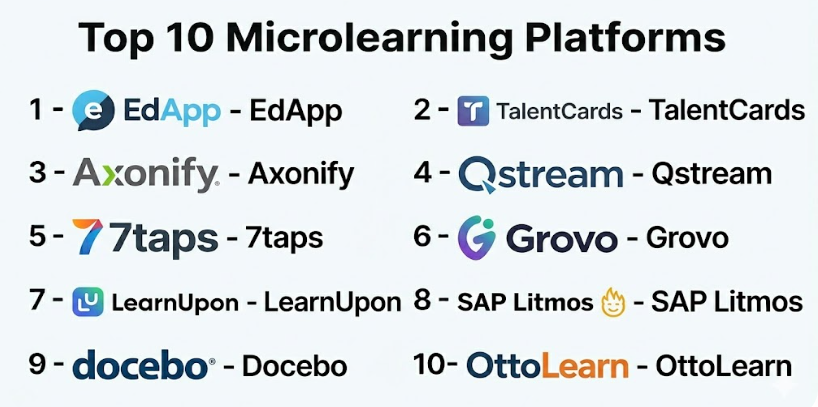
Top 10 Microlearning Platforms
#1 — EdApp
Short description: A mobile-first microlearning platform focused on gamification and rapid course creation.
Key Features
- Mobile-first learning experience
- Built-in course authoring
- Gamification (points, leaderboards)
- AI-powered content tools
- SCORM compatibility
- Analytics dashboards
Pros
- Highly engaging mobile experience
- Easy course creation
Cons
- Limited deep customization
- Advanced features in higher tiers
Platforms / Deployment
Web / iOS / Android
Cloud
Security & Compliance
Not publicly stated
Integrations & Ecosystem
EdApp integrates with LMS and enterprise tools.
- LMS platforms
- APIs
- SCORM support
Support & Community
Good documentation and onboarding resources.
#2 — TalentCards
Short description: Mobile microlearning platform designed for frontline and deskless workers.
Key Features
- Card-based learning modules
- Mobile-first delivery
- Offline access
- Quiz and assessment tools
- Analytics and reporting
Pros
- Ideal for mobile and remote workers
- Simple and intuitive
Cons
- Limited advanced features
- Basic customization
Platforms / Deployment
Web / iOS / Android
Cloud
Security & Compliance
Not publicly stated
Integrations & Ecosystem
Supports LMS integrations and APIs.
- LMS platforms
- APIs
Support & Community
Strong support for SMB users.
#3 — Axonify
Short description: AI-powered microlearning platform focused on frontline training and reinforcement.
Key Features
- Personalized learning paths
- AI-driven recommendations
- Gamification features
- Reinforcement learning
- Analytics dashboards
Pros
- Strong AI personalization
- Excellent for frontline training
Cons
- Enterprise-focused pricing
- Limited customization
Platforms / Deployment
Web / Mobile
Cloud
Security & Compliance
Not publicly stated
Integrations & Ecosystem
Integrates with enterprise systems.
- LMS platforms
- HR systems
- APIs
Support & Community
Enterprise-level support.
#4 — Qstream
Short description: Microlearning platform focused on knowledge reinforcement and performance improvement.
Key Features
- Scenario-based learning
- Spaced repetition
- Analytics and insights
- Gamification
- Mobile learning
Pros
- Strong reinforcement learning
- Data-driven insights
Cons
- Limited content creation tools
- Pricing varies
Platforms / Deployment
Web / Mobile
Cloud
Security & Compliance
Not publicly stated
Integrations & Ecosystem
Supports integrations with enterprise tools.
- LMS systems
- APIs
- CRM tools
Support & Community
Reliable enterprise support.
#5 — 7taps
Short description: Simple microlearning authoring tool focused on quick content creation.
Key Features
- No-code course builder
- Mobile-first design
- Interactive micro-lessons
- Instant sharing
- Analytics
Pros
- Extremely easy to use
- Fast content creation
Cons
- Limited advanced features
- Not enterprise-focused
Platforms / Deployment
Web
Cloud
Security & Compliance
Not publicly stated
Integrations & Ecosystem
Basic integrations and sharing capabilities.
- APIs
- LMS compatibility
Support & Community
Good support for small teams.
#6 — Grovo
Short description: Microlearning platform focused on employee training and development.
Key Features
- Microlearning content library
- Video-based learning
- Analytics dashboards
- Custom course creation
- Integration support
Pros
- Ready-made content library
- Easy implementation
Cons
- Limited customization
- Smaller ecosystem
Platforms / Deployment
Web
Cloud
Security & Compliance
Not publicly stated
Integrations & Ecosystem
Supports integrations with HR and LMS tools.
- LMS systems
- HR platforms
- APIs
Support & Community
Moderate support and documentation.
#7 — LearnUpon
Short description: LMS with strong microlearning capabilities and content delivery features.
Key Features
- Course management
- Microlearning delivery
- Reporting and analytics
- Gamification
- Integrations
Pros
- Combines LMS and microlearning
- Scalable for growing teams
Cons
- Not purely microlearning-focused
- Pricing varies
Platforms / Deployment
Web / Mobile
Cloud
Security & Compliance
Not publicly stated
Integrations & Ecosystem
Strong LMS integrations.
- HR systems
- CRM tools
- APIs
Support & Community
Strong support and onboarding.
#8 — SAP Litmos
Short description: Enterprise learning platform with microlearning and compliance training capabilities.
Key Features
- Microlearning modules
- Compliance training
- Analytics dashboards
- Automation tools
- Integration ecosystem
Pros
- Enterprise scalability
- Strong compliance features
Cons
- Complex interface
- Higher cost
Platforms / Deployment
Web / Mobile
Cloud
Security & Compliance
Not publicly stated
Integrations & Ecosystem
Extensive integrations.
- HR systems
- CRM platforms
- APIs
Support & Community
Enterprise-level support.
#9 — Docebo
Short description: AI-powered LMS with microlearning and social learning capabilities.
Key Features
- Microlearning delivery
- AI recommendations
- Social learning features
- Analytics dashboards
- Integration support
Pros
- Strong AI capabilities
- Scalable platform
Cons
- Complex setup
- Pricing varies
Platforms / Deployment
Web / Mobile
Cloud
Security & Compliance
Not publicly stated
Integrations & Ecosystem
Strong ecosystem integrations.
- HR systems
- CRM tools
- APIs
Support & Community
Strong enterprise support.
#10 — OttoLearn
Short description: Adaptive microlearning platform focused on continuous learning and retention.
Key Features
- Adaptive learning paths
- Reinforcement algorithms
- Microlearning modules
- Analytics dashboards
- Automation tools
Pros
- Strong adaptive learning
- Focus on retention
Cons
- Smaller ecosystem
- Limited integrations
Platforms / Deployment
Web / Mobile
Cloud
Security & Compliance
Not publicly stated
Integrations & Ecosystem
Basic integration capabilities.
- APIs
- LMS compatibility
Support & Community
Moderate support resources.
Comparison Table (Top 10)
| Tool Name | Best For | Platform(s) Supported | Deployment | Standout Feature | Public Rating |
|---|---|---|---|---|---|
| EdApp | SMB/Mid | Web, iOS, Android | Cloud | Gamification | N/A |
| TalentCards | Frontline teams | Web, Mobile | Cloud | Card-based learning | N/A |
| Axonify | Enterprise | Web, Mobile | Cloud | AI personalization | N/A |
| Qstream | Reinforcement | Web, Mobile | Cloud | Spaced repetition | N/A |
| 7taps | SMB | Web | Cloud | Simplicity | N/A |
| Grovo | SMB | Web | Cloud | Content library | N/A |
| LearnUpon | Mid-market | Web, Mobile | Cloud | LMS + microlearning | N/A |
| SAP Litmos | Enterprise | Web, Mobile | Cloud | Compliance training | N/A |
| Docebo | Enterprise | Web, Mobile | Cloud | AI learning | N/A |
| OttoLearn | SMB/Mid | Web, Mobile | Cloud | Adaptive learning | N/A |
Evaluation & Scoring of Microlearning Platforms
| Tool Name | Core (25%) | Ease (15%) | Integrations (15%) | Security (10%) | Performance (10%) | Support (10%) | Value (15%) | Weighted Total |
|---|---|---|---|---|---|---|---|---|
| EdApp | 8 | 9 | 7 | 6 | 8 | 7 | 9 | 7.9 |
| TalentCards | 7 | 9 | 6 | 6 | 7 | 7 | 9 | 7.6 |
| Axonify | 9 | 7 | 8 | 7 | 9 | 8 | 6 | 8.0 |
| Qstream | 8 | 7 | 7 | 6 | 8 | 7 | 7 | 7.5 |
| 7taps | 7 | 10 | 6 | 6 | 7 | 7 | 9 | 7.6 |
| Grovo | 7 | 8 | 6 | 6 | 7 | 7 | 8 | 7.3 |
| LearnUpon | 8 | 8 | 8 | 6 | 8 | 8 | 7 | 7.8 |
| SAP Litmos | 9 | 6 | 9 | 7 | 9 | 8 | 6 | 8.0 |
| Docebo | 9 | 7 | 9 | 7 | 9 | 8 | 6 | 8.1 |
| OttoLearn | 8 | 8 | 6 | 6 | 8 | 7 | 8 | 7.6 |
How to interpret scores:
- Scores are relative comparisons, not absolute benchmarks.
- Enterprise tools score higher in features and integrations.
- SMB tools excel in ease of use and value.
- AI-driven tools rank higher in personalization and analytics.
- Choose based on your learning strategy and workforce type.
Which Microlearning Platform Is Right for You?
Solo / Freelancer
7taps or EdApp for simple and fast content creation.
SMB
TalentCards, EdApp, and OttoLearn provide affordability and ease of use.
Mid-Market
LearnUpon and Qstream offer a balance of features and scalability.
Enterprise
Axonify, Docebo, and SAP Litmos are ideal for large-scale training and advanced analytics.
Budget vs Premium
- Budget: 7taps, TalentCards
- Premium: Docebo, SAP Litmos
Feature Depth vs Ease of Use
- Feature-rich: Docebo, Axonify
- Easy to use: 7taps, EdApp
Integrations & Scalability
- Strong integrations: SAP Litmos, Docebo
- Moderate: SMB tools
Security & Compliance Needs
- High compliance: Enterprise tools
- Basic: SMB tools
Frequently Asked Questions (FAQs)
What are microlearning platforms?
They are tools that deliver short, focused learning content in small modules.
Why is microlearning effective?
It improves retention and engagement by delivering content in bite-sized formats.
Are these platforms mobile-friendly?
Yes, most are designed for mobile-first experiences.
Can I integrate with LMS?
Yes, most platforms support LMS integration.
Are these tools suitable for compliance training?
Yes, especially enterprise platforms.
How long are microlearning modules?
Typically 2–10 minutes.
Can I create custom content?
Yes, most platforms include authoring tools.
Do they support gamification?
Many platforms include gamification features.
Is AI used in microlearning?
Yes, for personalization and recommendations.
What should I avoid when choosing?
Avoid tools lacking scalability, analytics, or mobile support.
Conclusion
Microlearning Platforms are transforming how organizations deliver training by making learning faster, more engaging, and more accessible. Whether you’re training frontline employees or enabling continuous learning across teams, these tools offer flexible and scalable solutions.