Introduction
Enterprise Service Bus (ESB) platforms are middleware solutions designed to enable communication, integration, and orchestration between different applications, services, and systems within an organization. They act as a centralized hub that facilitates message routing, transformation, and protocol mediation—allowing diverse systems to work together seamlessly.
ESB platforms are particularly valuable in enterprises with complex IT ecosystems, where legacy systems, on-premise infrastructure, and modern cloud applications must coexist. By decoupling services and standardizing communication, ESBs improve scalability, maintainability, and governance.
Common use cases include:
- Integrating legacy systems with modern applications
- Service orchestration and workflow management
- Data transformation between systems
- API and service communication
- Centralized integration architecture
What buyers should evaluate:
- Messaging and routing capabilities
- Protocol support (HTTP, JMS, SOAP, REST, etc.)
- Scalability and performance
- Ease of deployment and configuration
- Monitoring and management tools
- Security and governance
- Support for hybrid environments
- Vendor ecosystem and community
Best for:
Large enterprises, financial institutions, telecom companies, and organizations with complex integration needs.
Not ideal for:
Small teams or startups that require lightweight integrations—modern iPaaS or API-based solutions may be more suitable.
Key Trends in Enterprise Service Bus (ESB) Platforms
- Shift toward microservices: ESB evolving to support decentralized architectures
- Hybrid integration: Combining ESB with cloud-native tools
- API-first approach: Integration strategies centered around APIs
- Event-driven architecture: Real-time data processing and messaging
- Containerization: Deployment using Docker and Kubernetes
- Improved observability: Better monitoring and analytics
- Security enhancements: Identity management and encryption
- Gradual transition to iPaaS: Many organizations complement ESB with cloud integration platforms
How We Selected These Tools (Methodology)
We evaluated ESB platforms based on:
- Market adoption and enterprise usage
- Messaging and integration capabilities
- Protocol support and flexibility
- Performance and scalability
- Security and compliance readiness
- Ease of deployment and management
- Extensibility and customization
- Suitability for enterprise environments
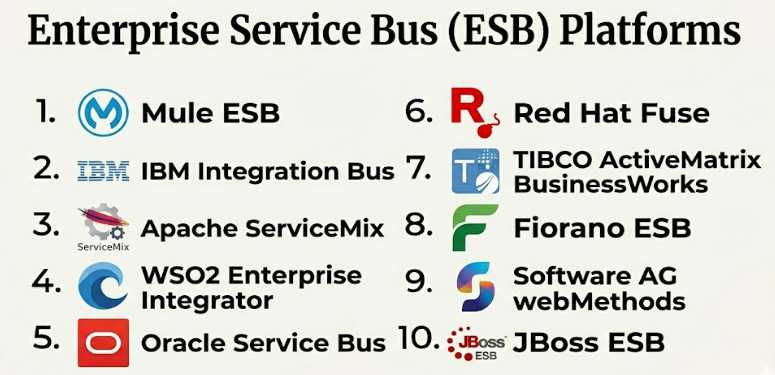
Top 10 Enterprise Service Bus (ESB) Platforms
#1 — Mule ESB
Short description: A widely adopted ESB platform offering robust integration and API capabilities.
Key Features
- Message routing and transformation
- API integration
- Protocol mediation
- Data mapping tools
- Monitoring and analytics
Pros
- Enterprise-grade capabilities
- Strong ecosystem
Cons
- Complex setup
- High cost
Platforms / Deployment
On-premise / Hybrid
Security & Compliance
SSO, RBAC, encryption. Compliance: Not publicly stated
Integrations & Ecosystem
- CRM systems
- Databases
- Enterprise applications
Support & Community
Large enterprise support and active community.
#2 — IBM Integration Bus (App Connect Enterprise)
Short description: Enterprise integration platform from IBM with advanced ESB capabilities.
Key Features
- Message transformation
- Protocol support
- Event-driven processing
- Integration with IBM ecosystem
- High-performance routing
Pros
- Highly scalable
- Reliable
Cons
- Expensive
- Steep learning curve
Platforms / Deployment
On-premise / Cloud
Security & Compliance
Enterprise-grade security. Compliance: Not publicly stated
Integrations & Ecosystem
- IBM Cloud
- Databases
- Enterprise systems
Support & Community
Strong enterprise support.
#3 — Apache ServiceMix
Short description: Open-source ESB platform built on Apache technologies.
Key Features
- OSGi-based architecture
- Message routing
- Protocol mediation
- Integration with Apache tools
- Flexible deployment
Pros
- Open-source
- Highly customizable
Cons
- Requires technical expertise
- Limited support
Platforms / Deployment
On-premise
Security & Compliance
Not publicly stated
Integrations & Ecosystem
- Apache Camel
- ActiveMQ
- Karaf
Support & Community
Community-driven support.
#4 — WSO2 Enterprise Integrator
Short description: Open-source integration platform with strong ESB capabilities.
Key Features
- Service orchestration
- Data transformation
- API management
- Event processing
- Pre-built connectors
Pros
- Cost-effective
- Flexible
Cons
- Complex configuration
- UI limitations
Platforms / Deployment
On-premise / Cloud
Security & Compliance
Encryption, RBAC. Compliance: Not publicly stated
Integrations & Ecosystem
- APIs
- Databases
- Enterprise apps
Support & Community
Active open-source community.
#5 — Oracle Service Bus
Short description: Enterprise ESB platform designed for Oracle environments.
Key Features
- Service virtualization
- Message routing
- Data transformation
- Integration with Oracle products
- Monitoring tools
Pros
- Strong Oracle integration
- Reliable
Cons
- Vendor lock-in
- Complex setup
Platforms / Deployment
On-premise / Cloud
Security & Compliance
Enterprise-grade controls. Compliance: Not publicly stated
Integrations & Ecosystem
- Oracle Cloud
- Databases
- ERP systems
Support & Community
Strong enterprise support.
#6 — Red Hat Fuse
Short description: Lightweight ESB platform based on Apache Camel.
Key Features
- Integration patterns
- Message routing
- Microservices support
- Container-ready
- Flexible deployment
Pros
- Open-source foundation
- Good for microservices
Cons
- Requires expertise
- Limited UI
Platforms / Deployment
On-premise / Cloud / Container
Security & Compliance
RBAC, encryption. Compliance: Not publicly stated
Integrations & Ecosystem
- Kubernetes
- OpenShift
- APIs
Support & Community
Strong Red Hat support.
#7 — TIBCO ActiveMatrix BusinessWorks
Short description: Enterprise integration platform with ESB capabilities and strong performance.
Key Features
- Workflow orchestration
- Data transformation
- Messaging support
- Real-time integration
- Monitoring tools
Pros
- High performance
- Reliable
Cons
- Expensive
- Complex UI
Platforms / Deployment
On-premise / Cloud
Security & Compliance
Enterprise-grade controls. Compliance: Not publicly stated
Integrations & Ecosystem
- Enterprise systems
- Databases
- APIs
Support & Community
Strong enterprise support.
#8 — Fiorano ESB
Short description: Event-driven ESB platform focused on real-time integration.
Key Features
- Event-driven architecture
- Peer-to-peer messaging
- Workflow automation
- Real-time processing
- Low latency
Pros
- Real-time capabilities
- High performance
Cons
- Smaller ecosystem
- Less popular
Platforms / Deployment
On-premise / Cloud
Security & Compliance
Not publicly stated
Integrations & Ecosystem
- Enterprise apps
- APIs
- Databases
Support & Community
Moderate support.
#9 — Software AG webMethods
Short description: Enterprise integration platform with strong ESB and API capabilities.
Key Features
- Integration workflows
- API management
- Data transformation
- B2B integration
- Monitoring tools
Pros
- Comprehensive features
- Scalable
Cons
- High cost
- Complex setup
Platforms / Deployment
On-premise / Cloud
Security & Compliance
Enterprise-grade security. Compliance: Not publicly stated
Integrations & Ecosystem
- Enterprise apps
- APIs
- Cloud services
Support & Community
Strong enterprise support.
#10 — JBoss ESB
Short description: Open-source ESB platform designed for enterprise integration.
Key Features
- Message routing
- Service orchestration
- Integration support
- Open-source flexibility
- Custom development
Pros
- Free and flexible
- Customizable
Cons
- Limited updates
- Requires expertise
Platforms / Deployment
On-premise
Security & Compliance
Not publicly stated
Integrations & Ecosystem
- Java ecosystem
- APIs
- Enterprise apps
Support & Community
Community support.
Comparison Table (Top 10)
| Tool Name | Best For | Platform(s) Supported | Deployment | Standout Feature | Public Rating |
|---|---|---|---|---|---|
| Mule ESB | Enterprise | Web | Hybrid | API integration | N/A |
| IBM Integration Bus | Large enterprises | Web | Hybrid | High performance | N/A |
| Apache ServiceMix | Developers | Web | On-prem | Open-source | N/A |
| WSO2 EI | Cost-conscious | Web | Hybrid | Flexibility | N/A |
| Oracle Service Bus | Oracle users | Web | Hybrid | Oracle ecosystem | N/A |
| Red Hat Fuse | Microservices | Web | Container | Camel-based | N/A |
| TIBCO BW | High performance | Web | Hybrid | Workflow engine | N/A |
| Fiorano ESB | Real-time | Web | Hybrid | Event-driven | N/A |
| webMethods | Enterprise | Web | Hybrid | B2B integration | N/A |
| JBoss ESB | Open-source | Web | On-prem | Customization | N/A |
Evaluation & Scoring of Enterprise Service Bus (ESB) Platforms
| Tool Name | Core (25%) | Ease (15%) | Integrations (15%) | Security (10%) | Performance (10%) | Support (10%) | Value (15%) | Weighted Total |
|---|---|---|---|---|---|---|---|---|
| Mule ESB | 9 | 6 | 9 | 8 | 9 | 9 | 6 | 8.1 |
| IBM Bus | 9 | 5 | 9 | 9 | 9 | 9 | 6 | 8.2 |
| ServiceMix | 7 | 5 | 8 | 6 | 7 | 6 | 9 | 7.0 |
| WSO2 EI | 8 | 6 | 8 | 7 | 8 | 7 | 9 | 7.8 |
| Oracle SB | 8 | 5 | 8 | 8 | 8 | 8 | 6 | 7.6 |
| Red Hat Fuse | 8 | 6 | 8 | 7 | 8 | 8 | 8 | 7.9 |
| TIBCO BW | 9 | 6 | 8 | 8 | 9 | 9 | 6 | 8.1 |
| Fiorano | 8 | 6 | 7 | 7 | 9 | 7 | 7 | 7.6 |
| webMethods | 9 | 5 | 9 | 8 | 9 | 9 | 6 | 8.2 |
| JBoss ESB | 7 | 5 | 7 | 6 | 7 | 6 | 9 | 6.9 |
Which Enterprise Service Bus (ESB) Platform Is Right for You?
Solo / Small Teams
- Best: Apache ServiceMix, JBoss ESB
- Focus on open-source flexibility
SMB
- Best: WSO2 EI, Red Hat Fuse
- Balance cost and scalability
Mid-Market
- Best: TIBCO BW, Fiorano
- Performance and real-time integration
Enterprise
- Best: Mule ESB, IBM Integration Bus, webMethods
- Governance, scalability, and reliability
Budget vs Premium
- Budget: ServiceMix, WSO2
- Premium: IBM, MuleSoft
Feature Depth vs Ease of Use
- Deep features: IBM, webMethods
- Easier options: WSO2
Integrations & Scalability
- Strong integrations: Mule ESB
- High scalability: IBM
Security & Compliance Needs
- High security: IBM, Oracle
- Moderate: Open-source tools
Frequently Asked Questions (FAQs)
What is an ESB?
An ESB is middleware that enables communication between applications using a centralized integration model.
How is ESB different from iPaaS?
ESB is typically on-premise and centralized, while iPaaS is cloud-based and more flexible.
Is ESB still relevant?
Yes, especially in large enterprises with legacy systems.
Can ESB support microservices?
Modern ESBs can support microservices, but alternatives like API gateways are often preferred.
Are ESB platforms expensive?
Enterprise-grade platforms can be costly, while open-source options are more affordable.
Do ESBs support APIs?
Yes, most modern ESBs include API integration capabilities.
Is ESB suitable for cloud-native apps?
Not always—iPaaS or API-first tools may be better.
What are common challenges?
Complexity, maintenance overhead, and scalability limitations.
Can ESB scale?
Yes, but scaling can be complex compared to cloud-native solutions.
Should I replace ESB?
Not necessarily—many organizations use ESB alongside modern integration tools.
Conclusion
Enterprise Service Bus (ESB) platforms remain a cornerstone of enterprise integration, especially in organizations with complex, legacy-heavy environments. They provide centralized control, robust messaging, and reliable service orchestration.