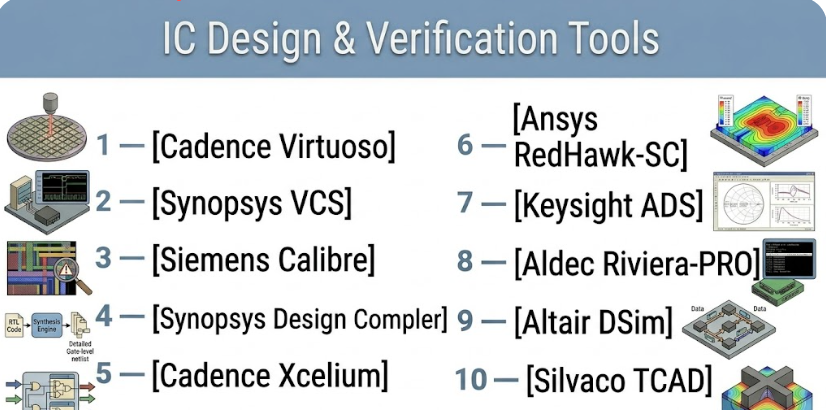
Introduction
IC Design & Verification Tools are specialized software platforms used to design, simulate, validate, and verify integrated circuits (ICs) before they are manufactured. These tools support the full semiconductor development lifecycle—from RTL design and synthesis to physical layout, verification, and sign-off.
As chip complexity continues to increase with billions of transistors and tighter power/performance constraints, these tools have become essential for avoiding costly design errors. Modern IC design environments now include AI-assisted verification, scalable simulation, and integration with manufacturing processes, making them critical for semiconductor companies and advanced hardware teams.
Common use cases include:
- ASIC and SoC design
- Functional and formal verification
- Analog and mixed-signal circuit design
- Timing, power, and performance analysis
- Physical verification (DRC/LVS)
What buyers should evaluate:
- Simulation speed and accuracy
- Verification methodology support (UVM, assertions)
- Scalability for large SoC designs
- Integration with EDA ecosystems
- Debugging and analysis tools
- Support for advanced process nodes
- Automation and AI capabilities
- Security and IP protection
- Licensing and cost structure
Best for: VLSI engineers, ASIC/SoC designers, verification engineers, semiconductor companies, and advanced R&D teams building complex silicon systems.
Not ideal for: Beginners, non-hardware teams, or projects that don’t involve silicon-level design. Simpler tools like PCB or circuit simulators may be more suitable.
Key Trends in IC Design & Verification Tools
- AI-assisted verification: Machine learning is used to improve bug detection and coverage optimization.
- Shift-left verification: Verification processes are moving earlier in the design cycle.
- Cloud-based simulation: High-performance workloads are increasingly executed in scalable environments.
- Unified EDA platforms: Vendors are integrating design, simulation, and verification into cohesive workflows.
- Advanced node readiness: Tools support increasingly smaller semiconductor geometries.
- Formal verification growth: Mathematical verification methods are gaining adoption.
- Security-focused design: Hardware-level security validation is becoming standard.
- Hardware-software co-verification: Ensuring compatibility between firmware and silicon.
- Automation of testbenches: Reusable frameworks reduce manual effort.
- Digital twin integration: Real-world performance data feeds back into design cycles.
How We Selected These Tools (Methodology)
- Evaluated industry adoption across semiconductor companies
- Assessed coverage across IC design and verification workflows
- Compared performance with large-scale SoC designs
- Reviewed integration with foundries and PDKs
- Analyzed security and IP protection features
- Evaluated ease of use for complex engineering workflows
- Compared vendor ecosystem strength and support quality
- Considered deployment flexibility (on-premise vs cloud)
- Ensured representation across analog, digital, and verification domains
Top 10 IC Design & Verification Tools
#1 — Cadence Virtuoso
Short description: A leading platform for analog, mixed-signal, and RF IC design, widely used for transistor-level precision and layout development.
Key Features
- Schematic-driven layout
- Advanced analog simulation
- Real-time DRC and LVS
- Mixed-signal design capabilities
- AI-assisted layout optimization
- Foundry PDK integration
Pros
- Industry standard for analog IC design
- Highly accurate and scalable
Cons
- Expensive licensing
- Steep learning curve
Platforms / Deployment
Linux / Self-hosted
Security & Compliance
Not publicly stated
Integrations & Ecosystem
Deep integration with Cadence ecosystem and semiconductor workflows.
- Spectre simulator
- PDK libraries
- Verification tools
- Manufacturing pipelines
Support & Community
Strong enterprise support, training programs, and documentation.
#2 — Synopsys VCS
Short description: A high-performance RTL simulation and verification tool widely used for digital and SoC verification.
Key Features
- SystemVerilog and UVM support
- Coverage-driven verification
- High-speed simulation engine
- Assertion-based verification
- Debugging and waveform analysis
- Scalable regression testing
Pros
- Excellent simulation performance
- Mature verification ecosystem
Cons
- Complex setup
- High cost
Platforms / Deployment
Linux / Self-hosted
Security & Compliance
Not publicly stated
Integrations & Ecosystem
- Synopsys verification tools
- Debug environments
- Simulation workflows
Support & Community
Enterprise-grade support and resources.
#3 — Siemens Calibre
Short description: A leading tool for physical verification, ensuring IC designs meet manufacturing and design rules.
Key Features
- Design Rule Checking (DRC)
- Layout vs Schematic (LVS)
- Design for Manufacturability (DFM)
- High-performance verification
- Error detection and reporting
Pros
- Industry leader in physical verification
- High accuracy
Cons
- Complex workflows
- Expensive
Platforms / Deployment
Linux / Hybrid
Security & Compliance
Not publicly stated
Integrations & Ecosystem
- Siemens EDA tools
- Foundry integration
- Verification pipelines
Support & Community
Strong enterprise support.
#4 — Synopsys Design Compiler
Short description: A synthesis tool that converts RTL designs into optimized gate-level implementations.
Key Features
- RTL synthesis
- Timing and power optimization
- Design rule checks
- Integration with backend flows
- Advanced optimization algorithms
Pros
- Industry-standard synthesis
- High accuracy and efficiency
Cons
- Steep learning curve
- Expensive
Platforms / Deployment
Linux / Self-hosted
Security & Compliance
Not publicly stated
Integrations & Ecosystem
- Synopsys toolchain
- Verification tools
- Backend design flows
Support & Community
Strong enterprise support.
#5 — Cadence Xcelium
Short description: A simulation and verification platform designed for digital and mixed-signal designs.
Key Features
- High-performance simulation
- Mixed-signal verification
- Coverage analysis
- Debugging tools
- Scalable architecture
Pros
- Fast and reliable simulation
- Strong integration with Cadence tools
Cons
- Requires expertise
- Expensive
Platforms / Deployment
Linux / Self-hosted
Security & Compliance
Not publicly stated
Integrations & Ecosystem
- Cadence ecosystem
- Verification frameworks
- Debug tools
Support & Community
Enterprise support and documentation.
#6 — Ansys RedHawk-SC
Short description: A specialized tool for power integrity, thermal analysis, and reliability verification in IC design.
Key Features
- Power integrity analysis
- Thermal simulation
- Reliability verification
- Signal integrity checks
- Large-scale simulation support
Pros
- Excellent for power and reliability
- Scalable for large chips
Cons
- Niche use case
- Expensive
Platforms / Deployment
Linux / Hybrid
Security & Compliance
Not publicly stated
Integrations & Ecosystem
- Ansys simulation tools
- IC design workflows
- Analysis environments
Support & Community
Enterprise-level support.
#7 — Keysight ADS
Short description: A tool focused on RF, microwave, and high-frequency IC design and simulation.
Key Features
- RF circuit simulation
- Electromagnetic analysis
- Signal integrity tools
- Layout capabilities
- High-frequency optimization
Pros
- Strong RF design capabilities
- Accurate simulations
Cons
- Limited general-purpose IC design
- Expensive
Platforms / Deployment
Windows / Linux
Security & Compliance
Not publicly stated
Integrations & Ecosystem
- RF workflows
- Simulation tools
- Component libraries
Support & Community
Strong in RF engineering domain.
#8 — Aldec Riviera-PRO
Short description: A simulation and verification platform for FPGA and ASIC development.
Key Features
- HDL simulation
- Multi-language support
- Debugging tools
- Waveform analysis
- Verification frameworks
Pros
- Flexible and efficient
- Good performance
Cons
- Smaller ecosystem
- Less industry adoption
Platforms / Deployment
Windows / Linux
Security & Compliance
Not publicly stated
Integrations & Ecosystem
- FPGA workflows
- Verification tools
Support & Community
Moderate support and documentation.
#9 — Altair DSim
Short description: A modern simulation tool designed for scalable and distributed verification workflows.
Key Features
- Cloud-enabled simulation
- Scalable architecture
- Debugging tools
- Automation support
- Verification frameworks
Pros
- Scalable and flexible
- Modern architecture
Cons
- Smaller ecosystem
- Limited adoption
Platforms / Deployment
Cloud / Linux
Security & Compliance
Not publicly stated
Integrations & Ecosystem
- APIs
- Cloud workflows
- Automation pipelines
Support & Community
Growing ecosystem and support.
#10 — Silvaco TCAD
Short description: A physics-based simulation tool used for semiconductor device modeling and process design.
Key Features
- Device simulation
- Process modeling
- Material analysis
- Visualization tools
- Physics-based modeling
Pros
- Highly accurate for device-level simulation
- Useful for research and development
Cons
- Complex to use
- Niche application
Platforms / Deployment
Windows / Linux
Security & Compliance
Not publicly stated
Integrations & Ecosystem
- Research tools
- Simulation workflows
- Semiconductor modeling
Support & Community
Academic and research-focused support.
Comparison Table (Top 10)
| Tool Name | Best For | Platform(s) Supported | Deployment | Standout Feature | Public Rating |
|---|---|---|---|---|---|
| Cadence Virtuoso | Analog IC design | Linux | Self-hosted | Transistor-level design | N/A |
| Synopsys VCS | RTL verification | Linux | Self-hosted | High-speed simulation | N/A |
| Siemens Calibre | Physical verification | Linux | Hybrid | DRC/LVS accuracy | N/A |
| Design Compiler | Synthesis | Linux | Self-hosted | RTL-to-gate conversion | N/A |
| Cadence Xcelium | Simulation | Linux | Self-hosted | Mixed-signal verification | N/A |
| RedHawk-SC | Power analysis | Linux | Hybrid | Power integrity | N/A |
| Keysight ADS | RF design | Windows, Linux | Self-hosted | RF simulation | N/A |
| Riviera-PRO | HDL simulation | Windows, Linux | Self-hosted | Multi-language support | N/A |
| Altair DSim | Scalable verification | Cloud, Linux | Cloud | Distributed simulation | N/A |
| Silvaco TCAD | Device modeling | Windows, Linux | Self-hosted | Physics simulation | N/A |
Evaluation & Scoring of IC Design & Verification Tools
| Tool Name | Core (25%) | Ease (15%) | Integrations (15%) | Security (10%) | Performance (10%) | Support (10%) | Value (15%) | Weighted Total |
|---|---|---|---|---|---|---|---|---|
| Cadence Virtuoso | 10 | 5 | 9 | 8 | 9 | 9 | 5 | 8.2 |
| Synopsys VCS | 9 | 6 | 9 | 8 | 9 | 9 | 5 | 8.1 |
| Siemens Calibre | 9 | 5 | 9 | 8 | 9 | 8 | 5 | 8.0 |
| Design Compiler | 9 | 5 | 9 | 8 | 9 | 8 | 5 | 8.0 |
| Cadence Xcelium | 9 | 6 | 9 | 8 | 9 | 8 | 6 | 8.2 |
| RedHawk-SC | 8 | 6 | 8 | 7 | 9 | 8 | 6 | 7.7 |
| Keysight ADS | 8 | 6 | 7 | 7 | 8 | 8 | 6 | 7.5 |
| Riviera-PRO | 7 | 7 | 7 | 6 | 7 | 7 | 7 | 7.0 |
| Altair DSim | 7 | 7 | 7 | 6 | 8 | 7 | 7 | 7.1 |
| Silvaco TCAD | 8 | 5 | 7 | 6 | 8 | 7 | 6 | 7.2 |
How to interpret these scores:
- These scores are comparative benchmarks, not absolute measures.
- Enterprise tools dominate in performance and features but score lower in value.
- Specialized tools may rank lower overall but excel in niche use cases.
- Choose tools based on your workflow stage (design, verification, or analysis).
- Always align your choice with project complexity and team expertise.
Which IC Design & Verification Tool Is Right for You?
Solo / Freelancer
- Best: Educational or limited-access tools
- Focus on learning and simulation
SMB
- Best: Riviera-PRO, Altair DSim
- Balance cost and functionality
Mid-Market
- Best: Cadence Xcelium, Synopsys VCS
- Scalable verification capabilities
Enterprise
- Best: Cadence Virtuoso, Synopsys, Siemens Calibre
- High performance and full ecosystem
Budget vs Premium
- Budget: Limited or academic tools
- Premium: Cadence, Synopsys, Siemens
Feature Depth vs Ease of Use
- Deep features: Cadence Virtuoso, Synopsys
- Easier tools: Riviera-PRO, DSim
Integrations & Scalability
- Strong ecosystems: Cadence, Synopsys
- Emerging ecosystems: Altair
Security & Compliance Needs
- Enterprise-grade: Cadence, Synopsys
- Basic: Smaller tools
Frequently Asked Questions (FAQs)
What are IC design tools used for?
They are used to design, simulate, and verify integrated circuits before manufacturing.
Why is verification important?
It helps identify errors before fabrication, reducing costly rework.
What is RTL verification?
It validates logic design using simulation before physical implementation.
Are these tools cloud-based?
Some support cloud workflows, but many remain on-premise.
What is DRC and LVS?
They ensure design correctness and manufacturability.
Are these tools expensive?
Yes, most enterprise tools are high-cost.
Do I need training?
Yes, these tools require specialized expertise.
Can startups use them?
Yes, often through special programs or partnerships.
What industries use these tools?
Semiconductors, automotive, telecom, and AI hardware.
What should I prioritize?
Accuracy, scalability, and integration.
Conclusion
IC Design & Verification Tools are the backbone of modern semiconductor innovation. They enable engineers to design, simulate, and validate complex chips while minimizing risks and ensuring manufacturability.
There is no single “best” tool—each serves a specific role in the IC design workflow. Enterprise platforms offer unmatched performance, while smaller tools provide flexibility for targeted use cases.