Introduction
Human Resource Information System (HRIS) platforms are centralized software solutions designed to manage and streamline core HR functions such as employee data, payroll, benefits administration, attendance, and performance tracking. In simple terms, an HRIS acts as the digital backbone of an organization’s HR operations.
As companies scale and workforce models evolve—including hybrid, remote, and global teams—managing HR processes manually becomes inefficient and error-prone. Modern HRIS platforms automate repetitive tasks, improve data accuracy, and provide actionable insights that help organizations make better workforce decisions.
Common use cases include:
- Employee data management and record keeping
- Payroll and compensation management
- Attendance, leave, and time tracking
- Performance and talent management
- Compliance and reporting
Key evaluation criteria:
- Core HR functionality and automation
- Ease of use and employee adoption
- Integration with payroll, finance, and IT systems
- Reporting and analytics capabilities
- Employee self-service features
- Security and compliance support
- Scalability for growing organizations
- Mobile accessibility
- Customization and workflow automation
Best for: HR teams, startups, SMBs, mid-market companies, and enterprises seeking to centralize and automate HR operations.
Not ideal for: Very small teams or freelancers with minimal HR needs; lightweight tools or spreadsheets may suffice.
Key Trends in HRIS Platforms
- AI-powered HR automation: Automating onboarding, performance reviews, and employee queries
- Employee self-service portals: Empowering employees to manage their own data and requests
- Unified HR ecosystems: Combining HR, payroll, and IT management in one platform
- Data-driven decision making: Advanced analytics for workforce planning
- Mobile-first HR management: Accessing HR tools on the go
- Global workforce support: Managing employees across multiple regions
- Workflow automation: Streamlining approvals and HR processes
- Integration-first platforms: Seamless connectivity with third-party tools
- Focus on employee experience: Improving engagement and retention
How We Selected These Tools (Methodology)
The tools in this list were selected based on:
- Market adoption and popularity
- Completeness of HRIS features
- Ease of use and onboarding experience
- Integration capabilities with business systems
- Scalability across different company sizes
- Reporting and analytics capabilities
- Vendor reliability and reputation
- Support and documentation quality
- Flexibility for various industries
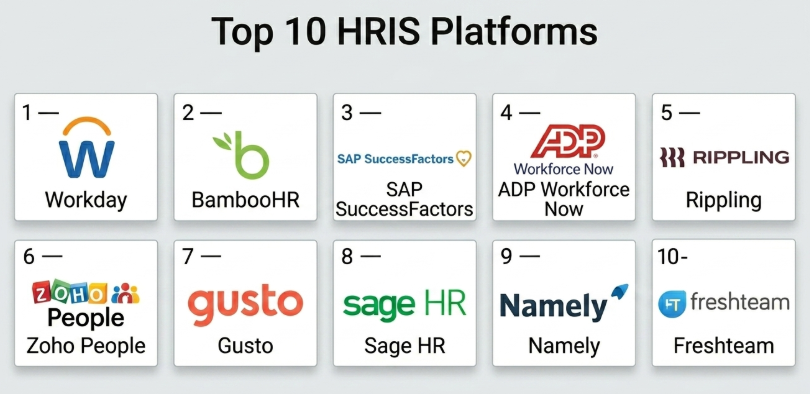
Top 10 HRIS Platforms
#1 — Workday
Short description: A leading enterprise HRIS platform offering comprehensive HR, finance, and workforce management solutions.
Key Features
- Employee data management
- Payroll and compensation
- Workforce planning
- Analytics and reporting
- Talent management
- Compliance tools
Pros
- Highly scalable
- Strong analytics
- Comprehensive platform
Cons
- Expensive
- Complex implementation
Platforms / Deployment
Web / Mobile
Cloud
Security & Compliance
Not publicly stated
Integrations & Ecosystem
Workday integrates with enterprise systems.
- ERP tools
- HR platforms
- APIs
Support & Community
Extensive enterprise support and documentation.
#2 — BambooHR
Short description: A user-friendly HRIS platform designed for small and medium businesses.
Key Features
- Employee records management
- Time-off tracking
- Performance management
- Reporting
- Onboarding tools
Pros
- Easy to use
- Quick setup
- Affordable
Cons
- Limited advanced features
- Not ideal for large enterprises
Platforms / Deployment
Web / Mobile
Cloud
Security & Compliance
Not publicly stated
Integrations & Ecosystem
- Payroll tools
- HR integrations
- APIs
Support & Community
Strong support and onboarding.
#3 — SAP SuccessFactors
Short description: An enterprise-grade HRIS suite with strong global workforce management capabilities.
Key Features
- Core HR management
- Payroll integration
- Talent management
- Analytics
- Compliance tools
Pros
- Enterprise scalability
- Strong global features
- Comprehensive capabilities
Cons
- High cost
- Complex setup
Platforms / Deployment
Web / Mobile
Cloud
Security & Compliance
Not publicly stated
Integrations & Ecosystem
- SAP ecosystem
- APIs
Support & Community
Global support network.
#4 — ADP Workforce Now
Short description: A comprehensive HRIS platform with strong payroll and compliance capabilities.
Key Features
- Payroll and benefits
- Employee management
- Time tracking
- Reporting
- Compliance tools
Pros
- Strong payroll integration
- Reliable platform
- Good reporting
Cons
- Interface complexity
- Expensive
Platforms / Deployment
Web / Mobile
Cloud
Security & Compliance
Not publicly stated
Integrations & Ecosystem
- Accounting tools
- HR systems
- APIs
Support & Community
Enterprise-level support.
#5 — Rippling
Short description: A modern HRIS platform combining HR, payroll, and IT management.
Key Features
- Employee management
- Payroll automation
- Device management
- Workflow automation
- Reporting
Pros
- All-in-one platform
- Strong automation
- Scalable
Cons
- Pricing complexity
- Setup effort
Platforms / Deployment
Web / Mobile
Cloud
Security & Compliance
Not publicly stated
Integrations & Ecosystem
- HR tools
- IT systems
- APIs
Support & Community
Strong onboarding and support.
#6 — Zoho People
Short description: An affordable HRIS platform with essential HR features and strong integration with the Zoho ecosystem.
Key Features
- Employee database
- Attendance and leave tracking
- Performance management
- Reporting
- Workflow automation
Pros
- Cost-effective
- Easy to use
- Good integrations
Cons
- Limited enterprise features
- Basic analytics
Platforms / Deployment
Web / Mobile
Cloud
Security & Compliance
Not publicly stated
Integrations & Ecosystem
- Zoho apps
- APIs
Support & Community
Good documentation and support.
#7 — Gusto
Short description: A payroll-focused HRIS platform designed for small businesses.
Key Features
- Payroll automation
- Benefits management
- Employee onboarding
- Reporting
- Compliance tools
Pros
- Easy to use
- Strong payroll features
- Good for SMBs
Cons
- Limited global capabilities
- Fewer advanced features
Platforms / Deployment
Web / Mobile
Cloud
Security & Compliance
Not publicly stated
Integrations & Ecosystem
- Accounting tools
- HR systems
- APIs
Support & Community
Strong support resources.
#8 — Sage HR
Short description: An HRIS platform focused on HR management and employee engagement.
Key Features
- Employee management
- Leave tracking
- Performance reviews
- Reporting
- Scheduling
Pros
- Easy to use
- Affordable
- Good for SMEs
Cons
- Limited advanced features
- Smaller ecosystem
Platforms / Deployment
Web / Mobile
Cloud
Security & Compliance
Not publicly stated
Integrations & Ecosystem
- Accounting tools
- APIs
Support & Community
Reliable support.
#9 — Namely
Short description: A mid-market HRIS platform combining HR, payroll, and benefits management.
Key Features
- Employee management
- Payroll
- Benefits administration
- Reporting
- Compliance
Pros
- Good for mid-sized companies
- Strong HR features
- User-friendly
Cons
- Limited scalability
- Pricing transparency
Platforms / Deployment
Web
Cloud
Security & Compliance
Not publicly stated
Integrations & Ecosystem
- HR tools
- APIs
Support & Community
Good support resources.
#10 — Freshteam
Short description: An HRIS platform focused on recruitment, onboarding, and employee management.
Key Features
- Applicant tracking
- Employee management
- Onboarding workflows
- Time-off management
- Reporting
Pros
- Easy to use
- Good for startups
- Affordable
Cons
- Limited advanced HR features
- Not ideal for large enterprises
Platforms / Deployment
Web / Mobile
Cloud
Security & Compliance
Not publicly stated
Integrations & Ecosystem
- HR tools
- APIs
Support & Community
Good onboarding and documentation.
Comparison Table (Top 10)
| Tool Name | Best For | Platform(s) Supported | Deployment | Standout Feature | Public Rating |
|---|---|---|---|---|---|
| Workday | Enterprise | Web, Mobile | Cloud | Unified HR suite | N/A |
| BambooHR | SMBs | Web, Mobile | Cloud | Ease of use | N/A |
| SAP SuccessFactors | Enterprise | Web, Mobile | Cloud | Global HR | N/A |
| ADP Workforce Now | Mid–Enterprise | Web, Mobile | Cloud | Payroll integration | N/A |
| Rippling | Growing teams | Web, Mobile | Cloud | All-in-one | N/A |
| Zoho People | SMBs | Web, Mobile | Cloud | Affordability | N/A |
| Gusto | SMBs | Web, Mobile | Cloud | Payroll | N/A |
| Sage HR | SMEs | Web, Mobile | Cloud | Simplicity | N/A |
| Namely | Mid-market | Web | Cloud | HR + Payroll | N/A |
| Freshteam | Startups | Web, Mobile | Cloud | Hiring + onboarding | N/A |
Evaluation & Scoring of HRIS Platforms
| Tool Name | Core | Ease | Integrations | Security | Performance | Support | Value | Weighted Total |
|---|---|---|---|---|---|---|---|---|
| Workday | 9 | 6 | 8 | 7 | 9 | 9 | 6 | 7.9 |
| BambooHR | 7 | 9 | 7 | 6 | 8 | 8 | 8 | 7.9 |
| SAP SuccessFactors | 9 | 5 | 8 | 7 | 9 | 9 | 6 | 7.8 |
| ADP | 9 | 7 | 8 | 7 | 8 | 8 | 7 | 8.0 |
| Rippling | 9 | 8 | 9 | 7 | 8 | 8 | 7 | 8.3 |
| Zoho People | 7 | 8 | 7 | 6 | 8 | 7 | 8 | 7.6 |
| Gusto | 8 | 9 | 7 | 6 | 8 | 8 | 8 | 8.0 |
| Sage HR | 7 | 8 | 6 | 6 | 8 | 7 | 8 | 7.5 |
| Namely | 8 | 7 | 7 | 6 | 8 | 7 | 7 | 7.6 |
| Freshteam | 7 | 8 | 6 | 6 | 7 | 7 | 8 | 7.4 |
Interpretation:
- Scores are comparative, not absolute
- Enterprise tools rank high in features but lower in ease of use
- SMB tools perform well in usability and value
- Choose based on your organization’s complexity and growth plans
Which HRIS Platforms Is Right for You?
Solo / Freelancer
- Not required; use basic tools
SMB
- Best: BambooHR, Zoho People, Gusto
Mid-Market
- Best: Rippling, Namely
Enterprise
- Best: Workday, SAP SuccessFactors
Budget vs Premium
- Budget: Zoho People
- Premium: Workday
Feature Depth vs Ease of Use
- Deep: SAP, Workday
- Easy: BambooHR
Integrations & Scalability
- Strong integrations: Rippling
- Scalable: Workday
Security & Compliance Needs
- Choose enterprise tools for strict compliance
Frequently Asked Questions (FAQs)
What is an HRIS platform?
It is software used to manage employee data and HR processes.
How is HRIS different from HRMS?
HRIS focuses on core HR functions, while HRMS includes broader features.
Is HRIS necessary for small businesses?
Yes, it helps streamline HR processes even for small teams.
Can HRIS handle payroll?
Many platforms include payroll or integrate with payroll tools.
Are HRIS platforms secure?
Most provide standard security features.
How long does implementation take?
From a few days to several weeks depending on complexity.
Can employees access their data?
Yes, via self-service portals.
Does HRIS support remote teams?
Yes, most platforms are cloud-based.
What industries use HRIS?
Almost all industries with employees.
What should I avoid?
Choosing tools that don’t scale with your growth.
Conclusion
HRIS Platforms are essential for modern organizations aiming to streamline HR operations, improve employee experience, and make data-driven decisions. From user-friendly tools like BambooHR to enterprise-grade platforms like Workday, the right solution depends on your company’s size, complexity, and goals.