Introduction
Finite Element Analysis (FEA) software is used to simulate how physical objects behave under real-world conditions such as forces, heat, vibration, and pressure. It breaks complex structures into smaller “finite elements” and calculates how each part responds—helping engineers predict performance before building physical prototypes.
FEA is essential in modern engineering because it reduces development costs, improves safety, and accelerates innovation. From designing aircraft components to testing consumer products, it plays a critical role in ensuring reliability and efficiency.
Common Use Cases
- Structural analysis (stress, deformation, fatigue)
- Thermal and heat transfer simulations
- Crash and impact analysis
- Vibration and dynamic simulations
- Material behavior modeling
What Buyers Should Evaluate
- Solver accuracy (linear vs nonlinear capabilities)
- Types of analysis supported (static, dynamic, thermal, fatigue)
- Ease of meshing and preprocessing
- Integration with CAD tools
- Automation and parametric studies
- HPC and cloud scalability
- Visualization and post-processing
- Hardware requirements
- Cost and licensing model
Best for: Mechanical engineers, structural engineers, aerospace and automotive teams, manufacturing companies, and R&D departments working on performance-critical products.
Not ideal for: Non-technical users or teams focused only on conceptual design—FEA tools are complex and require engineering expertise.
Key Trends in Finite Element Analysis (FEA) Software
- AI-assisted meshing and simulation setup
- Cloud-based FEA platforms reducing hardware dependency
- Multiphysics simulation (FEA + CFD + thermal) becoming standard
- GPU acceleration and HPC scaling for faster computation
- Integration with CAD and PLM ecosystems
- Automation through scripting and parametric design
- Digital twin integration for real-time monitoring
- Low-code simulation tools for wider adoption
- Open-source FEA gaining traction in research
- Subscription and usage-based pricing models
How We Selected These Tools (Methodology)
- Evaluated market adoption across industries
- Assessed solver robustness and simulation accuracy
- Considered performance in large-scale simulations
- Reviewed ease of use and learning curve
- Analyzed integration with CAD/PLM ecosystems
- Evaluated community, training, and documentation
- Considered scalability (cloud + HPC support)
- Assessed innovation in AI and automation
- Reviewed value for cost across segments
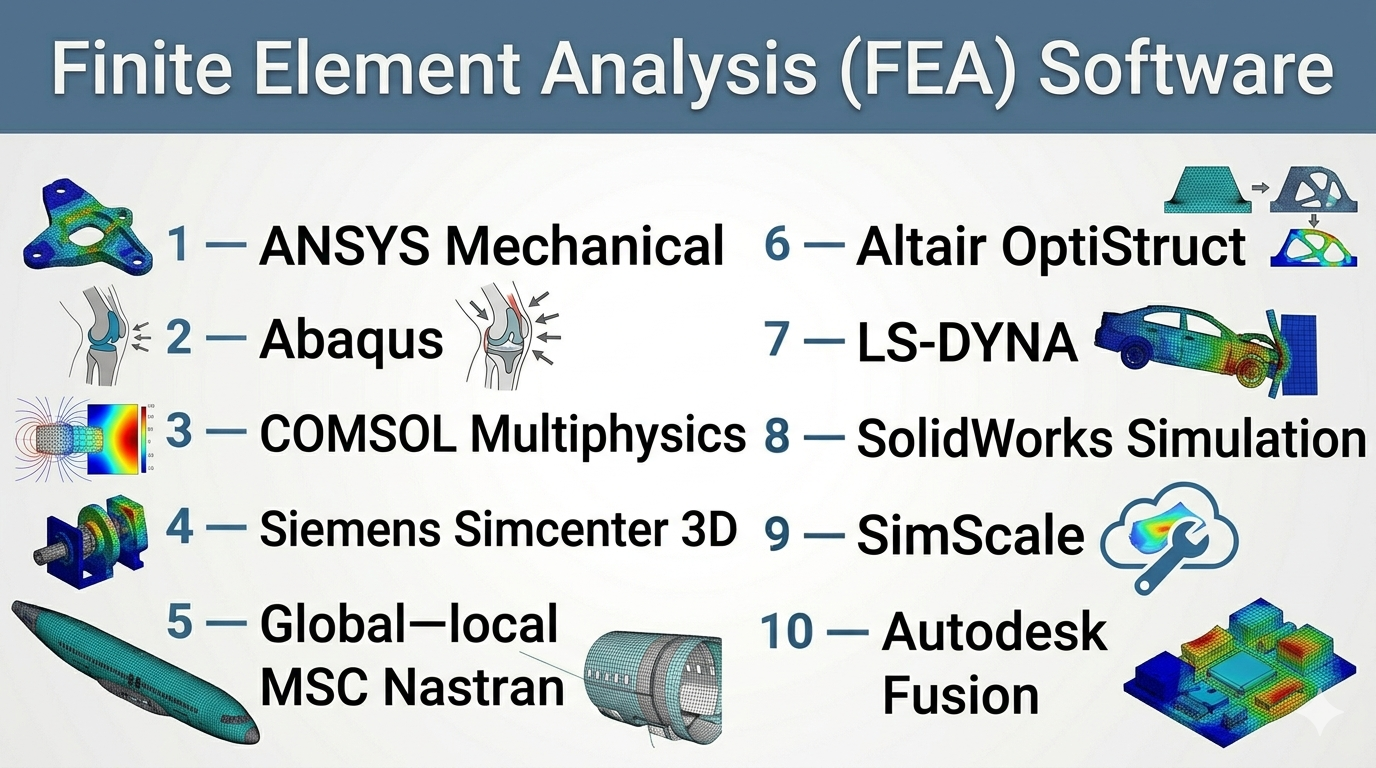
Top 10 Finite Element Analysis (FEA) Software Tools
#1 — ANSYS Mechanical
Short description: A leading general-purpose FEA platform used for structural, thermal, and multiphysics simulations across industries.
Key Features
- Linear and nonlinear structural analysis
- Multiphysics simulation
- Advanced meshing tools
- HPC scalability
- Material modeling libraries
- Automation via scripting
Pros
- Highly accurate and trusted
- Scales to complex simulations
Cons
- Expensive
- Steep learning curve
Platforms / Deployment
Windows / Linux / Cloud
Security & Compliance
Not publicly stated
Integrations & Ecosystem
- ANSYS ecosystem
- CAD integrations
- APIs and scripting
- HPC/cloud platforms
Support & Community
Very strong enterprise support and global community.
#2 — Abaqus
Short description: A powerful FEA suite known for advanced nonlinear analysis and material modeling.
Key Features
- Nonlinear and dynamic simulations
- Advanced contact modeling
- Multiphysics capabilities
- High-accuracy solvers
- Visualization tools
Pros
- Excellent for complex materials
- Strong research and enterprise use
Cons
- Complex workflows
- Expensive
Platforms / Deployment
Windows / Linux
Security & Compliance
Not publicly stated
Integrations & Ecosystem
- Dassault ecosystem
- CAD tools
- APIs
Support & Community
Strong professional and academic community.
#3 — COMSOL Multiphysics
Short description: A flexible simulation platform offering FEA with strong multiphysics capabilities.
Key Features
- Multiphysics simulations
- Custom equation modeling
- Parametric studies
- Application builder
- Visualization tools
Pros
- Highly customizable
- Strong for R&D
Cons
- Expensive modules
- Requires expertise
Platforms / Deployment
Windows / macOS / Linux
Security & Compliance
Not publicly stated
Integrations & Ecosystem
- MATLAB integration
- APIs
- CAD imports
Support & Community
Strong academic and research community.
#4 — Siemens Simcenter 3D
Short description: An enterprise-level FEA solution integrated with Siemens’ engineering ecosystem.
Key Features
- Advanced structural analysis
- Multiphysics simulation
- Integration with NX
- Digital twin support
- HPC scalability
Pros
- Strong enterprise integration
- Scalable
Cons
- Expensive
- Complex interface
Platforms / Deployment
Windows / Linux
Security & Compliance
Not publicly stated
Integrations & Ecosystem
- Siemens NX
- PLM systems
- APIs
Support & Community
Enterprise-level support.
#5 — MSC Nastran
Short description: A well-established FEA solver widely used in aerospace and automotive industries.
Key Features
- Linear and nonlinear analysis
- Dynamic and modal analysis
- Fatigue and vibration analysis
- High reliability
- Aerospace-grade validation
Pros
- Proven industry reliability
- Strong for structural analysis
Cons
- Older interface
- Steep learning curve
Platforms / Deployment
Windows / Linux
Security & Compliance
Not publicly stated
Integrations & Ecosystem
- CAD tools
- Engineering workflows
- APIs
Support & Community
Experienced industry user base.
#6 — Altair OptiStruct (HyperWorks)
Short description: A simulation tool focused on optimization and high-performance FEA.
Key Features
- Structural analysis
- Topology optimization
- Multiphysics capabilities
- Lightweight design tools
- Automation features
Pros
- Excellent optimization tools
- Efficient performance
Cons
- Complex interface
- Learning curve
Platforms / Deployment
Windows / Linux
Security & Compliance
Not publicly stated
Integrations & Ecosystem
- Altair ecosystem
- CAD tools
- APIs
Support & Community
Professional support.
#7 — LS-DYNA
Short description: A specialized FEA tool for crash, impact, and high-speed simulations.
Key Features
- Explicit dynamics simulation
- Crash and impact analysis
- Multiphysics support
- High-speed solvers
- Large deformation modeling
Pros
- Industry leader in crash simulation
- High-performance solver
Cons
- Complex setup
- Niche focus
Platforms / Deployment
Windows / Linux
Security & Compliance
Not publicly stated
Integrations & Ecosystem
- Engineering workflows
- APIs
- CAD tools
Support & Community
Strong in automotive and defense sectors.
#8 — SolidWorks Simulation
Short description: An integrated FEA tool within SolidWorks CAD for design validation.
Key Features
- Static and dynamic analysis
- Thermal simulation
- Fatigue analysis
- CAD integration
- Easy setup
Pros
- Seamless CAD integration
- Easy to use
Cons
- Limited advanced capabilities
- Not ideal for complex simulations
Platforms / Deployment
Windows
Security & Compliance
Not publicly stated
Integrations & Ecosystem
- SolidWorks ecosystem
- PLM tools
- APIs
Support & Community
Large user base and training resources.
#9 — SimScale
Short description: A cloud-based FEA platform allowing simulations directly in the browser.
Key Features
- Cloud-based simulation
- No local hardware required
- Collaboration tools
- Parametric studies
- Easy setup
Pros
- Accessible and scalable
- Beginner-friendly
Cons
- Internet dependency
- Limited advanced features
Platforms / Deployment
Web / Cloud
Security & Compliance
Not publicly stated
Integrations & Ecosystem
- CAD imports
- APIs
- Cloud workflows
Support & Community
Growing community.
#10 — Autodesk Fusion (Simulation)
Short description: A cloud-based CAD/CAM/CAE tool with built-in FEA capabilities.
Key Features
- Integrated CAD + FEA
- Generative design
- Cloud simulation
- Parametric modeling
- Collaboration tools
Pros
- All-in-one platform
- Easy to learn
Cons
- Limited advanced FEA
- Cloud dependency
Platforms / Deployment
Windows / macOS / Cloud
Security & Compliance
Not publicly stated
Integrations & Ecosystem
- Autodesk ecosystem
- APIs
- Cloud tools
Support & Community
Very strong community and tutorials.
Comparison Table (Top 10)
| Tool Name | Best For | Platform(s) Supported | Deployment | Standout Feature | Public Rating |
|---|---|---|---|---|---|
| ANSYS Mechanical | Enterprise FEA | Win/Linux/Cloud | Hybrid | Multiphysics depth | N/A |
| Abaqus | Nonlinear analysis | Win/Linux | Self-hosted | Material modeling | N/A |
| COMSOL | Multiphysics | Cross-platform | Hybrid | Custom physics | N/A |
| Simcenter 3D | Enterprise CAD/CAE | Win/Linux | Hybrid | NX integration | N/A |
| MSC Nastran | Aerospace | Win/Linux | Self-hosted | Reliability | N/A |
| OptiStruct | Optimization | Win/Linux | Hybrid | Topology optimization | N/A |
| LS-DYNA | Crash simulation | Win/Linux | Self-hosted | Explicit dynamics | N/A |
| SolidWorks Sim | Design validation | Windows | Self-hosted | CAD integration | N/A |
| SimScale | Cloud FEA | Web | Cloud | Browser-based | N/A |
| Fusion Simulation | SMBs | Win/macOS/Cloud | Hybrid | Integrated CAD/CAE | N/A |
Evaluation & Scoring of Finite Element Analysis (FEA) Software
| Tool Name | Core | Ease | Integrations | Security | Performance | Support | Value | Weighted Total |
|---|---|---|---|---|---|---|---|---|
| ANSYS | 10 | 6 | 9 | 5 | 10 | 9 | 6 | 8.6 |
| Abaqus | 10 | 5 | 9 | 5 | 9 | 9 | 6 | 8.3 |
| COMSOL | 9 | 6 | 8 | 5 | 8 | 8 | 6 | 7.9 |
| Simcenter | 9 | 6 | 9 | 5 | 9 | 8 | 6 | 8.1 |
| Nastran | 8 | 5 | 8 | 5 | 9 | 7 | 7 | 7.6 |
| OptiStruct | 8 | 6 | 8 | 5 | 9 | 7 | 7 | 7.7 |
| LS-DYNA | 9 | 5 | 7 | 5 | 10 | 7 | 6 | 7.9 |
| SolidWorks | 7 | 8 | 9 | 5 | 7 | 8 | 8 | 7.7 |
| SimScale | 7 | 9 | 7 | 5 | 7 | 7 | 8 | 7.6 |
| Fusion | 7 | 8 | 8 | 5 | 7 | 8 | 9 | 7.8 |
How to interpret the scores:
- Scores are comparative benchmarks, not absolute values
- Enterprise tools rank higher in performance and features
- Cloud tools rank higher in ease of use
- Open and affordable tools rank higher in value
- Choose based on your engineering needs, not just score
Which Finite Element Analysis (FEA) Software Is Right for You?
Solo / Freelancer
- Best: SimScale, Fusion
- Reason: easy setup and affordability
SMB
- Best: SolidWorks Simulation, COMSOL
- Reason: balance of usability and capability
Mid-Market
- Best: Abaqus, OptiStruct
- Reason: strong simulation depth
Enterprise
- Best: ANSYS, Simcenter, Nastran
- Reason: scalability and accuracy
Budget vs Premium
- Budget: SimScale, Fusion
- Premium: ANSYS, Abaqus
Feature Depth vs Ease of Use
- Advanced: ANSYS, Abaqus
- Easy: SolidWorks Simulation, SimScale
Integrations & Scalability
- Strong: Simcenter, ANSYS
- Moderate: Fusion
Security & Compliance Needs
- Most tools: Not publicly stated
- Enterprises should validate internally
Frequently Asked Questions (FAQs)
What is FEA software?
FEA software simulates how structures behave under forces and conditions.
Is FEA different from CFD?
Yes—FEA focuses on structural behavior, CFD on fluid flow.
Which FEA software is best?
ANSYS and Abaqus are widely used for advanced simulations.
Do I need high-end hardware?
Yes, especially for large or complex models.
Are there free FEA tools?
Some open-source options exist, but require expertise.
Can FEA integrate with CAD?
Yes, most tools integrate with CAD platforms.
What industries use FEA?
Aerospace, automotive, construction, manufacturing, and energy.
Is cloud FEA reliable?
Yes, but depends on internet and provider.
How long does it take to learn FEA?
Basic usage can be learned quickly; advanced use takes time.
Can FEA replace physical testing?
It reduces the need but does not fully replace it.
Conclusion
Finite Element Analysis software is a cornerstone of modern engineering, enabling precise simulation of structural and physical behavior. From enterprise platforms like ANSYS to accessible tools like Fusion and SimScale, each solution serves different needs.
There is no single “best” tool—only the one that fits your workflow, budget, and simulation complexity.