Introduction
Digital Twin Platforms are software systems that create virtual replicas of physical assets, processes, or systems. These digital models continuously receive real-world data from sensors, IoT devices, and enterprise systems, enabling organizations to monitor performance, simulate scenarios, and optimize operations in real time.
As industries move toward smarter operations and predictive decision-making, digital twin platforms have become a critical part of modern engineering, manufacturing, smart cities, and energy management. They help organizations reduce downtime, improve efficiency, and make data-driven decisions without impacting real-world systems.
Common use cases include:
- Predictive maintenance for industrial equipment
- Smart manufacturing and production optimization
- Infrastructure and smart city management
- Energy systems monitoring and optimization
- Product lifecycle simulation and testing
What buyers should evaluate:
- Real-time data integration capabilities
- Simulation and analytics features
- Scalability across assets and systems
- Ease of integration with IoT and enterprise tools
- Visualization and 3D modeling capabilities
- AI and predictive analytics support
- Security and data governance
- Deployment flexibility (cloud vs on-premise)
- Cost and licensing model
Best for: Enterprises, industrial organizations, IoT teams, and engineering companies managing complex physical systems and infrastructure.
Not ideal for: Small teams without connected devices or real-time data. Basic monitoring tools or analytics platforms may be sufficient in those cases.
Key Trends in Digital Twin Platforms
- AI-driven predictive insights: Platforms increasingly use machine learning for forecasting and optimization.
- Cloud-native architectures: Scalable platforms supporting global deployments.
- Integration with IoT ecosystems: Seamless data ingestion from connected devices.
- 3D and immersive visualization: Use of AR/VR for interactive digital twins.
- Edge computing integration: Processing data closer to devices for faster insights.
- Industry-specific solutions: Tailored platforms for manufacturing, energy, and healthcare.
- Low-code development: Simplified creation of digital twin models and workflows.
- Data governance and security: Stronger controls for sensitive operational data.
- Digital thread integration: Linking data across the product lifecycle.
- Sustainability optimization: Tools to monitor and reduce environmental impact.
How We Selected These Tools (Methodology)
- Evaluated market adoption and enterprise usage
- Assessed feature completeness across simulation, analytics, and visualization
- Compared real-time data processing capabilities
- Reviewed security and compliance features
- Analyzed integration with IoT, ERP, and cloud platforms
- Evaluated ease of use and development flexibility
- Considered scalability for large deployments
- Reviewed support and ecosystem strength
- Ensured coverage across industries and company sizes
Top 10 Digital Twin Platforms
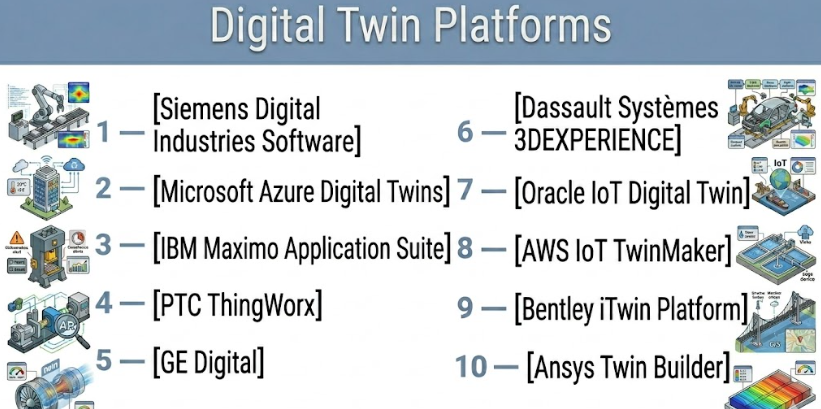
#1 — Siemens Digital Industries Software (Teamcenter / MindSphere)
Short description: A comprehensive digital twin ecosystem combining IoT, PLM, and simulation tools for industrial enterprises.
Key Features
- Digital twin modeling and simulation
- IoT data integration
- Product lifecycle management (PLM)
- Real-time analytics
- Industrial automation integration
- Scalability across large systems
Pros
- Strong enterprise capabilities
- Deep integration with manufacturing
Cons
- Complex implementation
- Expensive
Platforms / Deployment
Cloud / Hybrid
Security & Compliance
RBAC, encryption (details vary)
Integrations & Ecosystem
Part of Siemens industrial ecosystem with strong connectivity.
- IoT devices
- PLM systems
- Manufacturing platforms
- APIs
Support & Community
Enterprise-grade support and training.
#2 — Microsoft Azure Digital Twins
Short description: A cloud-based platform for building digital models of environments using IoT and data analytics.
Key Features
- Real-time data ingestion
- Graph-based modeling
- Integration with Azure services
- AI and analytics tools
- Scalable cloud architecture
Pros
- Highly scalable
- Strong cloud ecosystem
Cons
- Requires Azure expertise
- Configuration complexity
Platforms / Deployment
Cloud
Security & Compliance
MFA, RBAC, encryption
Integrations & Ecosystem
Deep integration with Microsoft cloud services.
- IoT Hub
- AI services
- Data analytics tools
- APIs
Support & Community
Strong documentation and enterprise support.
#3 — IBM Maximo Application Suite
Short description: An asset management platform with digital twin capabilities for monitoring and optimizing infrastructure.
Key Features
- Asset performance management
- Predictive maintenance
- AI-driven analytics
- IoT integration
- Workflow automation
Pros
- Strong asset management
- AI capabilities
Cons
- Complex setup
- High cost
Platforms / Deployment
Cloud / Hybrid
Security & Compliance
Encryption, RBAC (details vary)
Integrations & Ecosystem
- IoT systems
- Enterprise software
- APIs
Support & Community
Enterprise support with extensive resources.
#4 — PTC ThingWorx
Short description: An IoT platform with digital twin capabilities focused on industrial applications.
Key Features
- Digital twin modeling
- IoT connectivity
- AR integration
- Analytics tools
- Workflow automation
Pros
- Strong IoT integration
- Flexible platform
Cons
- Learning curve
- Licensing complexity
Platforms / Deployment
Cloud / Hybrid
Security & Compliance
Not publicly stated
Integrations & Ecosystem
- IoT devices
- AR tools
- Enterprise systems
Support & Community
Good support and documentation.
#5 — GE Digital (Predix)
Short description: A platform designed for industrial digital twins in energy and manufacturing sectors.
Key Features
- Industrial analytics
- Asset monitoring
- Predictive maintenance
- Data integration
- Visualization tools
Pros
- Industry-specific capabilities
- Strong analytics
Cons
- Limited flexibility outside core industries
- Complex deployment
Platforms / Deployment
Cloud / Hybrid
Security & Compliance
Not publicly stated
Integrations & Ecosystem
- Industrial systems
- IoT devices
- Data platforms
Support & Community
Enterprise-focused support.
#6 — Dassault Systèmes 3DEXPERIENCE
Short description: A platform combining design, simulation, and digital twin capabilities for product lifecycle management.
Key Features
- 3D modeling and simulation
- Product lifecycle integration
- Real-time collaboration
- Digital twin visualization
- Data management
Pros
- Strong design integration
- Comprehensive platform
Cons
- Expensive
- Complex interface
Platforms / Deployment
Cloud / Hybrid
Security & Compliance
Not publicly stated
Integrations & Ecosystem
- CAD tools
- PLM systems
- Simulation tools
Support & Community
Strong enterprise ecosystem.
#7 — Oracle IoT Digital Twin
Short description: A cloud-based platform for asset monitoring and predictive analytics.
Key Features
- IoT data ingestion
- Asset monitoring
- Predictive analytics
- Visualization dashboards
- Cloud integration
Pros
- Strong cloud capabilities
- Enterprise integration
Cons
- Requires Oracle ecosystem
- Limited flexibility
Platforms / Deployment
Cloud
Security & Compliance
Not publicly stated
Integrations & Ecosystem
- Oracle cloud services
- IoT systems
- APIs
Support & Community
Enterprise support.
#8 — AWS IoT TwinMaker
Short description: A service for creating digital twins using AWS cloud infrastructure.
Key Features
- Real-time data integration
- 3D visualization
- Scalable architecture
- Integration with AWS services
- Data modeling
Pros
- Highly scalable
- Strong cloud ecosystem
Cons
- Requires AWS knowledge
- Configuration complexity
Platforms / Deployment
Cloud
Security & Compliance
IAM, encryption (details vary)
Integrations & Ecosystem
- AWS IoT services
- Data analytics
- Visualization tools
Support & Community
Strong documentation and support.
#9 — Bentley iTwin Platform
Short description: A digital twin platform focused on infrastructure and construction projects.
Key Features
- Infrastructure modeling
- Real-time data synchronization
- Visualization tools
- Simulation capabilities
- Data integration
Pros
- Strong for infrastructure
- Good visualization
Cons
- Niche focus
- Complex workflows
Platforms / Deployment
Cloud / Hybrid
Security & Compliance
Not publicly stated
Integrations & Ecosystem
- Engineering tools
- Data systems
- APIs
Support & Community
Industry-focused support.
#10 — Ansys Twin Builder
Short description: A simulation-driven digital twin platform for engineering analysis and predictive maintenance.
Key Features
- Physics-based simulation
- Real-time analytics
- Predictive maintenance
- Integration with simulation tools
- Visualization
Pros
- Strong simulation capabilities
- Accurate modeling
Cons
- Complex
- Requires expertise
Platforms / Deployment
Windows / Cloud / Hybrid
Security & Compliance
Not publicly stated
Integrations & Ecosystem
- Simulation tools
- Engineering workflows
- APIs
Support & Community
Strong engineering-focused support.
Comparison Table (Top 10)
| Tool Name | Best For | Platform(s) Supported | Deployment | Standout Feature | Public Rating |
|---|---|---|---|---|---|
| Siemens Digital Industries | Enterprise | Cloud | Hybrid | Industrial integration | N/A |
| Azure Digital Twins | Cloud teams | Cloud | Cloud | Graph modeling | N/A |
| IBM Maximo | Asset management | Cloud | Hybrid | Predictive maintenance | N/A |
| PTC ThingWorx | IoT teams | Cloud | Hybrid | IoT integration | N/A |
| GE Predix | Industrial | Cloud | Hybrid | Industrial analytics | N/A |
| 3DEXPERIENCE | Product lifecycle | Cloud | Hybrid | 3D modeling | N/A |
| Oracle IoT | Enterprise | Cloud | Cloud | Asset monitoring | N/A |
| AWS TwinMaker | Developers | Cloud | Cloud | Scalability | N/A |
| Bentley iTwin | Infrastructure | Cloud | Hybrid | Infrastructure focus | N/A |
| Ansys Twin Builder | Engineering | Windows, Cloud | Hybrid | Simulation-driven twin | N/A |
Evaluation & Scoring of Digital Twin Platforms
| Tool Name | Core (25%) | Ease (15%) | Integrations (15%) | Security (10%) | Performance (10%) | Support (10%) | Value (15%) | Weighted Total |
|---|---|---|---|---|---|---|---|---|
| Siemens | 10 | 6 | 9 | 8 | 9 | 9 | 6 | 8.4 |
| Azure Digital Twins | 9 | 7 | 10 | 9 | 9 | 9 | 7 | 8.6 |
| IBM Maximo | 9 | 6 | 9 | 8 | 8 | 9 | 6 | 8.0 |
| ThingWorx | 8 | 7 | 9 | 7 | 8 | 8 | 7 | 7.9 |
| GE Predix | 8 | 6 | 8 | 7 | 8 | 8 | 6 | 7.6 |
| 3DEXPERIENCE | 9 | 6 | 9 | 7 | 8 | 8 | 6 | 7.9 |
| Oracle IoT | 8 | 7 | 8 | 7 | 8 | 8 | 7 | 7.8 |
| AWS TwinMaker | 9 | 7 | 10 | 9 | 9 | 9 | 7 | 8.6 |
| Bentley iTwin | 8 | 6 | 8 | 7 | 8 | 8 | 6 | 7.6 |
| Ansys Twin Builder | 9 | 6 | 8 | 7 | 9 | 8 | 6 | 7.9 |
How to interpret these scores:
- Scores are relative comparisons, not absolute rankings.
- Cloud platforms score higher in scalability and integrations.
- Engineering-focused tools excel in simulation accuracy.
- Enterprise platforms provide depth but may reduce ease of use.
- Select based on your industry, data sources, and scalability needs.
Which Digital Twin Platform Is Right for You?
Solo / Freelancer
- Best: AWS TwinMaker, Azure Digital Twins
- Focus on scalability and accessibility
SMB
- Best: ThingWorx, Oracle IoT
- Balance ease of use and features
Mid-Market
- Best: IBM Maximo, 3DEXPERIENCE
- Integration with enterprise systems
Enterprise
- Best: Siemens, Azure, AWS
- Large-scale deployment and integration
Budget vs Premium
- Budget: Cloud-based services
- Premium: Siemens, IBM
Feature Depth vs Ease of Use
- Deep features: Siemens, Ansys
- Easier: AWS, Azure
Integrations & Scalability
- Strong: AWS, Azure, Siemens
- Moderate: Oracle
Security & Compliance Needs
- Enterprise: Azure, AWS
- Moderate: Others
Frequently Asked Questions (FAQs)
What is a digital twin platform?
It is software that creates a virtual representation of a physical system using real-time data.
How does it work?
It collects data from sensors and systems to simulate and analyze real-world behavior.
What industries use digital twins?
Manufacturing, energy, construction, and smart cities.
Is it expensive?
Costs vary widely depending on scale and platform.
Do I need IoT devices?
Yes, most digital twin platforms rely on real-time data from sensors.
Can small businesses use digital twins?
Yes, especially cloud-based solutions.
Are these platforms secure?
Most include enterprise-grade security, but details vary.
What is predictive maintenance?
Using data to predict failures before they occur.
Can digital twins integrate with ERP systems?
Yes, many platforms support enterprise integrations.
What should I prioritize?
Scalability, integration, and analytics capabilities.
Conclusion
Digital Twin Platforms are transforming how organizations monitor, simulate, and optimize real-world systems. From predictive maintenance to smart infrastructure, these tools enable smarter, data-driven decision-making.
There is no single “best” platform—each solution is designed for specific industries and use cases. Cloud platforms offer scalability, while engineering-focused tools provide deeper simulation capabilities.