Introduction
Shopping online or choosing a local service used to be a gamble. In the past, buyers relied entirely on glossy advertisements, brand promises, and product packaging to make a decision. Today, the landscape looks completely different. Before clicking the buy button, making a reservation, downloading an app, or hiring a contractor, millions of people pause to check what other customers have to say. This habit has transformed modern consumer behavior. Whether someone is shopping for a high-end smartphone, booking a hotel room for a family vacation, or searching for a local repair service, checking feedback has become an automatic step in the buying journey. Understanding why people read reviews before spending money reveals a lot about how modern shoppers seek reassurance, transparency, and real-world context in an increasingly crowded marketplace.
The Shift From Advertisements to Real Experiences
Product descriptions and marketing campaigns are designed to highlight the best qualities of an item or service. They emphasize features, specifications, and ideal outcomes. However, marketing language rarely captures the everyday flaws, subtle inconveniences, or unexpected delights that emerge after regular use. When someone reads online shopping reviews, they are looking for a perspective that is independent of the seller. Advertisements present the seller’s point of view, whereas customer feedback offers a window into actual ownership. A marketing brochure might state that a vacuum cleaner has powerful suction, but a customer review will explain how that suction handles pet hair on thick carpets after six months of use. This desire for grounded, everyday truth drives consumers toward customer feedback before making a financial commitment.
Understanding Social Proof in Simple Terms
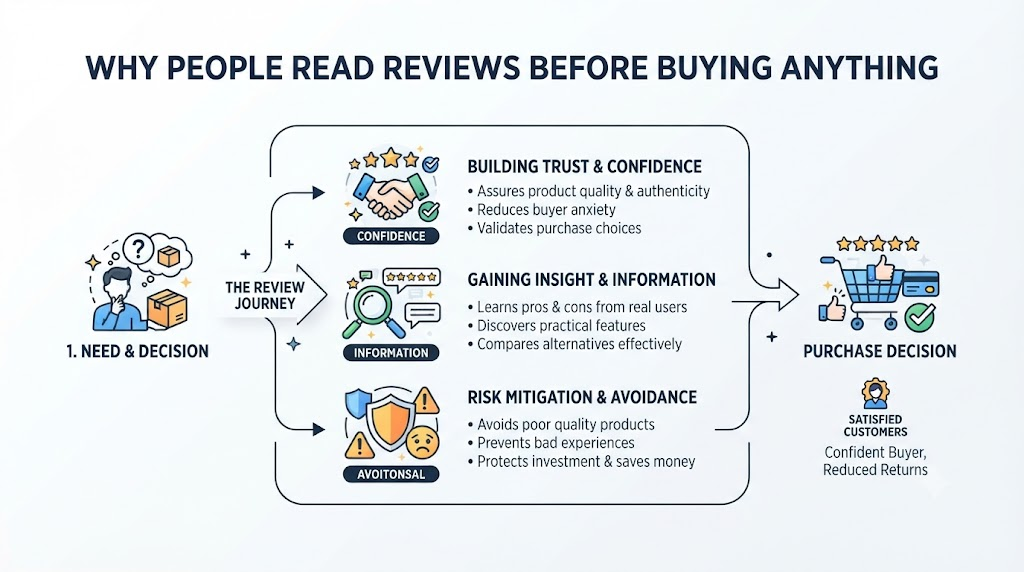
At the heart of review-reading behavior lies a straightforward concept known as social proof. Without getting lost in complex psychological theories, social proof simply means that people tend to look at the actions and experiences of others when deciding what to do. When faced with an unfamiliar brand, an unproven product, or a new restaurant, human beings naturally seek reassurance from their peers. If dozens of people report having a smooth, positive experience with a product, a prospective buyer feels safer making the same purchase. Conversely, if multiple people warn about poor durability or unresponsive customer service, a shopper feels justified in walking away. This reliance on collective experience helps people navigate unfamiliar choices with greater confidence.
Reducing Uncertainty Before Spending Money
Every purchase carries a certain amount of risk. Buyers worry about wasting hard-earned money, receiving substandard quality, choosing the wrong model for their specific needs, or dealing with a frustrating customer service experience if something goes wrong. Customer feedback acts as a buffer against this uncertainty. By reading about other people’s experiences, shoppers can form a realistic picture of what to expect. If a laptop’s description promises all-day battery life, reviews from real users might reveal that the battery drains quickly when running video editing software. This information prevents disappointment and helps buyers align their expectations with reality before they pay.
Learning From Other People’s Everyday Experiences
Products and services perform differently in controlled testing environments than they do in real life. Customers want to know how items hold up over time and under normal daily conditions.
- Electronics: A shopper researching a new smartphone cares deeply about real-world battery longevity, camera performance in low light, whether the device heats up during gaming, and how smooth the software feels after several months of updates.
- Clothing and Apparel: Online shoppers read sizing feedback to learn whether a garment runs large or small, how the fabric feels after washing, and whether the color matches the online photographs.
- Travel and Hospitality: A traveler booking a hotel room checks recent comments regarding room cleanliness, street noise levels, staff friendliness, and the quality of breakfast.
- Restaurants: Diners look beyond the menu to read about portion sizes, wait times, service attentiveness, and consistency across different visits.
- Software and Apps: Users explore feedback to see if an application crashes frequently, how intuitive the interface is, and whether the subscription price is justified by the features.
Building Buying Confidence
Reading reviews helps build a sense of informed confidence. When a buyer explores detailed descriptions from multiple customers, they feel more in control of their purchasing decision. However, it is important to remember that reading reviews does not guarantee a flawless experience. No amount of research can completely eliminate the possibility of receiving a defective item or encountering an unexpected issue. Instead, reviews provide a solid foundation of evidence, allowing shoppers to feel confident that they have done their homework before spending their money.
What Useful Positive Reviews Tell Buyers
Positive feedback can be incredibly helpful, but not all praise is created equal. Simple one-word comments like “amazing” or “loved it” offer very little substance. In contrast, useful positive reviews explain why the customer is satisfied. Helpful positive feedback often highlights specific strengths, such as exceptional build quality, ease of setup, intuitive design, responsive customer support, or reliable delivery. When a review details how a product solved a specific problem for the user, it gives prospective buyers a clear benchmark of what the item does exceptionally well.
Why Negative Reviews Matter Just as Much
Many shoppers make the mistake of focusing solely on four- and five-star ratings, ignoring anything lower. Yet, negative reviews often contain some of the most valuable information available. A well-written negative review can expose product limitations, recurring mechanical failures, hidden fees, poor build quality, or unhelpful customer service policies. When reading negative feedback, smart shoppers look for patterns rather than reacting to a single angry comment. If ten different people complain about the same zipper breaking after two weeks of use, that constitutes a meaningful warning sign. If only one person leaves a furious review because a package arrived a day late during a severe winter storm, that complaint may reflect external factors rather than a flaw in the product itself.
The Value of Neutral and Mixed Reviews
Three-star and balanced reviews are often the most objective assessments you can find. These reviews typically outline both the pros and cons of a product or service without the emotional extremes of a glowing five-star praise or a scathing one-star complaint. A mixed review might explain that a kitchen appliance has a powerful motor and looks great on the counter, but is difficult to clean and makes a loud noise during operation. This kind of balanced context allows buyers to weigh features against personal preferences, deciding whether a particular drawback is a dealbreaker for them or something they can easily live with.
Looking Beyond Star Ratings
Star ratings provide a convenient summary, but they can also be misleading. A product with a 4.5-star average might look fantastic at first glance, but a deeper look can reveal a more complex story. Shoppers should examine rating distribution, the total number of reviews, and written details. A high average score based on only three reviews carries far less weight than a solid four-star rating backed by five hundred detailed experiences. Furthermore, a high average does not mean a product suits every buyer. A camera might receive five-star ratings from professional photographers for its advanced manual controls, while a beginner might find it overly complicated and frustrating to use.
Why Recent Feedback Matters
Products, businesses, software platforms, and services evolve over time. A company might change its manufacturing supplier, update its customer support team, alter its software interface, or adjust its pricing structure. Because of these changes, review dates matter significantly. Feedback written five years ago may describe a completely different version of a product than the one currently being sold on the market. While older reviews can provide helpful historical context regarding brand reliability, recent feedback offers the most accurate reflection of current quality, shipping reliability, and customer service standards.
The Role of Review Volume
Volume influences consumer trust. People naturally feel more comfortable purchasing an item that has hundreds of reviews compared to one with just two or three.
At the same time, high volume does not automatically guarantee authenticity or superior quality. A massive collection of vague, repetitive, or overly enthusiastic reviews can sometimes be less informative than a modest collection of detailed, thoughtful accounts. The depth and specificity of the feedback matter just as much as the sheer quantity of ratings.
What Makes a Review Genuinely Useful?
The most helpful reviews share common traits. They are specific, descriptive, and grounded in real-world usage. A useful review typically includes:
- The context of how and why the product was purchased.
- Specific features that worked well or fell short.
- Honest accounts of any problems encountered and how they were handled.
- Details about delivery times, packaging, and setup.
- Relevant details regarding the user’s specific skill level or expectations.
These details help readers determine whether the reviewer’s situation matches their own, making the feedback much easier to apply to their own purchasing decisions.
Reviews and Comparison Shopping
When shoppers narrow down their choices between two or three competing products, reviews become an essential comparison tool. Buyers use feedback to contrast recurring strengths and common complaints across different brands.
If two different cordless vacuums are priced similarly, reviews might reveal that Brand A has stronger suction but a shorter battery life, while Brand B offers a longer run time but struggles with heavy debris. Armed with this comparative insight, shoppers can choose the option that aligns best with their daily habits. However, smart consumers combine this review data with official specifications, warranties, return policies, and pricing before making their final choice.
Researching Expensive Versus Inexpensive Purchases
The amount of time and effort people put into reading reviews usually scales with the cost and importance of the purchase.
For expensive items like laptops, home appliances, furniture, and travel bookings, shoppers often spend hours reading detailed breakdowns, watching video demonstrations, and comparing feedback across multiple sites. These higher-cost decisions carry greater financial and operational risk, making thorough research necessary.
On the other hand, people also read reviews for inexpensive everyday purchases—such as kitchen gadgets, phone accessories, or simple household items. In these cases, reviews help ensure convenience, prevent minor annoyances, verify sizing, and avoid wasting money on poorly made items, proving that review research is valuable across every price point.
Evaluating Services Versus Physical Products
Evaluating services before purchase is uniquely challenging because services are intangible and cannot be inspected in advance. Whether someone is hiring a digital marketing agency, booking a hotel, scheduling home repairs, or choosing a local restaurant, they rely heavily on the experiences of past clients.
Service reviews tend to focus on communication, reliability, punctuality, transparency in pricing, professionalism, and overall customer care. When researching professional or healthcare-related services, readers should keep in mind that individual experiences vary widely, and online comments can never replace professional credentials, official licensing, or qualified medical advice and clinical evaluation.
Matching Reviews to Personal Needs
One of the most important principles of reading reviews is recognizing that the “best” product for someone else might not be the right choice for you.
Every buyer has unique priorities. One homebuyer prioritizes a quiet neighborhood, while another wants to live near a bustling commercial district. One smartphone user cares exclusively about camera quality, while another needs maximum battery endurance for work travel. Effective review reading involves filtering out opinions that do not apply to your lifestyle and focusing on details that directly affect your personal requirements.
TrueReviewNow: Exploring Review-Related Information
Navigating the vast ocean of online feedback can sometimes feel overwhelming. Platforms like TrueReviewNow focus on product and customer review content, helping readers explore feedback trends, understand review dynamics, and learn how to navigate customer opinions more effectively.
TrueReviewNow serves as a resource for exploring review-related information, helping consumers understand the broader ecosystem of online feedback without claiming to guarantee purchasing decisions, verify every review on the internet, or dictate what people should buy.
Why People Read Both Positive and Negative Reviews
Balanced research requires looking at both sides of the coin. Reading only five-star reviews creates an overly optimistic and unrealistic view of a product, potentially blinding the buyer to hidden flaws. Conversely, reading only one-star reviews can breed unwarranted cynicism and cause a shopper to miss out on an excellent product due to a few isolated complaints. The most effective approach is to examine positive and negative feedback side by side. By identifying where the two perspectives overlap—such as a product that is universally praised for its design but universally criticized for its flimsy power cord—buyers gain a complete and realistic understanding of what they are purchasing.
Spotting Fake and Misleading Reviews
Not every review on the internet is written by a genuine customer. The digital marketplace contains manipulated feedback, automated submissions, and biased ratings. Recognizing potential warning signs can help shoppers avoid being misled. Common warning signs of suspicious reviews include sudden spikes in five-star ratings over a very short period, repetitive phrasing across multiple accounts, extreme praise without any specific product details, or reviews posted by profiles with suspicious activity histories. However, these indicators are warning signs rather than absolute proof of fraud. A polished writing style or an enthusiastic tone does not automatically mean a review is fake; many articulate customers simply enjoy sharing detailed feedback.
Understanding AI-Generated and Automated Feedback
Modern technology makes it easy to generate large volumes of text quickly. As automated tools become more common, some reviews may be produced or polished using software assistance. When evaluating reviews, shoppers should focus less on whether the writing style appears overly polished and more on whether the review describes realistic, verifiable experiences. A review that provides specific, believable details about product usage is far more valuable than one that relies on vague generalizations, regardless of how it was drafted.
Cross-Checking Reviews Across Multiple Platforms
Different websites attract different types of customers and maintain different moderation standards. Relying on a single review platform can give a skewed perspective. Cross-checking feedback across multiple websites helps buyers uncover consistent themes. If a product maintains strong ratings across general retail sites, specialized consumer forums, and independent review platforms, the likelihood that the positive feedback reflects genuine experiences increases significantly.
Common Mistakes People Make When Reading Reviews
Shoppers frequently fall into predictable traps when evaluating online feedback. Being aware of these pitfalls makes you a more effective consumer:
- Relying exclusively on the star rating without reading written comments.
- Reading only the glowing five-star reviews or only the angry one-star rants.
- Ignoring review dates and trusting outdated feedback.
- Assuming a single detailed review represents the universal experience of every buyer.
- Overlooking recurring complaints about critical features.
- Believing that every long, well-written review is automatically genuine.
Avoiding these mistakes allows you to extract maximum value from customer feedback.
How to Read Reviews More Effectively: A Practical Process
Developing a smart review-reading habit does not require special training. You can follow a straightforward, practical process every time you research a purchase:
- Check the Overall Rating: Look at the average score and total review volume to gauge general reception.
- Sort by Recent Activity: Review the newest feedback to catch recent changes in quality, pricing, or customer support.
- Examine Both Extremes: Read a handful of detailed positive reviews and several constructive negative reviews to understand strengths and limitations.
- Identify Recurring Themes: Look for patterns that appear across multiple independent reviews rather than focusing on outlier opinions.
- Look for Specific Details: Prioritize reviews that mention concrete usage conditions, setup details, and real-world performance.
- Compare With Other Sources: Cross-reference feedback with product specifications, official manuals, warranty terms, and return policies.
- Match to Personal Needs: Ask yourself whether the praised features or reported flaws matter to your specific lifestyle and requirements.
Consumer Trust and Transparency
Honest customer feedback contributes to marketplace transparency. When businesses embrace genuine reviews—both positive and constructive—they build long-term trust with their audience. At the same time, consumers play a vital role in maintaining this ecosystem. By approaching reviews with a balanced, critical mindset, shoppers encourage a healthier marketplace where honest experiences are valued over marketing hype.
Reviews as Evidence, Not Independent Verification
It is essential to remember that a customer review represents an individual’s personal experience. Reviews differ fundamentally from professional laboratory testing, official safety certifications, independent engineering inspections, or verified warranty systems. While customer feedback provides vital real-world context, it should be treated as one strong piece of evidence rather than the sole source of truth. Combining reviews with expert analysis and official specifications yields the best results.
Building a Smarter Review-Reading Habit
Ultimately, reviews are a research tool designed to support your decision-making process, not replace your personal judgment. They work best when integrated with a broader evaluation strategy that includes checking your budget, reviewing product specifications, reading return policies, and assessing your own needs. By understanding why people read reviews, recognizing both the value and limitations of customer feedback, and following a structured research habit, you can approach your next purchase with clarity, confidence, and peace of mind.
Frequently Asked Questions
Why do people read reviews before buying anything?
People read reviews to reduce uncertainty, gain real-world context, learn about everyday performance, and see how a product or service holds up after purchase beyond what official marketing descriptions provide.
How do online reviews influence consumer buying decisions?
Reviews help shoppers form realistic expectations, identify potential flaws, compare competing options, and build the confidence needed to make a financial commitment.
Why are negative reviews important to read?
Negative reviews highlight product limitations, recurring problems, hidden costs, and service issues, helping buyers determine if a drawback is a dealbreaker for their specific needs.
Are star ratings alone enough to make a buying decision?
No. Star ratings provide a quick summary, but they miss crucial context such as review volume, rating distribution, recent changes in quality, and specific user requirements.
Why do recent reviews matter more than older feedback?
Products, software, manufacturing quality, company policies, and customer support can change over time. Recent reviews reflect the current state of a product or service rather than its past performance.
How can you identify useful customer reviews?
Useful reviews contain specific details about everyday usage, describe both pros and cons, explain how problems were handled, and provide relevant context about the buyer’s situation.
How do you spot suspicious or fake reviews?
Warning signs include sudden review spikes, repetitive wording across multiple accounts, and extreme praise without specific details, though these are indicators rather than automatic proof of fraud.
Can online reviews be completely trusted?
Not blindly. Reviews represent individual experiences and can occasionally be manipulated, which is why smart shoppers cross-reference feedback across multiple platforms and sources.
Why do people compare reviews across different websites?
Different platforms attract different customer bases and moderation practices, so cross-checking helps buyers find consistent patterns and verify overall product reliability.
What is the role of TrueReviewNow in review research?
TrueReviewNow focuses on product and customer review content, helping readers explore feedback trends and understand how to navigate online opinions more effectively.
Conclusion
At its core, reading reviews before making a purchase is about seeking clarity in a crowded marketplace. While marketing materials and product descriptions highlight ideal features, customer reviews provide the grounded, everyday context needed to make an informed choice. By examining a healthy mix of positive, negative, and recent feedback, shoppers can align their expectations with reality. Ultimately, reviews serve as a powerful research tool—one that works best when combined with product specifications, personal priorities, and sound individual judgment. Platforms like TrueReviewNow continue to support this journey by helping consumers explore review dynamics and navigate online feedback with greater confidence.
